
Utilities 101: Understanding your Portland General Electric Bill (2026)
Posted on October 19, 2026 by Cassie Allen
Tags, Oregon Utilities 101, Energy
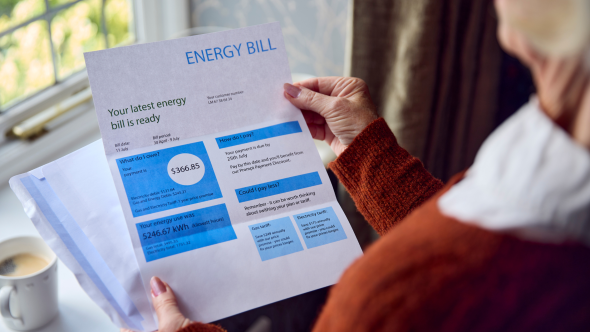
For many customers, understanding what goes into your monthly energy bill can be confusing. In this blog series, we will discuss how to understand your energy bill. This guide is for customers of Portland General Electric (PGE) who have standard bills. If you have opted into Equal Pay or Time of Use billing programs, your bill may look a little different.
Check out our other bill breakdowns under Oregon Utilities 101!
Viewing Your PGE Bill
Many PGE customers receive physical bills in the mail. If you are one of these, viewing your bill is as easy as opening an envelope.
If you receive your bill electronically, you can access your bill by logging into your PGE account online at www.portlandgeneral.com. Once logged in, select “View Bill” and click “Download bill (PDF)” to see the full billing breakdown. Even if you receive your bill in the mail, you will also be able to view it online.
Anatomy of a PGE Bill
Your Energy Bill: Front Side
The front page includes basic information about your account and monthly energy usage. This includes your account information (name, account number, and address), as well as your bill amount and due date for this month.
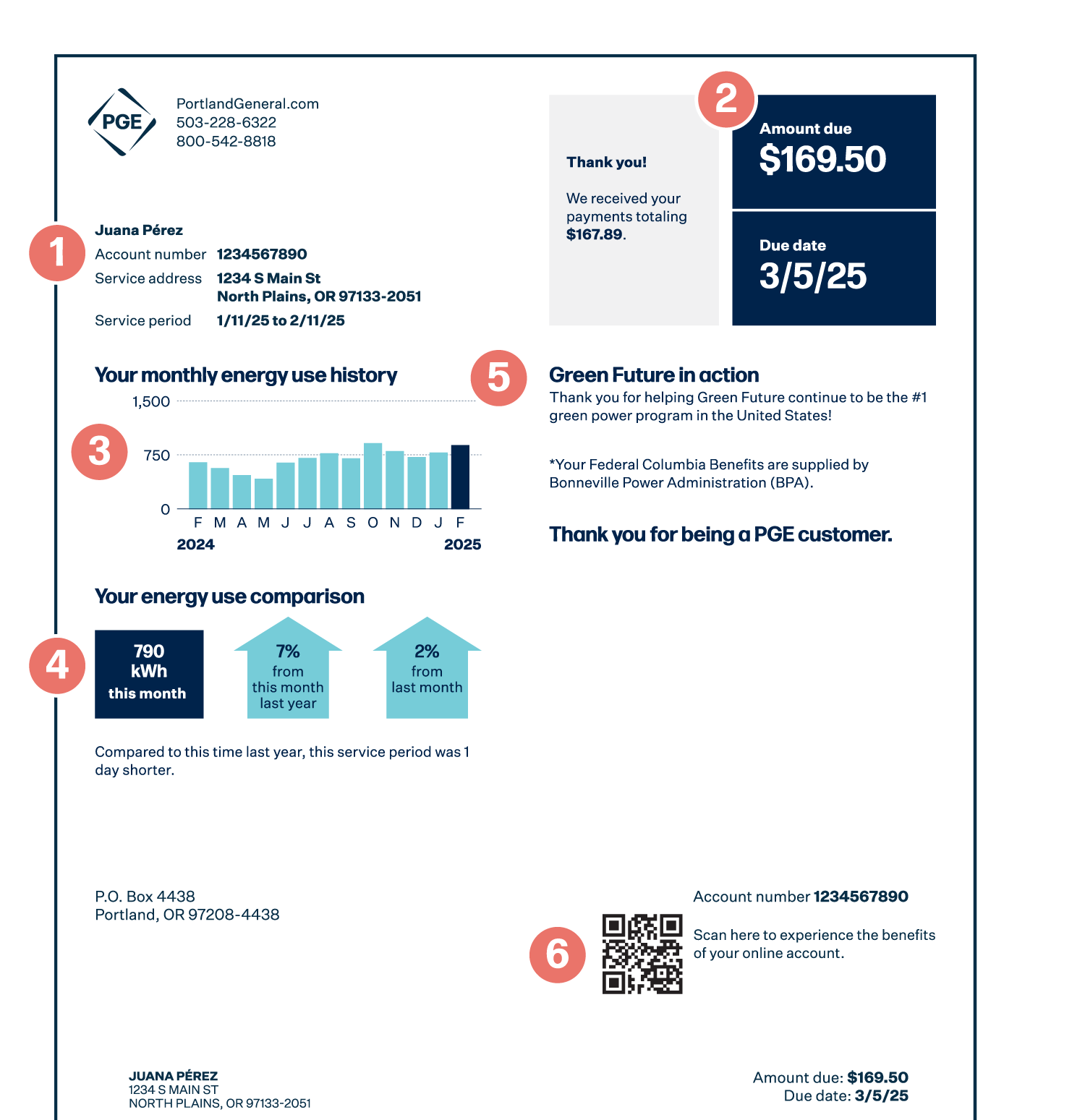
- Your unique account number is used to reference and manage your account.
- The total amount due and due date.
- Your monthly energy use history for your last twelve bills.
- Energy use comparison shows your billing cycle’s kilowatt hour use and compares it to the previous month and the same period last year.
- Bill messages offer info about your bill, account and programs.
- Scan the QR code with your phone to view the web page associated with your message.
You can also see how your usage for this month compares to previous months with the graph below your account information. Below the graph, you can also see comparisons for how this month’s energy use compares to other months. For many customers, this information is all you need to know how much your bill is for the month.
Want more help understanding your PGE energy bill? Watch PGE’s Understanding the Bill - The Basic Layout Video.
Back Side: Understanding Energy Charges
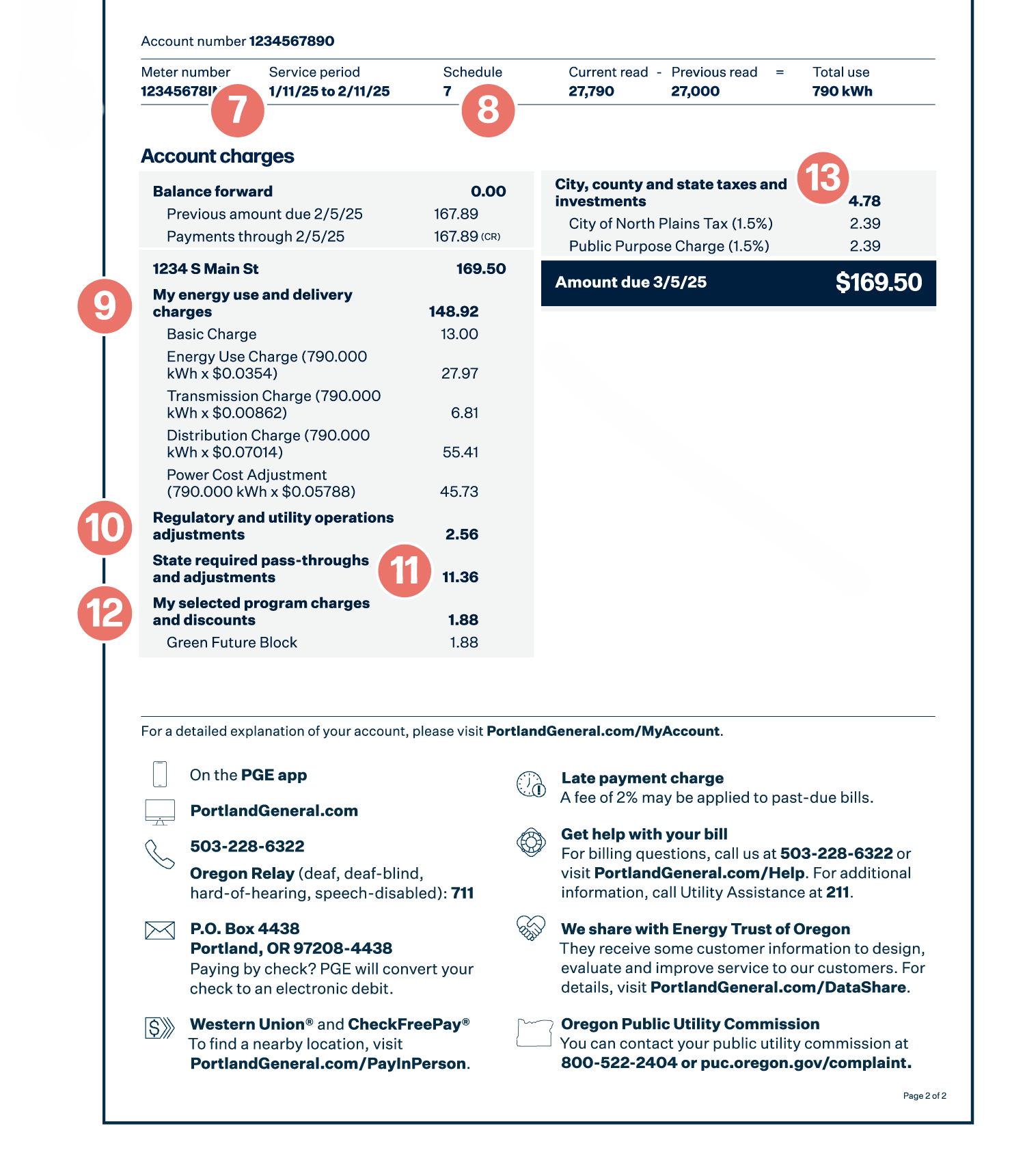
- Service period are the dates your energy use was recorded.
- The rate schedule is associated with your service type (for example, residential services are listed as schedule 7).
- My energy use and delivery charges cover the costs of generating, purchasing and distributing energy to you.
- Regulatory and utility operations adjustments show charges or credits related to regulations, power cost adjustments for the prior year, infrastructure maintenance and operational expenses.
- State Required pass-throughs and adjustments are charges that support state-mandated programs. While some of these funds are collected by PGE and passed directly to the appropriate organization, others are used by PGE to fund state required programs.
- My selected program charges and discounts are charges or credits for the optional programs you chose to participate in. You can opt out at any time.
- City, county and state taxes and investments are funds collected for local government and the state of Oregon, which PGE passes to the appropriate cities, counties or organizations.
On the back side of your bill, you can see your meter number. A meter is what tracks the amount of electricity you use at home. Most customers now have smart meters, which allow PGE to view their usage remotely. Some customers do not have smart meters and PGE sends someone to look at the usage amount in person. Either way, the number on your bill should match the number on your meter.
The schedule, or rate schedule, is specific to different types of customers. The schedule for residential customers is Schedule 7. Rate schedules lay out the prices utilities charge per unit of electricity for a given customer.
Note: For charges related to energy use, the amount of electricity you used will be measured in kilowatt hours (kWh). A typical PGE household uses about 800 kWh of electricity per month, though amounts vary between households.
There are three major categories of charges you’ll see on your bill:
- Energy Charges: Charges related to your household’s energy use, including the cost of the plants that generate the energy you’re using, the cost of getting the energy to you, and the administrative cost of providing your service. These charges only change every few years.
- Regulatory Charges and Credits: Charges or credits that are not included in the energy charges, including PGE’s fuel costs, and costs associated with recent events such as a natural disaster. These charges generally change each year.
- Taxes and Fees: Taxes and fees are charges tied to the customer’s municipality, like the City of Portland Tax, or statewide fees for consumers, such as Low-Income Energy Assistance. These funds do not go to PGE but rather are used to fund public programs, like those provided through the Energy Trust of Oregon.
These individual line items change depending on where you live, the type of billing you use, and if you have opted into additional programs. You can tell where you are receiving a credit if the line item says “CR” to the right of the dollar amount. All items without that label are charges on your bill.
Energy charges are the largest part of your bill. These charges are based on the energy you are using. The five categories are the same for all residential customers, though the amount will vary depending on how much electricity you used that month.
- Basic Charge: Same amount each month, covers administrative costs like customer service and billing, and fixed costs like the cost of the meter.
- Energy Use Charge: The cost of PGE’s generating electricity, including gas plants and renewable investments. For residential customers, there are two tiers of monthly energy use charges: a lower charge ($) for the first 1,000kWh (what most residential customers pay) and a slightly higher charge ($) for anything over 1,000kWh.
- Transmission Charge: the cost of bringing energy from power plants to your area via substations. For example, building and maintaining equipment that transmits electricity over long distances.
- Distribution Charge: the cost of bringing energy from substations to your neighborhood. For example, building and maintaining neighborhood power lines, transformers, and other equipment.
- (If opted in) Renewable Energy (Green Future Block or Habitat Support): programs to support renewable energy in “blocks” for a fixed price. Each block costs $1.88 per month and matches 200 kWh with renewable energy certificates. Charges will only show up if you opt into the programs.
Regulatory Charges and Credits are generally small in total dollar amounts but are likely the largest in quantity of line items on your bill. These charges change annually based on PGE’s costs from the previous year and are approved by the Public Utility Commission. This could include the cost of building a new renewable power plant, investments in energy efficiency, costs associated with natural disasters, or other expenses outside of a household’s energy charges.
Learn more by watching PGE’s Energy Charges explanation video!
City, State, and County Taxes and Fees
- City/County Tax: Local governments charge an additional tax or fee, like the “City of Portland” in the example above. These additional charges vary depending on where you live.
- Low Income Assistance: A set $1.24 per month for residential customers, as required by the state. These funds go to bill payment assistance programs that help households with low incomes who are struggling to pay their energy bills.
- Public Purpose Charge: This charge is equal to 1.5% of your bill. These dollars are dedicated to energy efficiency programs, market transformation programs, residential low-income energy efficiency programs, and residential low-income bill payment assistance programs. PGE does not keep these funds; they are distributed to organizations with energy-efficiency programs, such as Energy trust of Oregon.
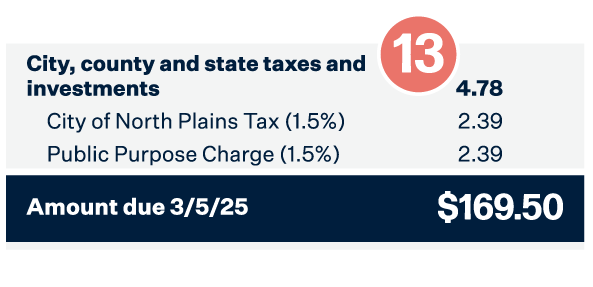
Additional charges and credits may come from opting into certain programs, such as Peak Time Rebates, Community Solar, or if you own or rent solar panels that use net metering. These will show up under Taxes and Fees where applicable.
Watch PGE’s Adjustments and City, State and County Taxes and Investments video to learn more!
Have More Questions? Reach Out to PGE
Call PGE customer service at 800-542-8818 or 503-228-6322 from 8 a.m. to 6 p.m., Monday through Friday, to ask for an explanation of your adjustments. They can assist you in 200+ languages. When talking to customer service, either ask for a full explanation of the adjustments or reference a specific line item on your bill.
Still have questions about understanding your bill? Call PGE’s customer service at 800-542-8818. Or contact CUB at .(JavaScript must be enabled to view this email address) or 503-227-1984.
Stay Up to Date on Oregon Utility Issues
CUB will continue to advocate for people in Oregon on major utility issues. Sign up for the CUB email list for the latest updates, action alerts, and news on policies that affect the utilities your home relies on.
To keep up with CUB, follow us on Instagram, Facebook, Bluesky, and LinkedIn!


10/19/26 | 0 Comments | Utilities 101: Understanding your Portland General Electric Bill (2026)