
Utilities 101: Understanding Your Gas & Electric Bills
Posted on June 1, 2026 by Charlotte Shuff
Tags, Oregon Utilities 101

For many customers, understanding what goes into your monthly energy bill can be confusing. CUB has guides available to help you access your bills, unpack what each charge means, and read your gas and electric bill with confidence.
In this blog series, we go utility by utility to explain the language included in your monthly gas and electric bill. Find the blog that covers your utility below!
Utility Guides:
Please note that CUB primarily works with for-profit utilities, so this list is limited to those utilities. If you have a question about a utility not on this list, you can still contact us at .(JavaScript must be enabled to view this email address)!



Utilities 101: Understanding your Portland General Electric Bill (2026)
Posted on October 19, 2026 by Cassie Allen
Tags, Oregon Utilities 101, Energy

For many customers, understanding what goes into your monthly energy bill can be confusing. In this blog series, we will discuss how to understand your energy bill. This guide is for customers of Portland General Electric (PGE) who have standard bills. If you have opted into Equal Pay or Time of Use billing programs, your bill may look a little different.
Check out our other bill breakdowns under Oregon Utilities 101!
Viewing Your PGE Bill
Many PGE customers receive physical bills in the mail. If you are one of these, viewing your bill is as easy as opening an envelope.
If you receive your bill electronically, you can access your bill by logging into your PGE account online at www.portlandgeneral.com. Once logged in, select “View Bill” and click “Download bill (PDF)” to see the full billing breakdown. Even if you receive your bill in the mail, you will also be able to view it online.
Anatomy of a PGE Bill
Your Energy Bill: Front Side
The front page includes basic information about your account and monthly energy usage. This includes your account information (name, account number, and address), as well as your bill amount and due date for this month.
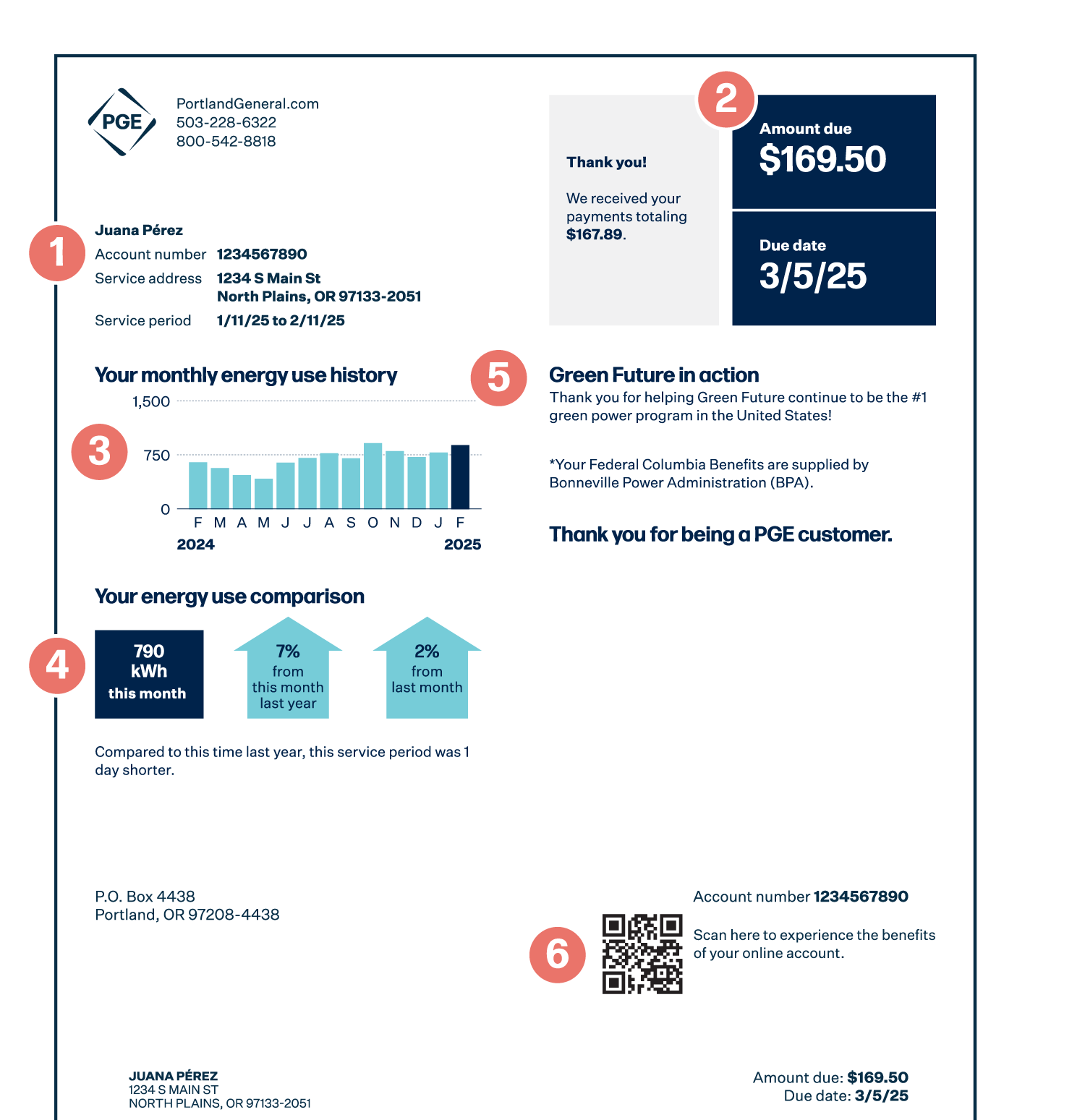
- Your unique account number is used to reference and manage your account.
- The total amount due and due date.
- Your monthly energy use history for your last twelve bills.
- Energy use comparison shows your billing cycle’s kilowatt hour use and compares it to the previous month and the same period last year.
- Bill messages offer info about your bill, account and programs.
- Scan the QR code with your phone to view the web page associated with your message.
You can also see how your usage for this month compares to previous months with the graph below your account information. Below the graph, you can also see comparisons for how this month’s energy use compares to other months. For many customers, this information is all you need to know how much your bill is for the month.
Want more help understanding your PGE energy bill? Watch PGE’s Understanding the Bill - The Basic Layout Video.
Back Side: Understanding Energy Charges
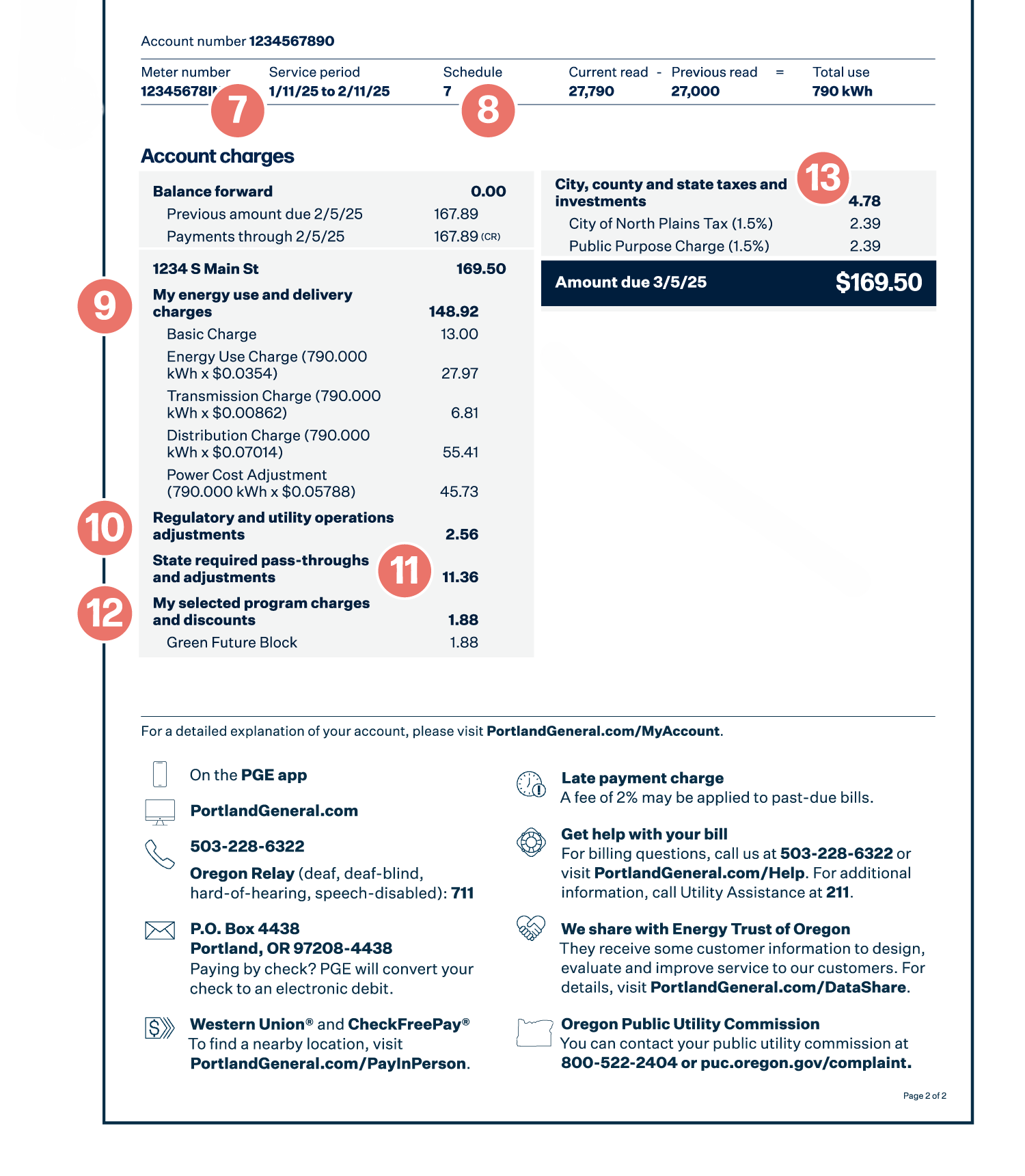
- Service period are the dates your energy use was recorded.
- The rate schedule is associated with your service type (for example, residential services are listed as schedule 7).
- My energy use and delivery charges cover the costs of generating, purchasing and distributing energy to you.
- Regulatory and utility operations adjustments show charges or credits related to regulations, power cost adjustments for the prior year, infrastructure maintenance and operational expenses.
- State Required pass-throughs and adjustments are charges that support state-mandated programs. While some of these funds are collected by PGE and passed directly to the appropriate organization, others are used by PGE to fund state required programs.
- My selected program charges and discounts are charges or credits for the optional programs you chose to participate in. You can opt out at any time.
- City, county and state taxes and investments are funds collected for local government and the state of Oregon, which PGE passes to the appropriate cities, counties or organizations.
On the back side of your bill, you can see your meter number. A meter is what tracks the amount of electricity you use at home. Most customers now have smart meters, which allow PGE to view their usage remotely. Some customers do not have smart meters and PGE sends someone to look at the usage amount in person. Either way, the number on your bill should match the number on your meter.
The schedule, or rate schedule, is specific to different types of customers. The schedule for residential customers is Schedule 7. Rate schedules lay out the prices utilities charge per unit of electricity for a given customer.
Note: For charges related to energy use, the amount of electricity you used will be measured in kilowatt hours (kWh). A typical PGE household uses about 800 kWh of electricity per month, though amounts vary between households.
There are three major categories of charges you’ll see on your bill:
- Energy Charges: Charges related to your household’s energy use, including the cost of the plants that generate the energy you’re using, the cost of getting the energy to you, and the administrative cost of providing your service. These charges only change every few years.
- Regulatory Charges and Credits: Charges or credits that are not included in the energy charges, including PGE’s fuel costs, and costs associated with recent events such as a natural disaster. These charges generally change each year.
- Taxes and Fees: Taxes and fees are charges tied to the customer’s municipality, like the City of Portland Tax, or statewide fees for consumers, such as Low-Income Energy Assistance. These funds do not go to PGE but rather are used to fund public programs, like those provided through the Energy Trust of Oregon.
These individual line items change depending on where you live, the type of billing you use, and if you have opted into additional programs. You can tell where you are receiving a credit if the line item says “CR” to the right of the dollar amount. All items without that label are charges on your bill.
Energy charges are the largest part of your bill. These charges are based on the energy you are using. The five categories are the same for all residential customers, though the amount will vary depending on how much electricity you used that month.
- Basic Charge: Same amount each month, covers administrative costs like customer service and billing, and fixed costs like the cost of the meter.
- Energy Use Charge: The cost of PGE’s generating electricity, including gas plants and renewable investments. For residential customers, there are two tiers of monthly energy use charges: a lower charge ($) for the first 1,000kWh (what most residential customers pay) and a slightly higher charge ($) for anything over 1,000kWh.
- Transmission Charge: the cost of bringing energy from power plants to your area via substations. For example, building and maintaining equipment that transmits electricity over long distances.
- Distribution Charge: the cost of bringing energy from substations to your neighborhood. For example, building and maintaining neighborhood power lines, transformers, and other equipment.
- (If opted in) Renewable Energy (Green Future Block or Habitat Support): programs to support renewable energy in “blocks” for a fixed price. Each block costs $1.88 per month and matches 200 kWh with renewable energy certificates. Charges will only show up if you opt into the programs.
Regulatory Charges and Credits are generally small in total dollar amounts but are likely the largest in quantity of line items on your bill. These charges change annually based on PGE’s costs from the previous year and are approved by the Public Utility Commission. This could include the cost of building a new renewable power plant, investments in energy efficiency, costs associated with natural disasters, or other expenses outside of a household’s energy charges.
Learn more by watching PGE’s Energy Charges explanation video!
City, State, and County Taxes and Fees
- City/County Tax: Local governments charge an additional tax or fee, like the “City of Portland” in the example above. These additional charges vary depending on where you live.
- Low Income Assistance: A set $1.24 per month for residential customers, as required by the state. These funds go to bill payment assistance programs that help households with low incomes who are struggling to pay their energy bills.
- Public Purpose Charge: This charge is equal to 1.5% of your bill. These dollars are dedicated to energy efficiency programs, market transformation programs, residential low-income energy efficiency programs, and residential low-income bill payment assistance programs. PGE does not keep these funds; they are distributed to organizations with energy-efficiency programs, such as Energy trust of Oregon.
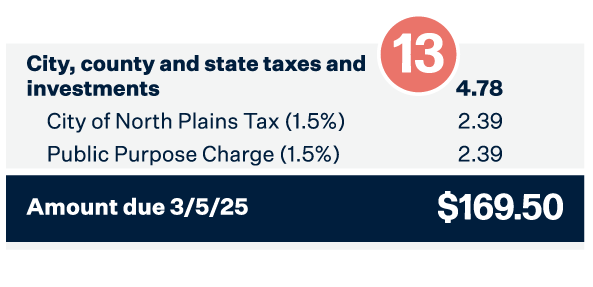
Additional charges and credits may come from opting into certain programs, such as Peak Time Rebates, Community Solar, or if you own or rent solar panels that use net metering. These will show up under Taxes and Fees where applicable.
Watch PGE’s Adjustments and City, State and County Taxes and Investments video to learn more!
Have More Questions? Reach Out to PGE
Call PGE customer service at 800-542-8818 or 503-228-6322 from 8 a.m. to 6 p.m., Monday through Friday, to ask for an explanation of your adjustments. They can assist you in 200+ languages. When talking to customer service, either ask for a full explanation of the adjustments or reference a specific line item on your bill.
Still have questions about understanding your bill? Call PGE’s customer service at 800-542-8818. Or contact CUB at .(JavaScript must be enabled to view this email address) or 503-227-1984.
Stay Up to Date on Oregon Utility Issues
CUB will continue to advocate for people in Oregon on major utility issues. Sign up for the CUB email list for the latest updates, action alerts, and news on policies that affect the utilities your home relies on.
To keep up with CUB, follow us on Instagram, Facebook, Bluesky, and LinkedIn!
10/19/26 | 0 Comments | Utilities 101: Understanding your Portland General Electric Bill (2026)
Utilities 101: What to Do If You Miss a Utility Bill Payment
Posted on October 13, 2026 by David Beltrán Barajas | CUB Oregon
Tags, Oregon Utilities 101, General Interest, Energy

Dealing with a utility disconnection is a stressful and miserable experience. I personally went through it when I was between jobs last year. And over the past few months, I’ve been hearing a ton from community members who are having to navigate the process.
What I’ve learned from my own experience and those from folks I’ve talked to is that disconnection is not an easy hardship to deal with.
Read on, and I’ll share what I’ve learned so that you can manage to deal with a disconnection warning or a utility disconnection for non-payment.
Note that the protections and programs in this blog only apply to Oregon’s for-profit utilities (PGE, Pacific Power, Idaho Power, NW Natural, Avista, and Cascade).
You Missed a Bill… Now What?
Missing a payment to your utility happens, but it does not have to lead to a disconnection.
In the days after a missed bill was due:
- If possible, pay the full amount from your missed bill as soon as possible
- Ask for an extension on your bill due date (you’ll still have to pay for the amount you use going forward, but this can buy you a little more time)
- Make a partial payment to keep the amount you owe as low as you can*
- If you need to spread out the amount you owe, contact your utility’s customer service to set up a payment plan
*Each utility has a different amount in its policies for how much a customer owes before it will move forward with a disconnection. These amounts can range from $50 - $200 in past due bills.
Two weeks after a missed bill:
- If you can pay your full bill, this is always the best option
- Contact your utility to set up a payment plan, spreading out the past-due amount for as long as possible**
- Seek out energy bill assistance from a local provider (funds are limited and may be difficult to find outside of the winter)
**Utilities may offer a payment plan that lasts two months or more. The most common length is 12 months. Remember that these payments are added to your monthly bills going forward, increasing your balance each month. A longer timeline will add less money to each bill. You can ask your utility for a longer timeline, though the utility may not agree to more than 12 months.
One Month Could Be Nearing Disconnection.
At this point, you may have already received a 20-day disconnection notice from your utility warning of a disconnection if payment is not received. A utility must give you a formal Notice of Disconnection at least 20 days before they shut off your power or gas. If you have received this notice, you need to pay the bills (either yourself or through emergency bill payment assistance funds) or set up a payment plan, or you will be disconnected.
Utilities must also send a 5-day Notice of Disconnection. It is best to seek emergency bill payment assistance at the 20-day notice to better ensure your chances of obtaining assistance to avoid disconnection.
Disconnected Happens
If you are disconnected, the only payment options available in order to have power reconnected are:
- Pay off the past due balance in full
- Pay off half of the past due balance and put the other half on a 2-month payment plan
You can seek emergency disconnection support from local energy assistance providers through 211, though these funds are very limited.
Once you’re disconnected, your options are extremely limited. This is why it is important to ask for a payment plan as soon as you realize you are unable to make the payment in full!
Seek Help At The Start Of Your Hardship Period
I see a pattern with most of the community members calling in about their disconnections, which I experienced. Folks are being laid off, struggling to find new jobs in this market. Others can’t work at the same capacity for medical or family reasons. All the while, bills continue to stack up. So when I say seek help before you actually need it, I mean seek help before things get out of hand.
A disconnection can add costs and make it harder to find help. Late fees and reconnection fees make the total amount you owe continue to grow. To get reconnected, utilities may request more money from the past due amount upfront, and emergency funds are limited, especially outside of the winter.
You really need to get started on all these steps as soon as you’ve stopped collecting income or have a hardship that would cause you to miss payments on your bills.
Start With Your Utility’s Bill Discount Programs
The easiest step is signing up for all of your energy utility income-based discount programs. :
Electric Utilities:
- Portland General Electric (PGE) Discount Program
- Pacific Power Discount Program
- Idaho Power Discount Program
Gas Utilities:
Don’t see your utility listed? Check out your utility’s website and see if they have an economic assistance page; their bill discount program applications will usually be housed there.
Ask for a Payment Plan on Your Past Due Balance
If you’ve already started building up a past-due balance, the next step you’ll want to take is calling your utility and requesting a payment plan. This will split what you owe and break it up over a couple of months to a year. The payment plan makes it a little easier to manage your balance, better protects you from disconnection, and protects you from having to make a large payment to get your utility back on.
The reason this is important is that you can only set up a payment plan before your utility disconnects you. Once your utility shuts off your power or gas, you won’t have the option available. You will need to pay half of your past due balance upfront, and commit to a 2-month payment plan for the other half, to get reconnected.
If you get on a payment plan, you need to keep up with it. Missing these payment plan payments will re-issue the disconnection process to begin again.
Reach Out To Community Organizations Early
If you’re not able to afford a payment plan or your past due balance continues to climb, there are still options. You’ll want to reach out to energy assistance providers in your local area to seek help.
To be frank, this process can be a slog, but we encourage you to power through! 211 will provide you with a list of agencies that serve your local area, as well as their website and contact information. You will have to call each one and inquire about the resources they’re offering and if they have energy assistance available, and if your household qualifies to receive it. The process is time-consuming, so you’ll require some patience and persistence.
Get Help with Bill Payment Assistance
The goal is to get you signed up for energy assistance programs like OEAP (for qualifying PGE and Pacific Power customers), OLGA and GAP (for qualifying NW Natural customers), Project Share (for qualifying Idaho Power and Avista customers) or LIHEAP (for qualifying customers of any energy utility who is a US citizen), or any other assistance program for another utility you have, like water.
Added Disconnection Protections
For all customers, disconnections are limited to certain times and days. Utilities are not allowed to shut off service for past-due bills Friday-Sunday or the day before or day of any Oregon or utility-designated holidays. You also cannot be disconnected from energy before, during, and even after certain qualifying extreme weather events.
Extreme weather events include:
- A winter storm warning, issued from November to March
- Forecasted temperatures of 32 degrees and below from November to March
- Poor air quality (air quality index above 100)
- Wildfire evacuation level 2 and 3 notices
- Heat advisories, extreme heat warnings, and extreme heat watches.
Importantly, if you were disconnected ahead of one of the extreme weather events, you should call your utility to be turned back on—with no upfront cost allowed!
Read More: New Protections Against Summer Power Shut-Offs (2025)
For low-income customers, there are additional protections during extreme weather and year-round. You qualify as a “low-income customer” if you have received energy bill assistance (LIHEAP or OEAP), are enrolled in a bill discount program, or have an income at or below 60% of the State Median Income.
Stronger Protections for Low-Income Households:
- No Deposits for Low-Income Households
- No Late Fees for Low-Income Customers
- Limited Reconnection Fees for Low-Income Customers
Think Holistically To Ease The Burden
The fact of the matter is that if you’re behind on your utility bill, you’re probably behind on all your other bills. No one just chooses to fall behind. These are symptoms of a challenging economy and underfunded safety nets. So you must think of holistic solutions because you’re likely taking hits in other areas of your life. For me, that looked like:
- Utilizing the food bank from the community garden that I helped maintain
- Allow my community, friends, and family to help me financially and with day-to-day tasks
- Utilizing free resources in my community to help me in the process of being disconnected
What they may look like for you:
- Finding a friend to stay with you or help split larger costs in your household
- Getting food from a food bank, community garden, or neighbors
- Reaching out to mutual aid projects to cover necessities and free up money for your bills or reconnection
- Connect with a church or community center for other resources or aid that might reduce your financial burden
- Utilize your local library for access to the internet, phones, and printers (some libraries even have crisis social workers!)
Don’t Turn Away! Don’t Feel Ashamed! Lean Into Community!
The biggest lesson I learned from my own disconnection was not to hide from the problem. The financial stress and fear of continuously falling behind can make you freeze up. We know we’re behind on our bills, that growing balance can feel scary, and then you stop opening the bills altogether.
I missed my disconnection notice because I was afraid of all the past due notices I kept getting for my mortgage, gas, electric, phone, and car bills. Everything I owed caused me to close my eyes, and then one day, the power was cut.
What was worse than all the fear I felt through this process was the shame. The shame prevented me from asking for help sooner. Lean into your community and reach out for a helping hand. Intervention before your problem is dire pays off. There is never any shame in asking for help.
Advocate, Get Involved And Share Your Story
A hardship period is time-consuming and stressful. But once you’re stable and back on track, the final step is shifting from advocating for yourself to advocating for others, using your experience to fight for fair protections for all Oregonians.
It’s through the stories and advocacy of community members just like you that we’ve been able to fight for affordable energy and disconnection protections. This year, we passed the FAIR Energy Act, which will focus on making utility rates more affordable. We also secured more funding for Oregon’s Energy Assistance Program (OEAP). Community members who have felt the sting of disconnections and passed-due payments made their voices heard and helped create policies that address the rising trend of disconnections in Oregon.
We need you, too! If you want to help in shaping policy for the better, share your own energy and disconnection story.
Share Your Past Due Bills Story
Stay Up to Date on Oregon Utility Issues
CUB will continue to advocate for people in Oregon on major utility issues. Sign up for the CUB email list for the latest updates, action alerts, and news on policies that affect the utilities your home relies on.
To keep up with CUB, follow us on Instagram, Facebook, Bluesky, and LinkedIn!
10/13/26 | 0 Comments | Utilities 101: What to Do If You Miss a Utility Bill Payment
PCEF and the People It Supports
Posted on October 9, 2026 by David Beltrán Barajas | CUB Oregon
Tags, General Interest, Energy

If you’re an energy head or a climate nerd, you’ve probably been seeing Portland Clean Energy Fund (PCEF) being targeted for all sorts of things all year long. Be it to hire more cops, renovate the Moda Center, or in more climate-focused lanes like funding TriMet. PCEF is a climate fund collected from large corporations to support community-led approaches to reducing emissions and supporting Portlanders. Since its inception, it has been incredibly successful in investing in clean energy and many other projects for our communities.
PCEF has done many wonderful things, ranging from building Portland’s only in-city community solar field to providing grants for micro mobility for Portlanders. These funds also helped to meet the moment and protect Portlanders after events like the 2021 heat dome by providing heat pumps and ACs for those who need them. PCEF funding has gone to materially help Portland from the increasingly encroaching effects of climate change on the Pacific Northwest.
Today I want to share a story with you about a 100-year-old Portland home, aging gas pipes, and a cold holiday season. This is the story of how PCEF is helping Julia get her heating back and protecting her against future extreme winters and summers all at once.
Portland Clean Energy Fund (PCEF) in Action: A Story About a Portland Home

Jeremy (he/him), an In-Home Auditor with Community Energy Project, stands outside with Julia (she/her), inspecting a cold spot on the exterior of Julia’s home.
Julia is a resident of SE Portland, living in a hundred-year-old home. She was fortunate enough to purchase her home a few years ago after some big life changes, a big win for many Americans.
Her home had natural gas for heating in the winter, and like many Portland homes, she had no AC. A decade ago, this wasn’t an issue because of our region’s historically beautiful temperate weather.
In late 2025, Julia’s home had a gas leak in the walls. She did the right thing and called NW Natural. They determined that the leak was not easily fixed without being costly to Julia — costs she couldn’t take on by herself — so NW red-tagged her meter, leaving her without any gas service at all.
Julia spent the holidays and all winter without gas. And this wasn’t just losing her furnace to heat her home. Julia not only couldn’t keep her home warm, but she also couldn’t cook on her stove because all her appliances were built for a gas system. And if having a cold home and not being able to cook a meal at home weren’t bad enough, she went the entire winter taking cold showers in order to save money.
The winter was an uncomfortable experience, but she made it work. However, comfort is one thing; the finances hit harder. She shared with me that her electric bill was a sore spot due to trying to heat her home with portable heaters. These heaters are made to warm small spaces, not someone’s whole home that they spend much of their time in. The longer she used these inefficient portable electric heaters, the higher her power bills rose.
High heating bills are not unique to Julia. Many Portlanders feel the effects of inefficient heating, particularly those with cadet or baseboard heaters common in apartments. Too many people have outdated, inefficient heaters, contributing to astonishingly high electric and gas bills.
With the help of the Portland Clean Energy Fund and the organizations it supports, homes like Julia’s have the opportunity to benefit. For Julia, the benefit is not in going back to old gas appliances, but in moving toward an even more resilient home than she had before.
Community Energy Project: Over 45 Years of Helping Portlanders
Julia reached out to me in January of 2026. She shared with me what she’s going through, knowing I worked with or around utilities. She asked if there was anything I could do to help or point her in the right direction. Right away, I reached out to my colleagues at the Community Energy Project (CEP) about what steps she can take to find help.
Thankfully, this is CEP’s lane! For over 45 years, CEP has been helping Oregonians weatherize and update their homes to be energy efficient. Importantly, CEP does much of its work thanks to PCEF grants.
Energy Assessment for the Whole Home
Within a few months, we had folks on the ground doing an energy assessment on Julia’s home.
Community Energy Project sends out its In-Home Auditor, who does a whole-home inspection to get an understanding of what issues are creating an energy burden in the home. This also helps them determine if the energy upgrades the home could use are a good fit for what their program can fund.
These issues can include:
- Holes and openings allowing air to leak between the inside and outside of the home
- Outdated or broken appliances
- Poorly functioning or missing mechanical ventilation in high humidity areas like bathrooms and kitchens
- Outdated or missing insulation
- Poor sealing and insulation in basements, attics, and other areas of the home
- Replacing outdated and non-functioning gas appliances with high-efficiency electric appliances.
This entire time I’ve tagged along for the visits like a fly on the wall, trying to learn about what the process is like. Very simple, honestly.
Finding the Right Fixes

Community Energy Project’s PCEF Program Manager, Geoff (he/him), heads into the attic of Julia’s home to get a better look at what areas of concern need to be addressed to ensure the home is properly sealed, insulated, and healthy.
After the first home assessment, Community Energy Project does a second one, looking to get an exact scope of work that can be covered for the homeowner. Here they’ll also do a blower door test to understand how sealed the home is and where there are gaps to seal that a simple visual inspection might not reveal.
Julia’s second home inspection was done this past August, and the plan for energy upgrades was created. CEP shared that Julia could expect to hear back from a contractor in the next month. She now has a real possibility of getting a high-efficiency electric heat pump that would provide heating and cooling, using the same ductwork that used to serve her gas furnace. Ductwork that’s currently sitting unused. All by November of 2026. All funded by the Portland Clean Energy Fund.
All of this likely would have been difficult or extremely expensive for Julia if we didn’t have organizations like CEP or programs like PCEF.
“This work is still expensive, but the burden shifts from an individual homeowner to a collective community-based fund.” - Abasi Umoh, In-Homes Auditor, Community Energy Project
Each project, including Julia’s, goes through an approval process to guarantee the project will significantly reduce the home’s carbon emissions. If Julia’s project is approved, PCEF will cover 100% of the cost burden of all the upgrades, including a new high-efficiency heat pump.
The Humans Behind the Funding
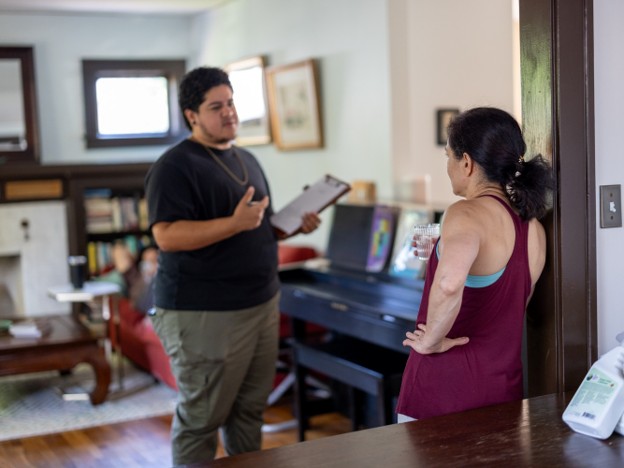
Abasi (they/them), a Community Energy Project In-Homes Auditor, walks Julia through some of the details of the inspection and areas where they can help in reusing the existing ducting for a possible ducted heat pump to provide both heating and cooling.
Through this entire process, I’ve seen the toll that living without a functional home has taken on Julia. The stress of having to take an uncomfortable cold shower every day. Having to sit with hot, still air in the summer. The inability to cook like normal because her stove hasn’t worked all year. The stress of seeing higher-than-average bills in an attempt to warm and cool her home. And the stress of having to move budgeting priorities around to ensure the bills get paid. It all adds up over time and can be draining.
It can be so easy to grow accustomed to the new added stressors until a bad situation just becomes our new normal. Julia got through this past winter and this recent summer. I’m sure she could have grown accustomed to this new norm, but she shouldn’t have to.
The Portland Clean Energy Fund exists exactly for the purpose of helping our community with big issues like this. This is why it is so important for PCEF to be preserved and continued.
There are real-life Portlanders who are being helped out by PCEF and the community initiatives that utilize the fund. There are important projects that have been awarded. PCEF isn’t just a pool of money. The program is going to help people like Julia. And likely neighbors and community members that you may not even know have been touched by the fund!
Beyond Portland: Eugene Seeks a Clean Energy Fund
In Eugene, community organizations are trying a similar approach to reaching local climate goals: passing the Eugene Clean Energy Fund (ECEF).
Activist and grassroots organizations have come together to launch a ballot initiative campaign. If passed, the ballot measure would establish a fee on large corporations to fund local climate actions.
CUB has officially endorsed the initiative and encourages other organizations to support these local efforts.
Editor’s Note: The name of the main subject of this story, Julia, has been changed to protect her privacy.
Stay Up to Date on Oregon Utility Issues
CUB will continue to advocate for people in Oregon on major utility issues. Sign up for the CUB email list for the latest updates, action alerts, and news on policies that affect the utilities your home relies on.
To keep up with CUB, follow us on Instagram, Facebook, Bluesky, and LinkedIn!
10/09/26 | 0 Comments | PCEF and the People It Supports
Member Spotlight: Why Do You Support CUB?
Posted on September 24, 2026 by Cassie Allen
Tags, General Interest

For over forty years, CUB has been a membership organization. Because of our members’ support, we can keep advocating for fair, affordable energy in Oregon. Our members empower us to keep pushing forward.
Today, we’re excited to spotlight the voices of our members. From affordability to climate justice to data centers, people join CUB for all kinds of reasons and from all walks of life. Hear directly from them on why they keep supporting CUB throughout the years.
Member Spotlight
Energy Affordability and the Cost of Living
Over the last 5 years, household energy bills have skyrocketed. Many Oregonians are struggling with the rising cost of living, and disconnection rates have hit all-time highs. Our staff often hears from folks deeply affected by Oregon’s energy affordability crisis.
For many members, advocating for more affordable energy is what motivates them to support CUB. We don’t take that support for granted. Thank you to our members for tirelessly pushing for more affordable energy rates!
“As a public school educator for 38 years, I am very aware of the connection between the lack of reliable access to basic human services such as water and electricity and the negative impact on our most vulnerable children/youths’ housing stability and educational outcomes. As a retiree in Portland, OR, I am very aware that continually rising electricity and water costs are a very real part of our housing crisis. It is vitally important that we work to stem the tide of ever-increasing rate hikes from PGE. We need concerned citizens to work together with our government and utility companies to ensure reasonable rates and practices that support the well-being of our community.”
- Carol M.
“I moved into a new place May 15th, and since then we’ve dealt with power loss three times, for around 6 hours or longer each time. Today is August 9th, so it has not even been three months of living here. Hearing rates would be raised again, and at such a high rate of increase is preposterous. We can’t rely on service, yet are going to be forced to pay on average $30 more a month (avg $360 more a year) on what’s already a roughly $150 monthly bill? Power, heat, and more are vital services. They’re necessary to keep people safe, healthy, and ultimately alive. When looking at the possibility of a recession and growing economic instability in the near future, how do you expect your customers to make ends meet to pay your increasing rates (with no guarantee of better service)?”
- Lex S.
Clean Energy: Reducing Utility Emissions
For some Oregonians, addressing climate change by reducing emissions is what draws them to CUB. Our work to transition the utilities to clean energy impacts all customers. In this respect, our members are doing the work to help everyone in Oregon transition to cleaner energy.
“I’ve worked in or around the clean energy sector for decades. As clean energy is almost always the best way of keeping emissions and utility rates down, Oregon policymakers consider CUB as one of the most credible and respected voices in this subject matter arena. Keep up the great work!”
- Jay W.
“CUB works for the benefit of all Oregonians—holding down unnecessary utility costs, advocating for clean energy, supporting needed help for those in financial difficulties with utility bills, plus other helpful deeds. Not everyone can afford to support the work CUB does. It is necessary for those of us who can donate to do so. OREGON NEEDS CUB to be our spokesperson with the PUC Board!”
- Bj S.
“I’ve been a CUB member for many years. I’ve now been retired for ten years, living on Social Security, but it’s still important to me to contribute to CUB. I look at it as an investment which has kept my utility bills lower than they would be otherwise, but also as an investment in the future for all Oregonians to have cleaner and more affordable energy.”
- Beverly W.
Energy Issues: Data Centers
For some members, specific energy issues, like data centers or corporate greed, were the catalyst to get involved. They understand that when data centers pass on their costs to customers, it drives up energy bills, hurting all Oregonians. Thank you to our members for advocating for more data center protections!
“I donated because I think it’s important that people place a check on private utility companies, especially with the emergence of AI data centers and the fact that these utility companies have decided to shift the cost burden to working-class ratepayers, and not to the billionaires who own these AI companies.”
- Brian A.
“For decades, I have supported CUB because unless giant corporations are challenged, they will justify and implement rate increases to the benefit of not only the corporation but also the stockholders, while the ratepayers bear the burden. I have no problem with normal expenses to maintain and improve the system as it stands. This is when CUB intervenes to balance out and justify the rate increases. Bravo CUB!!”
- John G.
A Lasting Impact: Supporting CUB Since the Beginning
Some of our members have been with CUB since we were founded in 1984. They’ve stuck with us and watched our organization grow from a tiny, scrappy group of volunteers to the well-respected nonprofit we are today.
“It must have been 1984 (I thought it was earlier) that a CUB supporter knocked, and we talked about the value of supporting CUB. Over the following years, I’ve come to better appreciate the impact and importance of having a Citizens Utility Board. After intermittent contributions, I became a sustaining member. All because an individual made that effort to share his conviction in a way that convinced me to listen and better understand the value of having a citizen’s lobby.”
- Hugh S.
“We have been a member/donor to CUB from its inception. As a non-profit organization, serving as our citizen lawyer, researching, watchdogging, and testifying on our behalf, we appreciate you. You’ve saved us untold dollars in energy charges over the years. Every user of energy in Oregon would benefit themselves and their neighbors by being a member of CUB. Thank you!”
- Fran G.
Thank You to Our Members
Our members truly empower us to advocate for all of Oregon’s utility customers. Together, we will keep pushing for more affordable and equitable utilities. Thank you to our members for making this work possible!
Stay Up to Date on Oregon Utility Issues
CUB will continue to advocate for people in Oregon on major utility issues. Sign up for the CUB email list for the latest updates, action alerts, and news on policies that affect the utilities your home relies on.
To keep up with CUB, follow us on Instagram, Facebook, Bluesky, and LinkedIn!
09/24/26 | 0 Comments | Member Spotlight: Why Do You Support CUB?
Accessing Energy Assistance
Posted on September 23, 2026 by David Beltrán Barajas | CUB Oregon
Tags, Oregon Utilities 101, General Interest

Energy assistance plays a critical role in keeping Oregon households connected to power. Without it, many families struggling to pay their energy bills would be left without electricity or gas service, causing a cascading effect in their lives. For customers who qualify, several programs can help make energy bills more affordable or provide bill payment assistance.
Types of Energy Assistance Programs
There are three main types of energy assistance programs in Oregon. The programs help households afford their energy bills, stay connected to power, or provide emergency payments in the case of disconnection.
Monthly Energy Bill Discount Programs:
Contact your energy service provider(s) to enroll in an electric or gas bill discount program if you meet the eligibility criteria. This is available for electric customers of Portland General Electric, Pacific Power, and Idaho Power. It is also available for gas customers of NW Natural, Avista, and Cascade.
One-Time Energy Bill Payment:
The Low Income Home Energy Assistance Program (LIHEAP) is a federally funded heating assistance program for all home heating costs, including electricity, natural gas, firewood, propane, pellets, and oil. Typically, this assistance can be used by a household twice a year.
Emergency Shutoff Payment:
If you have received a shutoff notice, there may be assistance available for you! Some utility assistance programs prioritize those who have received shutoff notices.
These assistance programs often require proof of shutoff or a shutoff notice, so be sure to have one in hand when applying. To find these programs, you can use the same tools as you would to find regular assistance programs. Search for emergency assistance or shutoff assistance to find these funds.
Monthly Bill Discount Programs
Oregon households can now find some relief through monthly bill discounts from their energy utilities. The discount programs are available for customers at or below 60% of the state median income (SMI). When signing up, eligible customers will provide their monthly or annual income and household size.
Depending on the utility program, customers will be able to sign up via an online application, calling into the utility, or visiting their local Community Action Agency. Eligible customers with dual-fuel homes qualify for assistance with both their electricity and natural gas providers.
Portland General Electric
503-228-6322
www.portlandgeneral.com
Idaho Power
1-800-388-6040 (toll free)
www.idahopower.com
Pacific Power
1-888-221-7070
www.pacificpower.net
NW Natural
1-800-422-4012
www.nwnatural.com
Avista
1-800-227-9187
www.myavista.com
Cascade
1-888-522-1130
www.cngc.com
How to Access Payment Assistance Programs
In Multnomah County, community action partners (CAPs Agencies) administer energy assistance for one-time payments and emergency shutoff payments.
See if you Qualify
To be eligible for energy assistance, a household income must be at or below 60% of Oregon´s median income. Income levels are based on household income and household size. Households may rent or own their property. A household must also have documented energy costs (a past utility bill).
Documents Needed to Apply
- Identification for all adults (18 years and older)
- Social Security cards for all household members
- Current proof of income (including Social Security benefit letter)
- Most recent energy bill (applicant’s name must be on the account)
Other supporting documents may be required as needed — check with the assistance provider!
Impact NW
10550 NE Halsey St, Portland, OR 97220
www.impactnw.org
(971) 308-7356
Our Just Future
10550 NE Halsey St, Portland, OR 97220
www.humansolutions.org
(503) 548-0200
El Programa Hispano Catolico
333 SE 223rd Ave #100, Gresham, OR 97030
www.elprograma.org
(503)669-8350
Self Enhancement, Inc.
3920 N Kerby Ave, Portland, OR 97227
www.selfenhancement.org
24/7 Hotline: (503) 713-5590
Latino Network
410 NE 18th Ave, Portland, OR 97232
16515 SE Oak St, Portland, OR 97233
www.latnet.org
24/7 Hotline: (503) 208-2174
Native American Youth & Family Center
5135 NE Columbia Blvd, Portland, OR 97218
www.nayapdx.org
24/7 Hotline: (503) 946-9898
Immigrant & Refugee Community Organization
709 NE 102nd Avenue, Portland, OR 97220
www.irco.org
(503) 235-4932
Ask Your Utility About Spreading Out Repayment
Utilities will have options to spread out payments over multiple months. If you are unable to pay your bill, call customer service for options
Accessing Assistance Can Be Challenging
It is important to note that getting utility assistance can sometimes take a while. The demand for help is often high, and the availability of funds can vary. Many programs have specific funding cycles, which means they might only have money to distribute at certain times of the year. When funds run out, applicants may have to wait until the next funding cycle to receive assistance. This can be frustrating, but staying in contact with the nonprofit or agency and regularly checking the status of their application windows can help.
Local nonprofits play an important role in helping people access utility assistance. They offer support through resource navigation and case management, helping Oregonians with their bills to the best of their ability. Using resources like the 211info database can help people find the assistance they need quickly and efficiently. Reaching out to these organizations can provide valuable support and make managing utility bills a bit easier.
Local Organizations Can Help You Find Utility Assistance
Local nonprofits often provide two main types of help: resource navigation and case management. While both aim to assist individuals and families, they do so in different ways.
Resource Navigation
Resource navigation is like having a guide. A resource navigator helps people find the right programs and services to meet their needs. They might give information on where to get help paying utility bills, how to apply for assistance programs, and what documents are needed. Resource navigators are great at pointing people in the right direction quickly and efficiently. However, they cannot offer direct assistance.
One useful tool for finding utility assistance is the 211info database. This is a free service that connects people with local resources. By dialing 211 or visiting 211info.org, people can get information on various assistance programs, including those for utility bills. The database is easy to use and provides up-to-date information on available services.
Stay Up to Date on Oregon Utility Issues
CUB will continue to advocate for people in Oregon on major utility issues. Sign up for the CUB email list for the latest updates, action alerts, and news on policies that affect the utilities your home relies on.
To keep up with CUB, follow us on Instagram, Facebook, Bluesky, and LinkedIn!
09/23/26 | 0 Comments | Accessing Energy Assistance
Yet Again, PGE Requests Residential Rate Increase
Posted on September 22, 2026 by Charlotte Shuff
Tags, General Interest, Energy

Yet again, Oregon’s largest electric utility is requesting a rate increase from Oregon households. PGE is asking regulators to approve a 3.9% rate increase (about $8 a month) for residential customers. If approved, PGE would add $65.6 million a year to bills starting July 2027. This request marks PGE’s eighth consecutive year of new rate increases.
CUB continues to believe that PGE assigns too much of its overall costs to residential customers, leading to expensive, unaffordable bills. We won’t let customers be left footing the bill, and we’re pushing back on PGE’s latest bill increases.
Want to learn even more about this case? Check out Docket UE 473 at the Oregon Public Utility Commission website!
What is the Impact to PGE Customers?
Across all customers, PGE is asking for a nearly 5% increase in power bills. For households, the proposed hike is nearly 4%, or about $8 a month on average. An average PGE household could expect an average bill of $178 a month starting in July 2027 if this request is approved. This will be a higher dollar amount increase in the winter months for those with electric furnaces or heaters.
This is the first time that PGE’s rate increase will impact data centers separately from other customers. Data centers are facing a nearly 8% increase in their power bills. This is a big win for Oregonians, as it clearly shows that more costs are benefiting data centers and are finally being assigned to the industry that is creating the need for many investments.
Why Does PGE Want to Raise Rates?
PGE is making a number of sizable investments across all parts of its system. While the ask for next year is to add $65.6 million, these costs, if approved, would stay on customers’ bills for decades. These investments will not all go onto residential customers’ power bills, but will be spread across all types of customers.
PGE’s biggest investments include:
- Transmission investments ($300 million spread over 50 years)*
- Distribution investments (Starting at $456 million spread over 50 years)
- Upgrades to power generation ($174 million spread over 25 years)*
- Reserve funds, unspecified ($236 million spread over unknown years)
- Higher profits (estimated, millions added each year)
*These costs will primarily impact data centers, not residential customers.
PGE is asking regulators to raise the cap on its allowable profit. In 2024, the Oregon Public Utility Commission lowered PGE’s profit margin in response to concerns about customer affordability. The utility is requesting to go from a 9.34% profit to a 9.75% profit. This change would add millions of dollars to customers’ bills each year, going beyond what it was allowed before regulators made the reduction.
While some of these costs may be reasonable, CUB is concerned that many of these costs are unnecessary. We are also keeping a close eye on which costs are going onto residential customers’ bills, when they should be assigned to other customers (like data centers).
Costs CUB is Digging Into
Reserve Funds
Reserve Funds: money set aside for categories of spending but not specific projects ($236 million)
CUB is highly concerned about a large pool of money that PGE is requesting for “reserves.” We’re worried that PGE is attempting to create a slush fund that allows spending with little to no oversight.
While it’s normal to include some amount of reserve funds, this method is anything but normal. Typically, extra money is built into a project itself to allow for more flexibility in a budget to go up a little bit. When a utility builds new infrastructure, this can take years. Accounting for prices to change for equipment or labor is a smart approach. But PGE is asking for reserve funds outside of any project and before regulators have approved a new infrastructure project.
PGE’s approach would leave spending to be approved by PGE management, not regulators. This means that there would be no justification for the spending. That means no oversight to ensure that the money is being spent on necessary projects. No review for cheaper alternatives. No protections for customers.
The point of this slush fund is to facilitate more capital spending — and more profits for shareholders — but not to ensure that customers are only paying for necessary costs.
Distribution Costs
PGE is including a number of big projects for the distribution system:
- Underground cabling: Burying some cables underground for safely delivering electricity, such as under waterways or in high fire risk areas ($104 million project)
- Wood pole replacement: updating the poles that hold up power lines when they fail safety inspection ($214 million project)
- Residential line construction: adding new homes to the electric system, such as a new house or apartment building ($104 million)
Distribution costs are the largest reason why PGE wants to increase rates for household customers. Residential customers pay for 60% of all distribution costs, so we are particularly interested in what is happening in this category of spending.
While many of these costs may be needed to have a safe and reliable electric grid, CUB will be taking a close look to ensure that Oregonians are getting a good deal.
Residential Meter Replacement
Residential meter replacement: replacing the smart meters that measure home electricity usage ($35.5 mil)
CUB is on high alert for PGE overspending — or gold plating — its system. One place we’re investigating is the residential meter replacement. PGE offers no evidence that their current smart meters are failing and need to be replaced. While the company says that it’s more cost-effective to replace all of them at once, we aren’t so sure.
CUB is worried that this meter replacement isn’t about necessary investments, but about maintaining spending to make profits for shareholders. You’ll see that this is a common concern across the board on this rate increase request.
PGE’s Narrow Focus on Profits Harms Customers
It seems like the most important issue for PGE is meeting targets for capital investments, not affordability for customers.
Oregonians rely on power for just about everything in life. Access to affordable electricity saves lives and helps our communities thrive. We need our utilities to act like companies that are providing an essential service, not profit machines for shareholders.
After nearly two years of an energy affordability crisis, Oregonians deserve reliable electricity that doesn’t break the bank.
PGE Has a Spending Problem; Customers Have an Affordability Problem
As CUB has said for years, PGE has a spending problem.
PGE has been a major offender in allowing costs to balloon without much accountability. In 2020, PGE set a capital spending target for 2024 at $500 million. By February of 2023, it had grown by almost 50% to $730 million. But its growth kept accelerating, to $1.34 billion in April of 2024 - a 268% increase from the original spending target in just four years.
But as Oregonians have said over and over, customers have an energy affordability problem.
PGE customers have been hit hard. Between 2021 and 2025, PGE has raised rates by nearly 50% for residential customers. This has resulted in a cascade of disconnections for families that can not afford their bills. PGE’s household rates are already higher than the national average and the highest among major utilities in Oregon.
PGE is Offering False Solutions with Little Collaboration
Oregon is on track to rein in endless increases for gas and electric bills starting in 2027. With the passage of the FAIR Energy Act in 2025, utilities will soon have to face new budgeting requirements, limits on how often they can ask for increases, and more. But PGE wants to take control of the new rules for limiting how utilities can charge customers.
In this case, PGE is attempting to propose its own “solutions” for rolling out the FAIR Energy Act without collaborating with advocates or regulators. By doing this, the utility would be going outside of an already year-long process and setting a dangerous precedent that could harm customers.
We can’t let one utility set the rules for rate increases for everyone. PGE can’t go outside of the official process of the FAIR Energy Act just because it wants to write its own rules. CUB is calling on regulators to rein in PGE and all utilities as our state legislators intended.
Stay Up to Date on Oregon Utility Issues
CUB will continue to advocate for people in Oregon on major utility issues. Sign up for the CUB email list for the latest updates, action alerts, and news on policies that affect the utilities your home relies on.
To keep up with CUB, follow us on Instagram, Facebook, Bluesky, and LinkedIn!
10/19/26 | 1 Comment | Yet Again, PGE Requests Residential Rate Increase
Agreement Reached on Pacific Power Data Center Protections
Posted on September 17, 2026 by Charlotte Shuff
Tags, General Interest, Energy, Data Centers

In 2025, the Oregon Legislature passed the POWER Act to help utilities rein in data centers’ added costs to Oregonians’ energy bills. Last fall, Portland General Electric began the work to roll out this new law in practice. In January, Pacific Power started a similar process for its customers. Now, Pacific Power customers have a strong suite of protections against data centers’ impact on our energy bills.
The fight is not over, though. Already, the Data Center Coalition requested the Commission reconsider its order to stop similar protections for PGE customers from taking effect. Regulators rejected this attempt in part, though we expect that the data center industry group will move this to the Oregon Court of Appeals soon. CUB will be there to defend Oregonians every step of the way, no matter what challenge comes next.
Want even more information? See the full docket (UE 463), including the settlement agreement, on the PUC’s website.
A Long Road to a Strong Finish
Back in April, CUB had some serious concerns about the direction Pacific Power was headed in with data center protections. We raised the alarm bells that Pacific Power was not providing clear information about how it intended to protect Oregonians and hold data centers accountable for their own energy use.
But after months of negotiations, public comment from hundreds of CUB supporters, and a lot of advocates coming together, we won. Now, Pacific Power has some of the strongest utility consumer protections against data centers in Oregon.
“With a long line of data centers waiting at Pacific Power’s door, I’m confident that we have the right protections at the right time for customers. We were able to stop more extreme impacts on customers’ bills just in time.”
- Bob Jenks, Executive Director of Oregon CUB
Over the summer, CUB participated in lengthy negotiations between Pacific Power, Public Utility Commission Staff, data centers, and other consumer advocacy groups. As of September, we have reached a strong agreement for new data center protections.
New Protections Against Data Centers for Pacific Power Households
As of September, Pacific Power has reached a new agreement on how it will protect home and small business customers from the impacts of data centers. CUB is pleased to announce that this deal is set to be the strongest from a for-profit electric utility yet.
Once approved, new Pacific Power data centers will be held responsible for their own energy costs:
- All costs for all distribution investments (local poles/wires)
- All costs for all energy generation/storage (power plants, batteries, etc.)
- All costs for power costs (purchased energy from the market or fuel costs)
- Fairly shared costs for shared transmission (longer distance poles/wires, substations)
Generation: Data centers will be responsible for all new generation costs that are created to serve them. This will remain true, even if there’s a co-benefit to other customers. Data centers will also be held responsible for any upgrades that are needed to ensure reliable service for everyone. And data centers will be responsible for costs to meet 100% clean energy requirements from state law (HB 2021).
Transmission: For shared transmission costs, who pays will be directly linked to how much different customer groups are using. So if a 50MW data center is using a 100MW transmission line, it would pay for 50% of those costs. (Note that this is a different approach than what PGE has taken, which is based on growth of customer groups, not usage.)
Additional Household Customer Benefits: Data centers over 100 MW will also have to pay a small surcharge to fund energy efficiency upgrades for low-income households. Additionally, data centers will be required to have flexible energy use, protecting Oregonians from blackouts.
All of these new protections will be baked into special contracts that Pacific Power signs with new data centers. The terms of these contracts will be reviewed by both regulators at the Oregon Public Utility Commission and advocates, like CUB. Having standardized contracts with terms agreed to by consumer advocates is a major win, especially for an industry like data centers that tends to favor very opaque nondisclosure agreements with utility companies.
This agreement comes out of the 2025 Oregon POWER Act, with final approval from regulators expected in October.
Read More: POWER Act Blog
This deal is supported by Pacific Power, Commission Staff, CUB, and Community Energy Project, Climate Solutions, Oregon Environmental Council, and Sierra Club. We anticipate the Data Center Coalition will object to the agreement.
Focusing on New Data Centers First
While these new rules will only apply to new data centers, CUB is confident that these were the most important protections to put in place. Pacific Power only has a very small number of existing data centers, but a long line of new data centers waiting to come online.
Importantly, this means that customers should not expect a rate decrease from this decision. While this was the case with PGE’s data center regulation process over the summer, that approach was focused primarily on existing data centers on PGE’s system. Because Pacific Power’s approach is forward-looking, there will not be any rate adjustments for existing customers.
Pacific Power is in a much different position than many other utilities with data centers. Because there are only a few data centers on its system, the impacts seem to be relatively small. And some of these existing data centers will be moved into the new special contracts soon, solving many of these issues.
For those who remain in the existing data center category, CUB is confident that there are enough guardrails to prevent major impacts on other customers in the near term:
- Pacific Power data centers are located away from other customers, so they are already isolated on the grid
- Pacific Power has required data centers to make many investments themselves, preventing costs for the utility (and other customers)
- Pacific Power has already set up some protections with regulators, including penalties for data centers going outside of expected electricity usage
But the sheer number of data centers that are wanting to come online in Oregon have the potential to raise costs to everyone. By focusing on stopping the bigger problem before it starts, Pacific Power households will be much better protected than starting with a small problem now.
The next step is to address the few existing data centers on Pacific Power’s system. CUB expects this process to begin as early as summer 2027. It is uncertain if this process will come with any adjustments to other customers’ billing rates, since the full impact is to be determined.
Pacific Power Went Beyond PGE’s Precedent
When comparing the process of adding protections from data centers between PGE and Pacific Power, PGE has left a lot to be desired.
This process of adding guardrails began way back in 2023, when the impact of data centers was first being raised. Pacific Power completed its first large load investigation relatively quickly. The utility added new protections for other customers by the next year. By comparison, PGE asked for continual delays for years, not adding any protections against data centers until summer 2026.
PGE’s delays have come at the cost of its household and small business customers. As these delays kept going for years, PGE kept making investments for data centers and racking up costs. If they had taken action sooner, we might not have been in such hot water going into this year.
Stay Up to Date on Oregon Utility Issues
CUB will continue to advocate for people in Oregon on major utility issues. Sign up for the CUB email list for the latest updates, action alerts, and news on policies that affect the utilities your home relies on.
To keep up with CUB, follow us on Instagram, Facebook, Bluesky, and LinkedIn!
09/21/26 | 0 Comments | Agreement Reached on Pacific Power Data Center Protections
Stay Connected with Oregon Lifeline
Posted on September 15, 2026 by Cassie Allen
Tags, General Interest, Energy

In honor of National Lifeline Awareness Week, we’re highlighting a program that helps Oregon households stay connected to essential phone and internet service. Oregon Lifeline is a federal and state government program that provides qualifying low-income households with access to discounted phone or high-speed internet service through participating providers. With modern life increasingly dependent on these services, Oregon Lifeline is vital in helping low-income families stay connected.
What is Oregon Lifeline?
Oregon Lifeline is a federal and state government program that provides a monthly discount on phone or broadband service for qualifying low-income Oregon households.
You can:
- Receive a discount on your phone bill of up to $19.25 per month;
- Receive a discount on your high-speed internet service of up to $24.25 per month; or
- Receive free cell phone and data service
The program also offers free wireless voice minutes and data through Access Wireless where coverage is available. Oregon residents on federally recognized Tribal lands may qualify for an additional $25 discount each month.
Whether it’s for keeping in touch with family, searching for jobs online, or simply browsing the web, Oregon Lifeline helps you stay connected.
Who Can Benefit?
If you’re having trouble managing the costs of your phone or internet bills and meet certain income guidelines, you may be eligible.
To qualify, Oregonians must receive benefits from select public assistance programs, such as Medicaid or the Supplemental Nutrition Assistance Program (SNAP). Oregon Lifeline is limited to one benefit per household for either discounted or free service.
You may qualify if you receive one of the following benefits:
- Supplemental Nutrition Assistance Program (SNAP)
- Medicaid
- Supplemental Security Income (SSI)
- Veterans or Survivors Pension
- Federal Public Housing Assistance (Section 8)
- Total Household Income is at or below 135% of the Federal Poverty Guidelines
Oregon residents on tribal lands may qualify if they already receive any of the following tribal-specific programs:
- Tribal General Assistance
- Tribal Head Start
- Tribal Temporary Assistance for Needy Families (TANF)
- Tribal Food Distribution Program
How to Access Oregon Lifeline
Accessing the Oregon Lifeline program is easy! Here’s what you’ll need to do:
Check Your Eligibility: First, you need to find out if you qualify. You can do this by visiting the Oregon Lifeline website or giving them a call. They will ask questions to determine your eligibility.
Gather Your Documents: You’ll need some paperwork to prove that you qualify. This might include documents showing your income or that you’re part of another assistance program.
Apply: Once you have all your documents ready, you can apply either online, by mail, or over the phone.
Get Connected: After your application is approved, you’ll start receiving the Lifeline benefit. This means a discount on your monthly phone or internet bill, making it more manageable to keep those services running.
Staying in the Program
To keep getting your Lifeline benefit, you’ll need to confirm every year that you still qualify. This is called recertification. The Lifeline program will remind you when it’s time to do this, so you won’t forget.
Stay Connected with Oregon Lifeline
The Oregon Lifeline Program is a great way for eligible Oregonians to make sure they can afford their phone and internet services. Staying connected is vital, now more than ever!
If you think this program could help you or someone you know, check it out and take the steps to apply.
Stay Up to Date on Oregon Utility Issues
CUB will continue to advocate for people in Oregon on major utility issues. Sign up for the CUB email list for the latest updates, action alerts, and news on policies that affect the utilities your home relies on.
To keep up with CUB, follow us on Instagram, Facebook, Bluesky, and LinkedIn!
09/15/26 | 0 Comments | Stay Connected with Oregon Lifeline
2026 Conference - Announcing CUB’s Consumer Champions
Posted on September 14, 2026 by Cassie Allen
Tags, General Interest, Conference & Events

We’re just weeks away from Harnessing Local Energy on October 2 in Portland, Oregon. Our 2026 Conference is packed with industry insights, expert speakers, and networking opportunities. Don’t miss out on this once-a-year event! Register today to save big before early bird pricing ends on September 18th!
Today, we’re excited to announce the recipients of our Consumer Champion Award: Soledad Molina and Rogelia Martinez Perez! CUB’s Consumer Champion Award honors community leaders who have substantially improved the lives and well-being of Oregon’s utility customers. Through their leadership, advocacy, and public service, these champions are leading the way to a more equitable energy future.
2026 Conference Theme: Harnessing Local Energy
Finding Local Solutions to (Inter)National Energy Challenges
In just the last few years, Oregon’s energy landscape has seen many big, new challenges. We’ve seen hyperscaled energy demand from data centers, cuts to federal support for customers and utilities, large rate increases, and record household disconnections. With all of these hurdles, attention is increasingly turning to what we can do close to home to address both our energy needs and the human impacts of our industry.
In a world with increasingly globalized energy, we need to start to think more locally for solutions.
Meet the 2026 Consumer Champions Award Winners

Soledad Molina, Community Advocate
Soledad Molina is a resident of East Portland and a participant in the program Lideres Verdes, Energy Justice, and other Advocacy programs. As a mother and a member of the community, her personal experience with public utility debt and disconnection has inspired her to advocate for the reform of public utility policies, giving testimony and raising her voice for all those affected by these policies.
Soledad Molina es residente de East Portland y participante en el programa : Lideres Verdes , Justicia Energética y otros programas de Abogacía . Como madre y miembro de la comunidad, su experiencia personal con las deudas de servicios públicos y las desconexiones le a inspirado a defender la reforma de las políticas de servicios públicos ,dando testimonios y alzando la voz por todos los afectados con estas políticas . Soledad defiende la energía asequible en la legislatura estatal, ante la PUC y a través de la participación comunitaria local.

Rogelia Martinez Perez, Community Advocate
Rogelia is a NE Portland resident and active participant in the Lideres Verdes program. As a mother and impacted community member, her lived experience with utility debt and disconnections has inspired her to repeatedly advocate for utility policy reform. She champions affordable energy at the state house, before the PUC, and through local community involvement.
Rogelia es residente de NE Portland y participante en el programa Líderes Verdes. Como madre y miembro de la comunidad, su experiencia personal con las deudas de servicios públicos y las desconexiones ha inspirado a defender repetidamente la reforma de las políticas de servicios públicos. Rogelia defiende la energía asequible en la legislatura estatal, ante la PUC y a través de la participación comunitaria local.
About the Conference
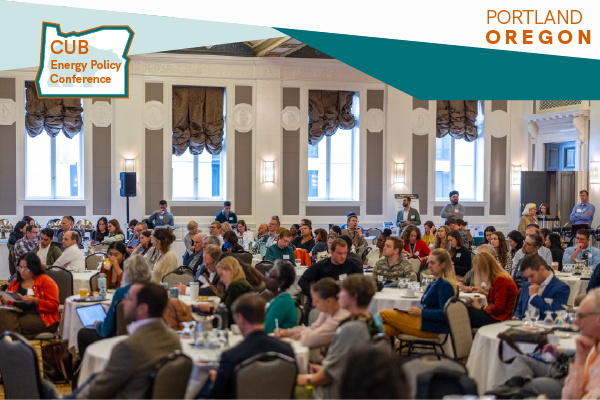
The CUB Energy Policy Conference is designed as a day of discussion, networking, and sharing diverse perspectives. This conference is ideal for community groups, regulators, advocates, utility representatives, attorneys, or those interested in our region’s energy industry.
16th Annual CUB Energy Policy Conference
Friday, October 2, 2026
9:00 am - 5:00 pm
Sentinel Hotel
614 SW 11th Ave, Portland, OR 97205
Stay Up to Date on Oregon Utility Issues
CUB will continue to advocate for people in Oregon on major utility issues. Sign up for the CUB email list for the latest updates, action alerts, and news on policies that affect the utilities your home relies on.
To keep up with CUB, follow us on Instagram, Facebook, Bluesky, and LinkedIn!
09/11/26 | 0 Comments | 2026 Conference - Announcing CUB’s Consumer Champions
2026 Conference - Announcing CUB’s Keynote Speaker
Posted on September 9, 2026 by Cassie Allen
Tags, General Interest, Conference & Events
CUB’s 16th Annual Conference,Harnessing Local Energy is just around the corner! Whether you’re an industry insider or a community member passionate about energy, our 2026 conference has something for you. Register today before early bird pricing ends on September 18th to save big!
Today, we’re thrilled to announce our Keynote Speaker, Elaine Hart! Elaine is the co-founder and Managing Principal at Sylvan Energy Analytics. With over 15 years of experience, Elaine brings a wealth of knowledge about the energy industry. Don’t miss out on her midday keynote address — Time to Think Outside the Box: Meeting Reliability Needs in an Era of Growth.
2026 Conference Theme: Harnessing Local Energy
Finding Local Solutions to (Inter)National Energy Challenges
In just the last few years, Oregon’s energy landscape has seen many big, new challenges. We’ve seen hyperscaled energy demand from data centers, cuts to federal support for customers and utilities, large rate increases, and record household disconnections. With all of these hurdles, attention is increasingly turning to what we can do close to home to address both our energy needs and the human impacts of our industry.
In a world with increasingly globalized energy, we need to start to think more locally for solutions.
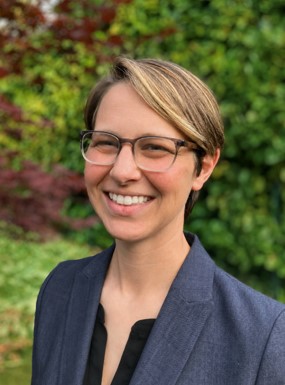
Meet CUB’s Keynote Speaker, Elaine Hart of Sylvan Energy Analytics
Elaine is a co-founder and Managing Principal at Sylvan Energy Analytics, where she leads the company’s consulting practice and strategic direction. She brings over fifteen years of experience in clean energy system planning, with expertise spanning integrated resource planning, resource adequacy, complex resource valuation, and clean energy policy design and implementation.
Elaine has driven innovation in resource planning and decarbonization strategy from within a major investor-owned utility and has advised state agencies, utilities, non-profits, and developers on the challenges and opportunities presented by the transition to cleaner energy systems. She holds a PhD in Civil and Environmental Engineering from Stanford University and is an alumna of Harvey Mudd College.
About the Conference
The CUB Energy Policy Conference is designed as a day of discussion, networking, and sharing diverse perspectives. This conference is ideal for community groups, regulators, advocates, utility representatives, attorneys, or those interested in our region’s energy industry.
16th Annual CUB Energy Policy Conference
Friday, October 2, 2026
9:00 am - 5:00 pm
Sentinel Hotel
614 SW 11th Ave, Portland, OR 97205
Stay Up to Date on Oregon Utility Issues
CUB will continue to advocate for people in Oregon on major utility issues. Sign up for the CUB email list for the latest updates, action alerts, and news on policies that affect the utilities your home relies on.
To keep up with CUB, follow us on Instagram, Facebook, Bluesky, and LinkedIn!
09/10/26 | 0 Comments | 2026 Conference - Announcing CUB’s Keynote Speaker
Extreme Heat Disconnection Protections
Posted on August 27, 2026 by Cassie Allen
Tags, General Interest, Energy

Each summer, heatwaves threaten the health and safety of our communities. Being disconnected from power during or before a heatwave can be particularly dangerous for people with medical conditions, seniors, and children. For families already struggling to keep the lights on, shutoffs from past-due bills can also have a cascading impact.
Thankfully, Oregonians are protected from disconnection for past-due bills during certain extreme heat events. These protections are designed to keep Oregonians connected to life-saving cooling devices during heatwaves and other extreme weather events.
Extreme Summer Weather: Disconnection Limits & Added Protections
Losing access to heating, cooling, and other essential services during extreme weather can be life-threatening. Now, customers of Oregon’s for-profit utilities have stronger permanent protections.
Protections: Disconnections for non-payment are limited during extreme heat and very poor air quality events.
Learn More: CUB Blog - Extreme Summer Weather Disconnection Protections
You Need to Call Your Utility to Regain Service in Extreme Weather
Extreme weather protections are available for all customers. If you have been disconnected because of past-due bills ahead of an extreme weather event, you must call your utility company to get gas or power restored during the protected times. Utilities will not reconnect you automatically. Income-qualified customers and medical certificate customers are not required to pay up-front costs to reconnect in these instances.
Hot Weather Protections
Year-Round Heat Protections
Hot-weather protections apply when an extreme heat warning, extreme heat watch, or heat advisory is issued, regardless of the time of year. These protections only apply to electric utilities (PGE, Pacific Power, and Idaho Power).
All Electric Residential Customers:
- No disconnections 24 hours before a hot weather event, during the event, and 48 hours after.
Electric Bill Discount Program Participants & Medical Certificate Holders:
- No disconnections 24 hours before a winter weather event, during the event, and 48 hours after.
- No upfront costs for reconnection for anyone who has been disconnected up to seven days before the event. Past due balances and applicable reconnection fees will be applied later.
We need to keep each other safe and informed during extreme summer weather. Share these protections with your community to stay safe!
Stay Up to Date on Oregon Utility Issues
CUB will continue to advocate for people in Oregon on major utility issues. Sign up for the CUB email list for the latest updates, action alerts, and news on policies that affect the utilities your home relies on.
To keep up with CUB, follow us on Instagram, Facebook, Bluesky, and LinkedIn!
08/26/26 | 0 Comments | Extreme Heat Disconnection Protections
CUB Welcomes Fall Legal Extern, Delaney Behning
Posted on August 26, 2026 by Cassie Allen
Tags, General Interest

CUB is excited to welcome Delaney Behning (she/her) as our Fall Legal Extern. Delaney is a 2L at the University of Oregon School of Law and is very excited to learn more about utility regulation and environmental and consumer advocacy through this externship.
Join us in welcoming Delaney to the CUB team!
Delaney Behning, CUB’s Fall Legal Extern
Prior to law school, Delaney studied Political Science, Ethics & Public Policy, and Sustainability at the University of Iowa. There, she was involved in Undergraduate Student Government as the Director of Sustainability, worked as an intern for the Office of Sustainability and the Environment, and held leadership roles at the Food Pantry at Iowa.
Over the summers, she worked in government affairs for the National Rural Electric Cooperative Association, in youth empowerment for AmeriCorps, and most recently as a Climate Government Affairs Intern for Our Children’s Trust. These experiences, as well as seeing climate change impact her communities in Iowa, made her passionate about addressing climate change through a clean and equitable energy transition.
At the University of Oregon, she works as a Research Fellow for the Energy Law and Policy Project in the Environment and Natural Resources Center and as a co-director of the Green Business Initiative.
In her free time, Delaney loves hiking across the PNW, training for half and full marathons, enjoying non-law-school-related reading, camping with her friends and partner, Tom, and crafting on her recycled sewing projects.
Welcome to the team, Delaney!
Stay Up to Date on Oregon Utility Issues
CUB will continue to advocate for people in Oregon on major utility issues. Sign up for the CUB email list for the latest updates, action alerts, and news on policies that affect the utilities your home relies on.
To keep up with CUB, follow us on Instagram, Facebook, Bluesky, and LinkedIn!
09/23/26 | 0 Comments | CUB Welcomes Fall Legal Extern, Delaney Behning
2026 Conference - What the Tech?!: Emerging Solutions for Energy Efficiency, Big and Small
Posted on August 26, 2026 by Cassie Allen
Tags, General Interest, Conference & Events

At CUB’s annual conference on October 2nd, we’re keeping it local. Harnessing Local Energy brings together leading experts in the Pacific Northwest to find local solutions to the global challenges facing the energy sector. We’ll discuss some of the technologies helping us solve these issues in our second afternoon breakout panel, What the Tech?!: Emerging Solutions for Energy Efficiency, Big and Small.
Register today for the 2026 CUB Energy Policy Conference and save! Early Bird registration closes at 5:00 pm on September 18.
2026 Conference Theme: Harnessing Local Energy
Finding Local Solutions to (Inter)National Energy Challenges
In just the last few years, Oregon’s energy landscape has seen many big, new challenges. We’ve seen hyperscaled energy demand from data centers, cuts to federal support for customers and utilities, large rate increases, and record household disconnections. With all of these hurdles, attention is increasingly turning to what we can do close to home to address both our energy needs and the human impacts of our industry.
In a world with increasingly globalized energy, we need to start to think more locally for solutions.
Panel 2B—What the Tech?!: Emerging Solutions for Energy Efficiency, Big and Small
Oregonians have new technologies available to reduce energy use and emissions that enable them to be good grid citizens. Promising tech such as balcony solar, residential battery storage systems, and window heat pumps may be excellent tools, but understanding how to effectively use them can be daunting. In homes and at scale, new tech in demand response and energy efficiency can have big impacts. We invite experts on this panel to discuss the larger policy implications and the practical use of new tech.
How can we sort through what is promising and what is over-promising in new technology? What are the tools that industry leaders are excited about that are currently available? What do we need to adapt in our energy policy to ensure these tools are accessible and affordable for Oregon? How do we go from pilot programs to widespread rollouts for new tech?
Moderator: Ryan Tran, Economist, Oregon CUB
About the Conference
The CUB Energy Policy Conference is designed as a day of discussion, networking, and sharing diverse perspectives. This conference is ideal for community groups, regulators, advocates, utility representatives, attorneys, or those interested in our region’s energy industry.
16th Annual CUB Energy Policy Conference
Friday, October 2, 2026
9:00 am - 5:00 pm
Sentinel Hotel
614 SW 11th Ave, Portland, OR 97205
Stay Up to Date on Oregon Utility Issues
CUB will continue to advocate for people in Oregon on major utility issues. Sign up for the CUB email list for the latest updates, action alerts, and news on policies that affect the utilities your home relies on.
To keep up with CUB, follow us on Instagram, Facebook, Bluesky, and LinkedIn!
08/26/26 | 0 Comments | 2026 Conference - What the Tech?!: Emerging Solutions for Energy Efficiency, Big and Small
Wildfire Mitigation Plans: Protecting Customers from Wildfire Risk
Posted on August 25, 2026 by Cassie Allen
Tags, General Interest, Energy
With Oregon’s wildfire season continuing to break records year after year, planning for wildfires is everyone’s responsibility, but especially our utilities. Thanks to legislation passed in 2021, Oregon’s electric utilities are required to file wildfire mitigation plans. These plans aim to lower the risk of wildfires caused by electric utilities. Wildfire mitigation plans improve customers’ safety during wildfire season and beyond.
These plans are meant to show how electric utilities intend to address wildfire risk in their service areas. These plans must identify high-risk areas and show how utilities’ policies and investment plans will reduce wildfire risk. Utilities are required to collaborate with local communities in the planning process.
Wildfire Mitigation Plans (WMPs)
In 2021, Oregon passed Senate Bill 762, a law requiring utilities to create comprehensive plans to lower wildfire risk in Oregon. This law applies to the state’s three for-profit electric utilities: Portland General Electric, Pacific Power, and Idaho Power. It tasks regulators at the Public Utility Commission with ensuring that utilities create holistic, cost-effective plans.
Why are Wildfire Mitigation Plans Important?
As Oregon’s wildfire seasons continue to worsen, we need these plans to keep our communities safe. In 2020, the Labor Day fires swept through Oregon, leaving over a million acres burned west of the Cascades. These fires impacted thousands of households, destroyed homes, and upended lives. In court, Pacific Power was deemed responsible for the four wildfires due to gross negligence. Utilities’ risk of causing wildfires is why these plans are necessary.
These plans show the strategies utilities will use to prevent wildfires in our state. This should include informing customers of planned and potential outages, called Public Safety Power Shutoffs. The goal of these plans is to minimize the risk of utility-caused wildfires. And most importantly—protecting Oregonians from life-threatening wildfires.
Managing Utility-Caused Wildfire Risk
Utilities’ plans are required to identify wildfire risks where they deliver electricity. Utilities also have to show risks around where they are moving electricity across distances (e.g., power lines). Through their analyses, utilities must include a description of what they are doing to reduce this risk.
Wildfire mitigation strategies include:
- Vegetation management (tree trimming, removal, etc.)
- System hardening (insulating wires, sensors for downed lines, etc.)
- Investment decisions (new line locations, power plant locations, etc.)
- Operational decisions (when to shut off power based on weather, etc.)
In addition to analysis and system plans, utilities must also plan for community engagement strategies. This includes their plans to work with local fire departments, local governments, and other public safety partners.
This year, regulators directed utilities to expand community-focused wildfire safety efforts. This change came at the recommendation of CUB and other energy advocates. This includes providing more home hardening and defensible space strategies. Utilities should also now provide communities with preparedness materials, fire location, and awareness tools at local events.
Multi-Year Planning: Updating the Planning Process
Previously, these plans had to be filed by December 31 of each year for the next year. Regulators then had six months to review the plans and provide recommended changes to utilities. That meant that a plan filed at the end of 2023 for 2024 wasn’t evaluated until after it had already been implemented. This system wasn’t working.
In 2025, Oregon moved from a one-year to a three-year planning process. After being filed, regulators now have six months to analyze the plans and make recommendations. An independent evaluator, who is a utility wildfire mitigation expert, also provides feedback on whether the utility has met state requirements. At the end of the review, regulators either approve the plans as is or with recommendations. These plans will be in place for the next three years.
Where They’re At Now: Wildfire Plans
On December 31, 2025, Oregon’s electric utilities filed plans with state regulators for 2026, 2027, and 2028. After being reviewed, all the plans were approved with conditions.
This year, regulators directed the utilities to provide more information on their data, analysis methods, and measurable results. This information shows the effectiveness of utilities’ wildfire mitigation strategies to inform their next multi-year plan.
The utilities will be coming back to update regulators on where they are in implementing their current plans in 2027. CUB expects utilities to address regulators’ recommendations in their updates.
Advocating for Customers: CUB’s Role in Wildfire Mitigation
Throughout the wildfire mitigation plan review process, our staff advocates for customers’ interests by prioritizing cost-effective best practices. We also work closely with fellow energy advocates to demystify this complex process and explain plans. Regulators are working to make this process more transparent for community groups and the public.
Costs from wildfire mitigation plans can be passed on to customers.
Because customers ultimately foot the bill for wildfire mitigation, these plans must be evaluated to ensure they’re the lowest-cost option. Independent evaluators have consistently found that our electric utilities are not meeting the requirements.
At CUB, we believe investments in wildfire protections are important, but they also must be smart. While utilities are allowed to pass wildfire mitigation costs to customers, they can’t be given a blank check. Our staff consistently advocates for the least-cost strategies and holds utilities accountable for providing hard data to back up their plans.
CUB will continue to advocate for Oregon households and ensure we are only paying for necessary costs that protect our communities, not utility cash grabs.
Stay Up to Date on Oregon Utility Issues
CUB will continue to advocate for people in Oregon on major utility issues. Sign up for the CUB email list for the latest updates, action alerts, and news on policies that affect the utilities your home relies on.
To keep up with CUB, follow us on Instagram, Facebook, Bluesky, and LinkedIn!
08/25/26 | 0 Comments | Wildfire Mitigation Plans: Protecting Customers from Wildfire Risk
Disconnection Protections for Wildfire Season
Posted on August 18, 2026 by Cassie Allen
Tags, General Interest, Energy
Sadly, this year’s wildfire season is on track to be the worst in Oregon’s history. With millions of acres burned, we all must know our protections to stay connected to life-saving power around an emergency. State regulators have adopted these protections to keep more Oregonians safe during wildfire season.
The reality is that utilities are not always able to keep the lights on during a wildfire. Public safety power shutoffs are a key tool for preventing utility-caused wildfires. But when it is safe to keep power flowing during and after a wildfire emergency, customers have protections from a disconnection for non-payment.
These protections keep our communities safe and healthy in our homes, specific to times surrounding evacuation notices and poor air quality events.
Protections: Disconnections for non-payment are limited during extreme heat and very poor air quality events.
You Need to Call Your Utility to Regain Service in Extreme Weather
Extreme weather protections are available for all customers. If you have been disconnected because of past-due bills ahead of an extreme weather event, you must call your utility company to get gas or power restored during the protected times. Utilities will not reconnect you automatically. Income-qualified customers and medical certificate customers are not required to pay up-front costs to reconnect in these instances.
Wildfire Evacuation Protections
Wildfire protections apply during Level 2 and Level 3 evacuation notices issued in a customer’s area. These protections only apply to all for-profit utilities (PGE, Pacific Power, Idaho Power, NW Natural, Cascade, and Avista).
All Residential Customers:
- No disconnections for 48 hours after wildfire evacuation notices have been lifted.
- No up-front costs for reconnection for anyone who has been disconnected up to seven days before the event. Past due balances and applicable reconnection fees will be applied later.
Protecting Against Wildfires: Public Safety Power Shutoffs
During periods of high wildfire risk, utilities may shut off power to lower the risk of creating or worsening a fire. Shutting off power during fire season is itself a public hazard, which is why Oregon’s electric utilities use this option only as a last resort. Shutoffs can interrupt cell phone service, delay emergency response, and endanger the health of residents. These kinds of outages are particularly hazardous when they coincide with extreme heat waves.
Not all Oregonians are subject to these preventative outages. Only customers in certain high-risk zones will see public safety shutoffs.
The best way to prepare for a public safety power shutoff is to stay informed ahead of time. Customers can sign up to receive alerts from their utility when a power shutoff is coming.
Portland General Electric:
Sign up for text alerts through your account. Download the PGE app for up-to-date alerts.
Pacific Power:
Sign up for text alerts through your account. Download the Pacific Power app for up-to-date alerts.
Idaho Power:
Sign up for text alerts through your account. Download the Idaho Power app to receive real-time alerts.
For more in-depth information on wildfire emergencies and alerts, download the FEMA mobile app to receive details on large-scale wildfires. During an emergency declaration, FEMA updates its app to ensure people have access to up-to-date evacuation information.
We need to keep each other safe and informed during wildfire season. Share these protections with your community to stay safe!
Stay Up to Date on Oregon Utility Issues
CUB will continue to advocate for people in Oregon on major utility issues. Sign up for the CUB email list for the latest updates, action alerts, and news on policies that affect the utilities your home relies on.
To keep up with CUB, follow us on Instagram, Facebook, Bluesky, and LinkedIn!
08/19/26 | 0 Comments | Disconnection Protections for Wildfire Season
Staying Connected to Power During Poor Air Quality Events
Posted on August 12, 2026 by Cassie Allen
Tags, General Interest, Energy

During fire season, harmful smoke from wildfires can have dangerous impacts on Oregonians’ health. To stay safe, it’s critical that households stay connected to power and keep air filters running. No one should lose power due to nonpayment during poor air quality days.
Thankfully, permanent rules adopted by state regulators ensure Oregonians have better disconnection protections during poor air quality events. These protections are designed to keep more households connected to power, ensuring Oregonians can safely stay inside and access necessary air filter devices during hot, smoky weather.
Extreme Summer Weather: Disconnection Limits & Added Protections
Losing access to heating, cooling, and more in extreme weather can be life-threatening. Now, customers of Oregon’s for-profit utilities have stronger permanent protections.
Protections: Disconnections for non-payment are limited during extreme heat and very poor air quality events.
You Need to Call Your Utility to Regain Service in Extreme Weather
Extreme weather protections are available for all customers. If you have been disconnected because of past-due bills ahead of an extreme weather event, you must call your utility company to get gas or power restored during the protected times. Utilities will not reconnect you automatically. Income-qualified customers and medical certificate customers are not required to pay up-front costs to reconnect in these instances.
Air Quality Protections
Year-Round Protections
Air quality protections apply when the Air Quality Index (AQI) is forecasted to be at or above 100, no matter the time of year. These protections only apply to all for-profit utilities (PGE, Pacific Power, Idaho Power, NW Natural, Cascade, and Avista).
All Residential Customers:
- No disconnections during the air quality event and 48 hours after.
Bill Discount Program Participants & Medical Certificate Holders:
- No disconnections during the air quality event and 48 hours after.
- No up-front costs for reconnection for anyone who has been disconnected up to seven days before the event. Past due balances and applicable reconnection fees will be applied later.
Help us keep each other safe and informed during extreme summer weather. Share these disconnection protections with your community!
Stay Up to Date on Oregon Utility Issues
CUB will continue to advocate for people in Oregon on major utility issues. Sign up for the CUB email list for the latest updates, action alerts, and news on policies that affect the utilities your home relies on.
To keep up with CUB, follow us on Instagram, Facebook, Bluesky, and LinkedIn!
08/13/26 | 0 Comments | Staying Connected to Power During Poor Air Quality Events
2026 Conference - Local Takes the Lead: The Future of Gas in Oregon
Posted on August 10, 2026 by Cassie Allen
Tags, General Interest, Conference & Events
CUB’s 16th annual Energy Policy Conference, Harnessing Local Energy, is all about keeping it local. This year, we’re bringing together some of the greatest minds in the Pacific Northwest to find local solutions to the global challenges of the energy sector. We’ll dive headfirst into this challenge during the first afternoon breakout panel, Local Takes the Lead: The Future of Gas in Oregon.
Register today for the 2026 CUB Energy Policy Conference and save! Early Bird registration closes at 5:00 pm on September 18.
2026 Conference Theme: Harnessing Local Energy
Finding Local Solutions to (Inter)National Energy Challenges
In just the last few years, Oregon’s energy landscape has seen many big, new challenges. We’ve seen hyperscaled energy demand from data centers, cuts to federal support for customers and utilities, large rate increases, and record household disconnections. With all of these hurdles, attention is increasingly turning to what we can do close to home to address both our energy needs and the human impacts of our industry.
In a world with increasingly globalized energy, we need to start to think more locally for solutions.
Panel 2A—Local Takes the Lead: The Future of Gas in Oregon
Oregonians across the state are pushing their community leaders and utilities to invest in policies that focus on moving us away from fossil fuels. Natural gas utilities may have fewer tools available to achieve this goal, regardless of the future of the Climate Protection Program. But across the state, gas utilities, local governments, and community organizations are pursuing getting creative in transitioning customers away from gas appliances. And different approaches will be needed to meet the needs of local communities. In this panel, attendees will hear diverse perspectives on balancing climate imperatives with operational realities.
What is on the horizon for electrification for gas customers? How are local community leaders working to make appliances in our homes and businesses more efficient? What lessons can we learn from local efforts to decarbonize the gas system in their communities? And what is the role of gas in a decarbonizing energy system?
Moderator: Emily Dougan, Utility Analyst, Oregon CUB
About the Conference
The CUB Energy Policy Conference is designed as a day of discussion, networking, and sharing diverse perspectives. This conference is ideal for community groups, regulators, advocates, utility representatives, attorneys, or those interested in our region’s energy industry.
16th Annual CUB Energy Policy Conference
Friday, October 2, 2026
9:00 am - 5:00 pm
Sentinel Hotel
614 SW 11th Ave, Portland, OR 97205
Stay Up to Date on Oregon Utility Issues
CUB will continue to advocate for people in Oregon on major utility issues. Sign up for the CUB email list for the latest updates, action alerts, and news on policies that affect the utilities your home relies on.
To keep up with CUB, follow us on Instagram, Facebook, Bluesky, and LinkedIn!
08/04/26 | 0 Comments | 2026 Conference - Local Takes the Lead: The Future of Gas in Oregon
Agreement Reached for Cascade 2026 Rate Increase
Posted on August 6, 2026 by Charlotte Shuff
Tags, General Interest, Energy

After months of analysis, questions, and negotiations, all parties have come to an agreement with Cascade on the gas utility’s request to raise customers’ bills. Starting in October, Cascade households are set to see a 12.3% rate increase, down from the initial ask of 17.4%. The agreement is expected to be approved by state regulators in October.
An average household can expect to pay about $133 on a peak winter bill next January (a $14 increase). While this is a big change for customers, Cascade still has the lowest gas billing rates in Oregon.
Big Wins for Customers: In addition to significantly reducing the total increase, CUB helped secure big wins for customers. This includes rejecting large profit margin increases, removing expensive renewable natural gas costs, and phasing out a customer-funded subsidy to add new buildings to the gas system.
Large Rate Hikes Are On Their Way Out
One big reason Cascade’s increase is so high is that the utility has been quietly accumulating costs since it last raised rates in 2020. While rates have gone up some in recent years because of the rising cost of methane (natural gas’s main component), the costs of big projects and investments have been piling up. We saw a similar issue with Idaho Power in 2025, with the utility waiting ten years before requesting a 27% increase.
But these large, surprise increases could soon be a thing of the past. With the new FAIR Energy Act rolling out next year, utilities will now be required to create five-year spending plans, meet community-supportive metrics, and stick to a budget. This new customer-centered process will help to prevent big increases and help Oregonians know what to expect on their gas and electric bills.
Read More: Regulators Adopt Phase 1 FAIR Energy Act Proposal (CUB Blog)
Wins for Cascade Customers
Overall, this agreement includes some big wins for customers. Advocates were able to cut the increase by nearly 30%, from $16.4 million to $12 million.
Cuts to the initial request include:
- Rejecting big profit margin increases
- Removing expensive renewable natural gas costs
- Phasing out a customer-funded subsidy to add new buildings to the gas system
New Program: Customers will also now have access to a pilot program to fund heat pumps in homes, without having to stay on the gas system.
Reducing Profit Margins
The agreement has rejected Cascade’s request to increase profit margins by millions of dollars each year at the cost of customers. Now, the utility is only allowed a very modest increase in allowable profits to 9.5% (was 9.4%). The new limit is in line with other gas utilities in the state.
As a regulated utility, Cascade’s profit margin is set by the Oregon Public Utility Commission. This is not a guarantee for profit, but rather a way to ensure customers are not being overcharged to benefit shareholders.
Cutting Expensive Renewable Gas Costs
This year, CUB pushed back to ensure household gas customers are not being overcharged for expensive renewable natural gas projects. And we were successful in cutting new charges for renewable natural gas! This win was largely due to the hard work of advocates at the Green Energy Institute, which CUB supported.
And this win against expensive gas alternatives will last for years. The agreement rejected Cascade’s request to allow it to invest in renewable natural gas projects and add costs to customer bills with very little oversight. Cascade was taking a page from NW Natural’s request just a few years ago, where CUB was also able to secure strong customer protections.
We can expect to see Cascade coming back next year with new asks to charge customers for renewable gas. But the agreement made it clear that there are limits on what the gas utility can ask for, thanks to advocate pushback.
Phasing Out the Growth Subsidy
Major Victory: Cascade is set to be the final gas utility to phase out the customer-funded growth subsidy for household customers in Oregon.
The agreement rejected Cascade’s request to expand its customer-funded subsidy to grow the gas system. Existing customers pay for expanding Cascade’s business through a subsidy called a “line extension allowance.” This subsidy benefits building developers, encouraging new homes to be built with gas.
Now, Cascade must phase out its growth subsidy for households by 2028. The cost it can charge existing households to add a new home will drop to $1,750 this October, down to $678 in October 2027, and finally $0 in October 2028.
The agreement also phases out this subsidy for small commercial and small industrial customers, too. Now, only large industrial and large volume customers will have access to the subsidy, which will now be tracked to these customers alone with new limits for overruns. Households and small businesses have strong protections against these costs to expand the gas system land on their bills.
Cascade was the last remaining Oregon gas utility charging customers an expansion subsidy. Over the past few years, regulators at the Oregon Public Utility Commission have ended similar policies for NW Natural and Avista. Regulators agreed with CUB that these policies are not in the best interest of customers. These subsidies also undermine climate policies in Oregon communities, such as Bend and Ashland, that discourage new homes from being connected to the gas system.
New Heat Pump Pilot
Cascade customers will soon have access to a new program to help offset the cost of heat pumps in their homes. The new pilot program will provide up to $1,500 per customer to get this high-efficiency heating and cooling.
This new pilot comes on the heels of a similar program CUB helped win for Avista customers, the gas utility serving parts of Southern and Eastern Oregon. Soon, Avista will pilot a program to offer incentives to switch homes to all-electric appliances and leave the gas system, instead of paying for expensive pipe replacements. Avista will also ensure that low-income customers are included in this pilot, which may help many receive necessary home upgrades and benefits.
Both of these pilot programs will help save household money, provide high-efficiency cooling, and help the gas utilities meet requirements to reduce emissions. A win all around!
Cascade Needs to Be Realistic on the Climate Protection Program
Under Oregon’s Climate Protection Program, gas utilities are now required to reduce emissions by 90% by 2050. While there are many ways for utilities to achieve this mandate, renewable natural gas is a favorite option because of its profitability. Cascade had multiple big investments it wants to charge customers for, as well as a proposal to make these charges automatic going forward.
Cascade also attempted to argue that expanding its growth subsidy at the expense of customers was beneficial to meeting Climate Protection Program rules. But adding more customers adds more emissions, which is the opposite of what Cascade needs to do under state requirements.
CUB, other advocates, and analysts at the Oregon Public Utility Commission were able to successfully call out Cascade’s unrealistic and expensive arguments. But we can expect to see more of these confusing and unrealistic plans in the name of the Climate Protection Program from gas utilities going forward. After all, these are the same utilities that have sued the state twice in an attempt to end the emissions reduction program!
Stay Up to Date on Oregon Utility Issues
CUB will continue to advocate for people in Oregon on major utility issues. Sign up for the CUB email list for the latest updates, action alerts, and news on policies that affect the utilities your home relies on.
To keep up with CUB, follow us on Instagram, Facebook, Bluesky, and LinkedIn!
08/06/26 | 0 Comments | Agreement Reached for Cascade 2026 Rate Increase
CUB’s Grid Infrastructure Bike Tour
Posted on August 4, 2026 by David Beltrán Barajas | CUB Oregon
Tags, General Interest, Energy, Conference & Events
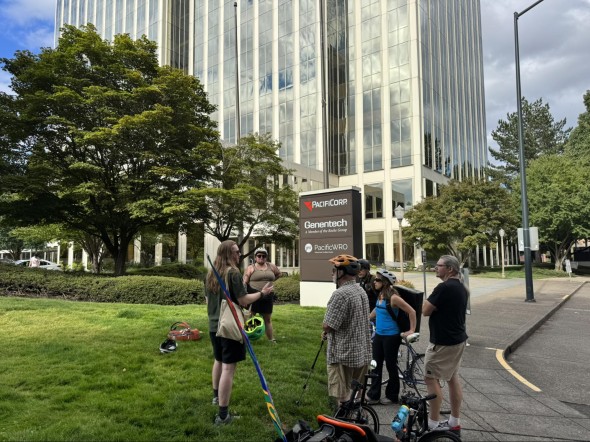
At the end of July, CUB hosted its first-ever Grid Infrastructure Bike Tour! Ten community members came out on this sunny summer day to learn about Portland’s electrical grid and how Oregonians can take action to combat energy bill rate increases.
Stop 1: Generation
We started the tour at Chapman Square, near the SW waterfront, for introductions and a discussion on generation. Generation is the act of creating electrical energy from a resource, such as fossil fuels, like coal or natural gas, or a renewable source, like solar or wind.
We chose Chapman Square as our first stop because it’s the endpoint of the first long-distance transmission line in North America, connecting Willamette Falls to Portland. Willamette Falls was Oregon’s first electric generating dam.
We discussed Oregon’s generation makeup, what our state’s energy generation has looked like, what it’s transitioning to, and where we would like go to have a green transition over the coming years.
According to the Oregon Department of Energy, as of 2024, Oregon’s energy mix comes from:
- Hydro - 33.91%
- Natural Gas - 20.41%
- Wind - 7.85%
- Coal - 8.29%
- Solar - 3.90%
Do you have a preferred form of generation? If so, share in the comments what you prefer and what you would like to see more of in Oregon!
Stop 2: Transmission
Transmission is the physical transportation of the energy produced at a generation site to local areas where it will be used. This energy can travel hundreds of miles before entering your home to power your devices, keep your home warm, and light up our city.
Electricity travels on high-voltage transmission lines that span the state and bind our grid together, making it possible for us to go about our days without questioning if the lights will turn on when we flip a switch.
Transmission doesn’t always have to span hundreds of miles to make it to you and other customers. On this tour, we stopped in front of the Oregon Convention Center, which houses about six thousand solar panels on its roof! This generation is right in the heart of the city. According to the Energy Trust, they have a 2MW capacity and provide about 25% of the convention center’s energy needs. However, these panels only provide power for the convention center itself.
There is, however, a community solar park out near the Cully neighborhood that also provides generation within city limits. This project provides energy credits for 150 low-income Cully families, and makes renewables accessible to demographics that may not be able to access rooftop solar.
Read More: When a Solar Panel is More Than a Solar Panel (CUB Blog)
Stop 3: Distribution
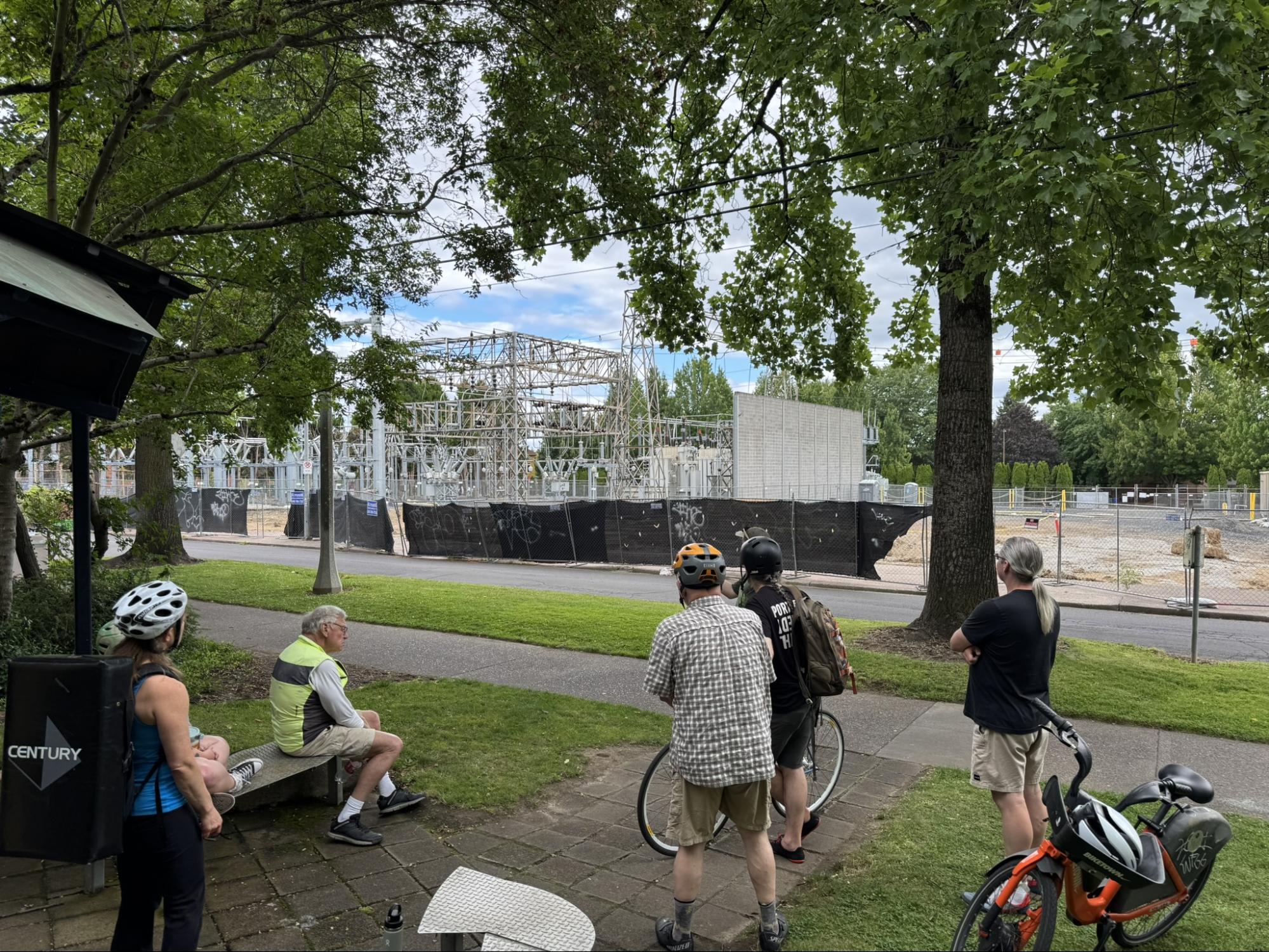
Community members gathered across from the Knott Substation owned by Pacific Power. We gathered to hear Joe D’Ambrosia explain what a substation is and does for our grid.
The final stretch of our group ride took us up NE 7th to Matt Dishman Community Center and the Knott Substation. Along the way, we could see the web of distribution cables that connected all the homes in the Irvington neighborhood to our grid.
Did you know one of the largest chunks of your bills is actually made up of distribution costs? All of this statewide infrastructure is necessary to keep our homes connected to the grid. Compare this to large industries or commercial businesses that are a little more concentrated and easier to connect to the grid. This is why residential rates for distribution are larger than other customers.
While in front of the Knott substation, community member and Electrical Engineer, Joe D’ Ambrosia, joined us to explain what a substation is and does. In short, substations are the bits of infrastructure that take all the high-voltage electricity sent over from generating sites and convert it, or “step it down,” to lower voltages that then will be distributed to our homes, businesses, or other needs depending on the type of substation being used.
Last Stop: Public Comment Workshop
The final stop on the bike tour was the PacifiCorp headquarters in the Lloyd district. Here, we talked about the ongoing request from Pacific Power to increase customers’ bills. In this public comment workshop, we went through the details about the request and how community members can get involved.
Read More: Pacific Power Requests 11.3% Residential Increase (CUB Blog)
There was a lot of discussion on the projected sale of Pacific Power’s Washington state territories to PGE, and the addition of Washington coal generation costs onto Oregonian bills. Community members were also interested in learning about the recent years of rate increases and how they impact Oregonians throughout the state.
In 2025, Oregon saw its second record-breaking year for disconnections. Oregonians are maxed out on what they can afford for energy. Pacific Power has already raised rates by more than 50% between 2021 and 2025, and now they’re asking for an additional 11%.
Look Out for More Bike Tours From CUB
Feedback from participants was positive, so CUB looks forward to hosting another bike tour in the future. If you’re interested in getting involved with CUB, sign up for our newsletter and follow us on our socials to keep up with the latest on what we’re up to!
Stay Up to Date on Oregon Utility Issues
CUB will continue to advocate for people in Oregon on major utility issues. Sign up for the CUB email list for the latest updates, action alerts, and news on policies that affect the utilities your home relies on.
To keep up with CUB, follow us on Instagram, Facebook, Bluesky, and LinkedIn!
08/04/26 | 1 Comment | CUB’s Grid Infrastructure Bike Tour
06/01/26 | 0 Comments | Utilities 101: Understanding Your Gas & Electric Bills