
ECO Center Steals the (Auto) Show
Posted on January 29, 2013 by Stephanie Levine
Tags, Emerging Technologies
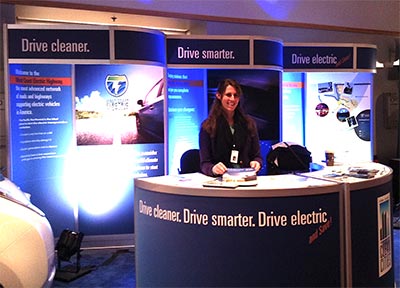
Thousands of people visited the Portland International Auto Show this past weekend, packing the Oregon Convention Center for all four days. I spent opening and closing day at the ECO Center, which featured a variety of hybrids, plug-in electric hybrids (PHEVs), and fully electric vehicles (EVs). Alongside the vehicles were booths for local organizations representing the many sides of the EV industry in Oregon, including PGE, Drive Oregon, and contractors with information on installing a charging station inside your home. I was lucky enough to hang out with our friends from the Columbia-Willamette Clean Cities Coalition, talking to visitors about the West Coast Electric Highway and answering all kinds of EV related questions.
During my two days at the auto show, I talked with many EV-curious people. The most frequently asked question was about the limitations of battery range. People wanted to know: what do I do when I need to go farther than the range of the battery? Most EVs under $50,000 have a range of about 80-100 miles. For the average driver, this is more than enough to satisfy daily traveling needs, but not enough for their recreational trips.
The best way to answer this question is to take a practical look at your own driving needs. For example, the all-electric Nissan Leaf is probably not the best option for the woman I spoke with who drives to visit her mother in Montana once a month. Although the Leaf would have more than enough range to accomplish her daily commute to work, with such frequent long-distance weekend trips it would add considerable time to charge the car along the way. I suggested looking into a plug-in electric hybrid, like the Chevy Volt or the Prius Plug-In Hybrid. With these cars, she could only use the electric battery to fuel her trips to work, but could then rely on the gasoline-powered engine for her longer trips. In the gasoline mode, these PHEVs run like a standard hybrid vehicle, averaging 50 mpg. This certainly seemed like her best option if she was going to switch to electric.
Another common driving concern people were worried about was accommodating their annual long-distance trip. One man I talked to told me that he does almost all of his driving in the city, but generally makes one long trip a year. In situations like this, it might be worthwhile to consider going with an all-electric option that he can use for all of his local trips, and then renting a high efficiency vehicle for his annual vacation drives. By fueling the majority of his driving with electricity, this could be the best-cost option, especially with car-sharing programs in the area like Getaround.
Many people who frequently travel up and down I-5 were exited to hear about the progress Oregon has made on our portion of the West Coast Electric Highway, which is now complete with DC Fast Chargers approximately every 40 miles. These fast chargers can fully charge an EV battery in 20-30 minutes. With the I-5 project complete, the state is now developing EV routes along the other major thoroughfares. With funding from the second Transportation Investment Generating Economic Recovery (TIGER II) grant, the Oregon Department of Transportation is busy installing DC fast-chargers up and down the Oregon coast and out to the Columbia Gorge.
To keep up with CUB, like us on Facebook and follow us on Twitter!



03/31/17 | 0 Comments | ECO Center Steals the (Auto) Show