
CUB’s 2026 Priorities
Posted on January 22, 2026 by Charlotte Shuff
Tags, Energy, General Interest

A new year means new opportunities for CUB to advocate for Oregon’s utility customers. Across the state, Oregonians are feeling the pinch from the rising cost of living. High energy costs continue to hurt many households, making it even more essential that we rein in out-of-control energy bills.
This year, we’re working to address the energy affordability crisis by pushing back on utility attempts to raise your bills. We’re advocating for moving away from expensive fossil fuels, saving customers money in the long run. And we’re holding corporations accountable, ensuring regulators prioritize people over profits.
Read on to learn more about CUB’s top priorities in 2026.
CUB’s Top Priorities
Energy affordability is CUB’s top priority in 2026. The cost of living is on the rise in Oregon, and energy costs make up a significant portion of household bills. In 2024 alone, Oregon utilities disconnected a record 70,000 households, impacting an estimated 130,000 Oregonians.
No one should have their power turned off because of unaffordable energy bills. Our staff is working hard to advocate for long-term solutions to the energy affordability crisis that too many in Oregon are facing.
Pushing Back on Utility Attempts to Raise Your Bills
While we made significant progress in reining in out-of-control energy costs last year, we need to go even further to help struggling households. Our staff will focus our efforts on pushing back against utility attempts to raise customers’ bills this year.
Slowing Billing Rate Increases
CUB will focus on customer affordability by pushing back on big bill increases that grow shareholder profits.
Some utilities have already proposed massive bill increases. Cascade Gas is asking regulators for a 17.4% increase in residential customer bills, with more increases potentially on the way later in the year. The gas utility plans to invest millions of dollars in adding new customers, utilizing expensive renewable natural gas, and expanding the gas system, which could mean higher bills with no tangible benefits for customers.
Rolling Out the FAIR Energy Act
CUB is pushing back on utilities’ attempts to weaken new affordability laws, ensuring that the economic impact on customers is always front and center.
We’ll also be working hard to ensure that new energy laws are implemented fairly, which will reduce the frequency and amount of bill increases. In 2025, CUB passed the Fair Energy Act (HB 3179) - a huge step towards reining in utilities. Now, the regulators will need to overhaul the utility regulation process, requiring careful implementation and input from community leaders.
Stronger Consumer Protections on Disconnections
CUB will continue advocating for expanding customer protections and programs that keep more households connected to life-saving power.
A record number of utility disconnections and rising energy costs show a concerning problem: unaffordable energy bills are leaving Oregon families without access to power. We need to prevent more households from being disconnected and ensure all Oregonians have access to energy assistance programs.
Thankfully, CUB and many other advocates pushed regulators to take decisive action last year. Oregonians now have stronger disconnection protections in place, keeping more households connected during the winter and beyond. This year, we will go further to expand debt management and relief programs to help more people avoid disconnection altogether, plus more protections!
Moving Away from Expensive Fossil Fuels
When it comes to climate change, one thing is abundantly clear: inaction is the most expensive option. Oregon has an opportunity to lead the way in transitioning to clean energy, but we need strong, coordinated action on energy efficiency and electrification to make that happen.
This year, CUB is committed to advocating for moving away from expensive fossil fuels, saving customers money in the long run.
Removing Subsidies for Growing Gas
CUB is committed to advocating for opportunities to move customers away from reliance on fossil fuels, including electrification and switching to heat pumps.
One of the ways we’re doing this is by pushing back on gas utilities’ attempts to grow the gas system. In UG 525, Cascade Natural Gas is holding on to Line Extension Allowances (LEAs), subsidies that help install natural gas hookups into new developments. Cascade will soon be the last remaining Oregon gas utility charging customers an expansion subsidy.
In 2024, CUB successfully eliminated NW Natural’s LEA, saving customers millions. NW Natural is still challenging this win for customers in the courts. As more households all over the state choose to go electric, it’s time we put these subsidies behind us.
A Managed Clean Energy Transition
CUB will keep holding utilities accountable for meeting climate mandates, supporting an affordable shift away from fossil fuels.
Our for-profit energy utilities are required to reduce emissions by the Oregon state government. Passed in 2021, HB 2021 requires Oregon’s regulated electric utilities to reduce emissions by 80% by 2030, 90% by 2035, and 100% by 2040. The Climate Protection Program requires major gas utilities to reduce greenhouse gas emissions from natural gas, liquid fuels, and propane by 90% by 2050.
Utilities must submit plans to regulators to meet these requirements. So far, no major utility has shown that they have an actionable plan to meet our state’s climate objectives. Without clear, smart plans, utilities are putting customers at risk for high costs down the line. CUB is pushing for affordable plans this year that set us up for success over the next two decades.
Tackling Corporate Greed: They Pay, Not Us
To address Oregon’s energy affordability crisis, we need to identify one major source of rising energy costs: corporate greed. Data centers and other big energy users are driving up energy costs for everyday people. Prioritizing shareholder profits adds more to our energy bills with little benefits Oregonians. And utilities continue to attempt to pass on wildfire liability costs while adding unchecked costs (and profits) on investments to avoid future fires.
Enough is enough. It’s time we hold corporations accountable instead of passing on costs to us.
Taking Data Centers Off Our Home Energy Bills
CUB is committed to reining in data centers and ensuring Big Tech is paying its fair share.
Data centers have heavily contributed to the sharp rise in energy rates for Oregonians. Last year, CUB passed the POWER Act (HB 3546) to hold big energy users accountable for increasing energy costs—and make them pay their share. Now, CUB is working with regulators to implement the POWER Act and remove data center costs from customers’ bills.
In UM 2377, CUB is leading an investigation into PGE and how they’re planning on complying with the POWER Act. While PGE’s initial plans received heavy criticism, public pressure has pushed them into a more favorable position for customers. CUB is in the process of analyzing PGE’s newest proposal to ensure that it is fair for residential utility customers.
Only Necessary Investments in Wildfire Plans
CUB will push back on utility cash grabs when making wildfire mitigation plans, ensuring customers aren’t being charged for unnecessary investments.
We’re also working with regulators to hold utility companies accountable for affordable, efficient wildfire mitigation. Currently, utilities are switching to a 3-year process for wildfire planning. These plans are incredibly important to ensuring we do not see a repeat of the 2020 utility-caused wildfires.
Utility programs and infrastructure need to be updated to make the grid more resistant to wildfires. But those investments cannot be used as a blank check for projects to earn shareholders big profits. CUB will advocate for utility plans that focus on the greatest bang-for-our-buck, while protecting Oregonians and our land from harm.
Protecting Reliable, Life-Saving Landline Services
CUB will hold Lumen accountable for their promise to improve life-saving landline service, or they won’t receive the increases they’re looking for.
Lastly, we’re working on holding corporations like Lumen, also known as CenturyLink, accountable for providing quality service to customers. Lumen has a long track record of failing to provide quality services to Oregon customers, especially rural communities. Despite that, they want to charge customers more money without delivering on promises to upgrade their infrastructure and improve service for many customers.
While this case continues to drag out, CUB will continue to fight for reliable access to landlines. For many in rural areas, this service is the only way to stay connected to the community, vital support services, and emergency services from home.
Stay Up to Date on Oregon Utility Issues
CUB will continue to advocate for people in Oregon on major utility issues. Sign up for the CUB email list for the latest updates, action alerts, and news on policies that affect the utilities your home relies on.
To keep up with CUB, follow us on Instagram, Facebook, Bluesky, and LinkedIn!



CUB Endorses the Power to the People Act
Posted on January 20, 2026 by Charlotte Shuff
Tags, Energy, General Interest

On January 15, 2026, U.S. Senator Chris Van Hollen of Maryland introduced the Power to the People Act. This bill aims to control the impacts of data centers across the country on households and other businesses. As data centers have exploded, most utility customers have seen higher bills, and many states are starting to face energy shortages in the coming years.
The Power to the People Act promotes the creation of data center customer classes and incentivizes data centers to come online with their own energy resources. Both of these goals will help manage the huge amount of electricity data centers are now demanding, while protecting other customers — including families —from rising power bills.
This bill has been endorsed by CUB, as well as Maryland People’s Counsel, Consumer Federation of America, National Consumer Law Center, Public Citizen, NRDC, and Union of Concerned Scientists.
Data Centers Put Our Energy Systems at Risk
Data centers are putting a strain on our energy system and driving up costs on our power bills. These giant campuses, mainly filled with computers, use a massive amount of electricity — an entire city’s worth! A single 30 MW data center uses more electricity than the City of Ashland. Larger, 250 MW data centers, associated with AI, require a similar amount of energy to the City of Eugene.
And these city-sized energy users are coming to Oregon in droves. In just the last five years, data centers’ growth for just Portland General Electric has been the equivalent of adding 162,400 families to PGE’s system.
Data centers are a huge problem across the country, too. Virginia has been the leader in the country for this new industry and has seen catastrophic impacts on energy bills. Texas, California, and Ohio have also seen an explosion in recent years. While many states have either proposed or passed protections to slow skyrocketing energy bills, the Power to the People Act is the first national solution proposed.
What Does the Power to the People Act Do?
At its core, the Power to the People Act seeks to control the impacts of data centers on our energy systems and energy costs. According to Senator Van Hollen:
“The Power for the People Act seeks to hold data centers accountable for the increased energy prices they are causing through needed reforms that would prevent consumers from subsidizing data center development through their energy bills. It also would ensure that data centers interconnecting to the grid do not overwhelm the system, causing grid reliability issues that result in power outages.”
A New Type of Customer: Data Centers vs. The Rest of Us
The way this bill would accomplish holding data centers accountable is by singling out data centers and cryptocurrency operations from the rest of the electric utility customers.
Normal Utility Customers: Organic Load Growth
The Power to the People Act separates “normal” utility customers, who behave the way that we traditionally expect in adding energy use. New homes, small businesses, and even industry, like manufacturing, add small amounts of load (new energy demand) to utilities every year. This growth happens at about the same pace between residential, commercial, and industrial customers, making it easy for utilities to plan to provide enough electricity for everyone.
Outside the Normal: Data Centers
Data centers are a different animal. We have never seen a single type of energy customer grow at a rate that outpaces all others. Not only are these new data centers requiring more energy than almost anyone else, but they are growing well beyond what our utilities could have expected a decade ago. Adding a city’s worth of electricity to the system takes an enormous amount of planning and investment from utilities, making data centers very expensive for the energy grid to take on.
States Must Consider New Customer Category for Data Centers
The Power to the People Act would require states to consider creating a new customer class for data centers. Creating this separation makes it much easier for utilities to charge data centers for the costs that they are adding to the energy system.
Sound familiar? That’s because in 2025, Oregon passed the POWER Act to do this! Thanks to CUB’s efforts, along with huge community support, Oregon utilities are currently going through the process of separating data center costs. While the impacts on our energy bills has not yet been finalized, CUB expects data centers will be paying significantly more.
The Power to the People Act also identifies local transmission costs as something to be charged directly to data centers. These costs can be extremely high and are too often spread between all customers despite only serving data centers. In Oregon, we have seen PGE invest at least $210 million in Hillsboro for local transmission just for data center use.
While the federal government cannot actually direct states to implement this big change, it is an important step toward creating consumer protections. Just the act of considering this new customer category could be enough for many states to take action.
Incentivizing Data Centers That Bring Their Own Energy Sources
In addition to rising costs, data centers’ demand for huge amounts of electricity is putting a massive strain on utilities and regional energy grids. Too often, data centers request to be connected to the energy grid at the expense of utilities’ ability to add new homes or small businesses. If too many data centers come online at once, utilities could face energy shortages that may cause rolling blackouts — or worse.
The Power to the People Act creates a queue (a waiting line) for new data centers that prioritizes facilities that have smaller impacts on the energy grid. In this queue, data centers that have their own generation would get to be higher in the queue to get on the grid. Those with battery storage or the technology to lower energy consumption during days when utilities need more power for other customers will also get preferential treatment.
Any data center that would cause an issue for the reliability of the energy grid would be delayed in getting service from utilities. The bill also stop data centers using diesel generators from being added to the queue.
Take Action: Contact Your Legislators
Your U.S. legislators need to hear from you! You can call or email your legislators directly and ask them to support the Power to the People Act (find your elected officials here!)
Stay Up to Date on Oregon Utility Issues
CUB will continue to advocate for people in Oregon on major utility issues. Sign up for the CUB email list for the latest updates, action alerts, and news on policies that affect the utilities your home relies on.
To keep up with CUB, follow us on Instagram, Facebook, Bluesky, and LinkedIn!
01/20/26 | 0 Comments | CUB Endorses the Power to the People Act
Cascade Gas Requests 17.4% Increase for Residential Customers
Posted on January 13, 2026 by Charlotte Shuff
Tags, Energy, General Interest

This year, Cascade Natural Gas is asking regulators to approve a 17.4% increase in home billing rates. This is the first time Cascade has asked for a big increase since 2020. There is also a possibility that the increased amount could grow as the utility assesses fuel costs.
Cascade’s initial request includes infrastructure projects, higher profits for shareholders, and new ways to charge for investments in renewable natural gas (captured methane). CUB is also investigating the gas utility’s policy that requires customers to subsidize new hookups for homes and businesses, expanding the gas system.
Want even more information on this case? Check out the full docket on the Oregon Public Utility Commission website!
Customer Impacts
Customers could see average home gas bills rise to $75 per month (an $11 per month increase). Cascade is also asking to double the fixed charge from $6 to $12 per month for household bills. The impact would be even greater in the winter months when usage is higher. For an average customer paying $119 in January 2025, Cascade’s request would raise that to about $135 in January 2027. If approved, this increase would go into effect on October 31, 2026.
We also anticipate Cascade filing for another rate change later this year related to the cost of gas. This filing happens every year as the market continues to change and impact fuel costs. While this is a normal adjustment, it is uncertain if the change will have a significant impact on customers in combination with the already requested 17.4% increase.
What Cascade is Asking For
Overall, Cascade is requesting $16.4 million from all customers. $10.3 million of the request would apply to residential customers.
Cascade is asking for:
- Increased shareholder profits
- Operations costs up from inflation
- Big infrastructure projects (pipes and other equipment)
- Renewable natural gas projects and purchases
CUB is reviewing all of the costs to ensure they are reasonable for customers to pay. We are particularly concerned with the request to increase profit margins. This 1% increase would cost customers millions of dollars each year.
CUB Opposes Expanding Subsidies for Growing the Gas System
The gas utility is also asking for a change to its customer-funded subsidy to grow the gas system. Existing customers pay for expanding Cascade’s business through a subsidy called a “line extension allowance.” This subsidy benefits building developers, encouraging new homes to be built with gas.
Cascade is the last remaining Oregon gas utility charging customers an expansion subsidy. Over the past few years, regulators at the Oregon Public Utility Commission have ended similar policies for NW Natural and Avista. Regulators agreed with CUB that these policies are not in the best interest of customers.
Cascade is not just holding on to the subsidy, but also trying to punish new customers who decide to move away from using gas. The utility is proposing that customers will continue to subsidize new hookups. But now, if a new customer doesn’t use a baseline amount of gas each year, that new customer will have to pay Cascade back up to thousands of dollars. This means if someone buys a new home built with gas and decides to go electric, they could be penalized.
CUB will continue to push back on these customer-funded subsidies and encourage regulators to eliminate them.
Big Questions Remain on Renewable Natural Gas Investments
Under the Climate Protection Program, gas utilities are now required to reduce emissions by 90% by 2050. While there are many ways for utilities to achieve this mandate, renewable natural gas is a favorite option because of its profitability. Cascade has multiple big investments it wants to charge customers for, as well as a new proposal to make these charges automatic going forward.
Big Investments with Questionable Customer Costs
Cascade is investing in two big renewable natural gas plants: Knott Landfill and Pine Creek. The first may raise some questions for Deschutes County residents, who were recently informed that Knott Landfill is set to close.
Overall, CUB is questioning whether residential customers could be overcharged for these projects. While gas utilities must reduce emissions, many studies have shown that the cheapest way to do this is to electrify homes and businesses. Swapping gas stoves and furnaces for highly efficient induction burners and heat pumps is a one-time cost. This saves the utility money on reducing emissions and saves customers money on their monthly bills.
Big renewable natural gas projects mainly benefit business and industrial customers. Many industries do not have electric alternatives and need to stay on a combustion fuel, like methane. But Oregon families should not have to pay for projects that do not benefit them.
It is also unclear how this methane would be delivered to customers. While blending this gas into the overall supply would go to homes and businesses, utilities can also provide this renewable natural gas directly to consumers. It’s unclear if residential customers will see this captured methane in homes at all.
CUB is pushing back to ensure household gas customers are not being overcharged for expensive renewable natural gas projects.
Cascade Wants to Automatically Charge Customer for Renewable Natural Gas
While CUB still has lingering questions about how reasonable Cascade’s investments are, the gas utility wants to automatically charge customers for renewable natural gas. Cascade is asking regulators to allow it to invest in these projects and add costs to customer bills with very little oversight.
This is not the first time we’ve seen this request for automatic charges for expensive investments. Cascade is taking a page from NW Natural’s request just a few years ago. In that case, CUB was able to secure strong customer protections and limit what gas customers would be on the hook for.
CUB will continue to push back against removing oversight on customer charges and ensure we are only paying for the lowest cost and most reasonable investments in our utility systems.
Cascade May Be Overinvesting in Growing Its System
Cascade seems to be projecting more growth in its gas system than makes sense for Oregon. Utilities make money by investing in infrastructure and then charging customers for the cost plus additional profit. When a gas utility forecasts growth on its system, it can justify spending a lot of money — and earning a lot of profits — on new projects.
The problem is that Cascade’s largest service area is in Bend, a city with strong climate policies. Bend is currently considering new laws that would make adding new gas hookups less appealing to builders and homeowners. This is part of a larger trend in Oregon with many cities and counties across the state pushing for all-electric buildings.
CUB is digging deeper to see if the projected growth is reasonable or just a pipe dream.
Customers Can Speak Out Against Rising Cascade Gas Bills
Regulators at the Oregon Public Utility Commission are currently planning for two hybrid public comment hearings. One will be held in Bend in February, and the other will be held in Umatilla County in March. Stay tuned for more information on how to join these hearings!
Throughout much of this year, customers can submit written comments to the Oregon Public Utility Commission on this case. Submit your comments on the Commission’s website!
Stay Up to Date on Oregon Utility Issues
CUB will continue to advocate for people in Oregon on major utility issues. Sign up for the CUB email list for the latest updates, action alerts, and news on policies that affect the utilities your home relies on.
To keep up with CUB, follow us on Instagram, Facebook, Bluesky, and LinkedIn!
01/14/26 | 0 Comments | Cascade Gas Requests 17.4% Increase for Residential Customers
Portlanders Show Up To Resist Data Centers!
Posted on January 9, 2026 by David Beltrán Barajas | CUB Oregon
Tags, General Interest

On Wednesday, January 7, 2026, Portlanders gathered at the NW Portland Havurah Shalom synagogue for a community forum on data centers. Rumble on the River is a Portland-based community forum focused on uplifting issues and topics impacting Oregonians. Rumble 28 focused on data centers and the threats they pose to our water, land, and energy affordability.
CUB helped organize this forum along with 350PDX and the Rumble on the River planning team. The Panel included speakers from CUB, Columbia Riverkeeper, Oregon Rural Action, Oregon Agricultural Trust, and Data & Society. Each one shared information relevant to tangible organizing opportunities happening in Oregon.

CUB’s Equity Analyst & Advocate, Sarah Wochele, talks about energy affordability.
CUB, Energy Affordability and the POWER Act
CUB’s Equity Analyst & Advocate, Sarah Wochele, talks about energy affordability.
If you were following CUB’s work in 2025, you’ve probably seen the POWER Act (HB 3546) referenced a ton! This new law seeks to hold large energy users accountable for paying for their own energy needs. This bill requires state regulators to:
- Create new policies to help protect Oregon households from paying for the energy needs of data centers, cryptocurrency, and other big tech.
- Make for-profit utilities identify the costs that these large energy users are adding to the system—and make them pay their share, by creating a new data center and large energy user category.
Sarah shared how data centers have heavily contributed to the sharp rise in energy rates for Oregonians. We have seen our power bills go up due to the large construction of electrical infrastructure to get these behemoths online. Because of an outdated way of dividing grid costs between customer types, residential customers are paying for more than what is fair!
PGE’s Data Center Investigation: UM 2377
Sarah shared how CUB is leading an investigation into PGE and how they’re planning on complying with the POWER Act. While at the start of this investigation, PGE seemed intent on skirting around the bill, public pressure on this case seems to have pushed PGE towards a more favorable proposal for residential customers.
Nearly 2,000 community members shared public comments pushing regulators to ensure fairness and protect Oregonians’ energy affordability in the face of PGE’s lackluster proposal. CUB is in the process of analyzing PGE’s newest proposal to ensure that it is fair for residential utility customers. We’ll provide an update once we have more information.
Panel Of Experts Fighting To Protect Oregon

Left to Right: Dr. Ana Carolina de Assis Nunes-Data & Society, Nellie McAdams-Oregon Agricultural Trust, Kaleb Lay-Oregon Rural Action, Kelly Campbell-Columbia River Keeper, State Senator Khanh Pham, Sarah Wochele-CUB.
Dr. Ana Carolina De Assis Nunes, Data & Society

Dr. Ana Carolina, in red, is speaking on the history of the Columbia River and how data centers are a continuation of the exploitative industry in the Pacific Northwest.
Ana Carolina de Assis Nunes is a postdoctoral fellow with Data & Society. She has worked as a researcher for nonprofits, including Campaign Zero and TechSoup. Ana earned her PhD in anthropology from Oregon State University, where her research focused on industrial transformations promoted by the data center industry in the US Pacific Northwest.
Ana shared her expertise on the history of the Columbia River and how data centers are a continuation of the region’s exploitative industry. Her context helps tie together why this industry is drawn to Oregon. Learn more about their work here!
Nellie McAdams, Oregon Agricultural Trust
Nellie is an attorney and Executive Director of Oregon Agricultural Trust—a statewide agricultural land trust that partners with Oregon farmers and ranchers to protect and pass on their land to the next generation. Nellie Shared about the land use issues involving data centers and their accumulation of arable land in the Willamette Valley. Learn more about Oregon Agricultural Trust’s work here!
Kaleb Lay, Oregon Rural Action
Kaleb Lay is the Research and Policy Director with Oregon Rural Action, an Eastern Oregon non-profit focusing on protecting immigrant communities and the health of rural Oregonians. Recently, much of their work has focused on the massive data center campuses going up in Hermiston, Umittila and Boardman. Which poses land use and water issues for the local population. Learn more about Oregon Rural Action’s work here!
Kelly Campbell, Columbia Riverkeeper
Kelly is the Policy Director with Columbia Riverkeeper, an organization focused on the protection of the Columbia River and all things related to it, including:
- Ensuring clean water free of contamination
- Cleaning up the Hanford nuclear site
- Salmon recovery on the river
- Climate & energy work
Columbia Riverkeeper has been monitoring how data centers are clustering around the Columbia for access to water and cheap energy, and how these massive industries are impacting Northern Oregon and the communities around the Columbia. Learn more about Columbia Riverkeepers’ work here!
How to get involved!
It’s clear that there’s a hunger for education and knowledge on how to curb the negative effects that data centers are creating for Oregonians. There was a ton of engagement and amazing questions from community members, but the core message coming out of the night was connect with those in your community, get involved, and organize!
CUB will continue to protect Oregonians’ energy affordability from data center costs, so make sure to keep up with what we’re doing on the POWER Act implementation at the PUC and other involvement to hold data centers accountable!
CUB is looking for more ways to bring the voices of our communities into the regulatory space. Write to us and let us know how you would like to get involved, share your stories with us, and keep an eye out for training we’ll be doing soon. We want to make sure that Oregonians are best equipped to understand and advocate along with CUB for fair and affordable rates!
Stay Up to Date on Oregon Utility Issues
CUB will continue to advocate for people in Oregon on major utility issues. Sign up for the CUB email list for the latest updates, action alerts, and news on policies that affect the utilities your home relies on.
To keep up with CUB, follow us on Instagram, Facebook, Bluesky, and LinkedIn!
01/09/26 | 0 Comments | Portlanders Show Up To Resist Data Centers!
Utility Disconnection Pause Extended for Many Customers
Posted on January 8, 2026 by Charlotte Shuff
Tags, Energy, General Interest

Last fall, Oregon’s for-profit energy utilities agreed to a temporary pause on disconnecting some customers who were behind on their bills. Now, going into 2026, state utility regulators have told utilities they need to keep this narrow moratorium until March 1, but now there are important caveats for gas customers.
In the wake of the longest government shutdown and other federal policy changes, many in Oregon are struggling to make ends meet without vital programs like SNAP and energy assistance. While the federal government has reopened, the Low Income Home Energy Assistance Program (LIHEAP) has been delayed in delivering funds to states. This extension of pausing gas and electric shutoffs for some customers is a big win for those who are still recovering from the impacts of last fall.
The following temporary policies apply to Oregon’s six for-profit energy utilities: NW Natural, Cascade, Avista, Portland General Electric (PGE), Pacific Power, and Idaho Power.
Relief for Customers of All For-Profit Utilities
Temporary relief is now available for some customers of both gas and electric utilities in Oregon.
30-Day Pause for Hardship
Any residential customer can call their utility and self-attest to experiencing hardship to receive a 30-day pause on disconnection. Customers can call to ask for this pause through March 1, 2026. This means if you receive a disconnection notice, you can call and get an extra 30 days to manage past due bills to avoid disconnection. Customers would have to call their utilities to request this.
Longer Repayment Options
Utilities must now provide an option for a 24-month payment plan, called a Time Payment Arrangement (TPA), to all residential customers. Customers must request this additional repayment time by May 1, 2026. When you are behind on your bills, but before a disconnection happens, utilities must allow you to break up the past due amount over a longer period of time. Before, most options only went up to 12 months.
More Reporting from Utilities
All utilities are required to file reports with state regulators for January, February, and March, up from quarterly reports. This increased reporting on energy burden will help regulators and advocates understand the needs of customers to plan for the next steps in March.
Added Relief for Electric Customers
No Disconnections for Many Low-Income and Medically Vulnerable Customers
Electric utilities must pause disconnections for bill discount program customers and medical certificate customers through March 1, 2026. A four-person household making under $73,816 qualifies for bill discount programs. Think you may qualify for discounts or a medical certificate? Contact your utility!
One-Time Relief Grants for Very Low-Income Customers
For customers with very low incomes, electric utilities must provide a minimum one-time grant of $500 to pay off past due bills. This grant will be automatically applied once the disconnection pause ends in March. To qualify, you must be enrolled in a bill discount program and make 0-15% State Median Income (SMI) ($18,454 and below for a family of four).
More Protections for Medical Certificate Customers
Customers with medical certificates have added protections across the board. But now through March 1, 2026, utilities cannot charge late fees for anyone with a medical certificate.
This protection is permanent for anyone enrolled in a bill discount program, even beyond March 1.
Stay Up to Date on Oregon Utility Issues
CUB will continue to advocate for people in Oregon on major utility issues. Sign up for the CUB email list for the latest updates, action alerts, and news on policies that affect the utilities your home relies on.
To keep up with CUB, follow us on Instagram, Facebook, Bluesky, and LinkedIn!
01/09/26 | 1 Comment | Utility Disconnection Pause Extended for Many Customers
New Energy Utility Consumer Protections Start in 2026
Posted on January 8, 2026 by Charlotte Shuff
Tags, Oregon Utilities 101, Energy, General Interest

In 2024, Oregon’s for-profit utilities disconnected a record number of households — nearly 70,000 households — because of unaffordable energy bills. CUB and many other advocates pushed regulators to take quick and decisive action to support these struggling households. After securing improved temporary rules over the last year, Oregonians now have stronger permanent rules in place for consumer protections around disconnection.
Regulators have also approved new customer protection rules for accessibility in starting utility service and communications from utilities. After advocacy from CUB and other advocates, regulators also extended and enhanced the temporary winter disconnection moratorium for some customers.
New Disconnection and Reconnection Policies
Extreme Weather: Disconnection Limits & Added Protections
Additional Improvements
All of the rules outlined in this blog apply to Oregon’s for-profit utilities: PGE, Pacific Power, Idaho Power, NW Natural, Cascade, and Avista.
Want even more information? Check out the full docket at the Oregon Public Utility Commission!
New Disconnection and Reconnection Policies
When a utility disconnects a customer for past-due balances, there are specific rules they must follow. While there is still room for improvement, these new protections can help make this process clearer and less expensive up front.
Improved Noticing and Outreach Before Disconnection
Between a past due bill and a disconnection, utilities are required to notify customers that a shutoff is possible. Utilities are required to give a disconnection notice at least 20 days and then 5 days before shutting off your power.
NEW: Utilities must notify customers of disconnection protections in more places and more often:
- Disclose disconnection protections and reconnection fee waivers on their website
- Notify customers of protections in all disconnection notifications
- Notify customers of protections in monthly bills regularly (Electric Utilities: at least in May and October, Gas Utilities: at least in October)
- Notify energy assistance partners of protections annually
- Train customer service representatives on all protections and reconnection fee waivers
Limits on Reconnection Fees
In the past, it has been common practice for a utility to charge customers a fee on top of their past due balances to restart service after a shutoff for past due bills. This practice adds an unnecessary financial burden for people who are already struggling to pay their bills.
NEW: Utilities have strict limits on when they can charge a reconnection fee:
- No reconnection fees for bill discount program participants (does not apply to after-hours reconnections)
- No reconnection fees for medical certificate holders (does not apply to after-hours reconnections)
- No reconnection fees for anyone who can be remotely turned back on (does not apply to after-hours reconnections)
The last rule for remote reconnection applies to most electric utility customers. Customers with standard modern meters can have their usage read, disconnected, and reconnected over the internet. But if a utility worker comes to your home to disconnect and reconnect you, like for gas utilities, this is not a remote reconnection. Unsure if this applies to you? Call your utility’s customer service!
Limits on Bill Repayment for Reconnection
In the past, utilities have required customers to pay at least half of their past due amounts up front and the other half across the following two months after a disconnection. When a past-due bill is too high, many customers cannot afford this big upfront payment. Now, utilities must lower the barrier for reconnection.
NEW: Utilities cannot charge more than $200 upfront for past due amounts before restarting service for bill discount program customers or medical certificate holders. This is separate from a reconnection fee and is applied to the total owed.
NEW: Utilities must allow customers to spread remaining past due amounts over at least six months, for all customers following a reconnection.
New Bill Relief & Forgiveness Programs
While gas utilities have programs to manage past due bills, often called arrearage management programs, electric utilities do not. Now, all of Oregon’s for-profit utilities are required to have a program that helps customers manage their past-due bills, including providing relief, like bill forgiveness.
Utilities have until August 1, 2026, to give regulators a final proposal for relief programs in time for next winter:
- NEW: At a minimum, utilities must have relief programs for very low income customers on the bill discount program (0-15% of the State Median Income).
- NEW: Relief programs must include a “no risk” relief grant to lower past due amounts for qualifying customers.
- NEW: For relief payment programs, utilities also must ensure that monthly payments for past due amounts don’t exceed the customer’s ability to pay.
These relief programs must accept customers enrolled in bill discount programs, making it easy for customers to sign up. Utilities must also work with energy assistance providers, like Community Action Agencies, and Energy Trust of Oregon to identify customers who may need relief and to verify eligibility.
Extreme Weather: Disconnection Limits & Added Protections
Losing access to heating, cooling, and more in extreme weather can be life-threatening. Over the last year, regulators adopted enhanced temporary rules to limit when utilities can shut off power for past due bills. Now, customers will see stronger permanent protections.
NEW: Disconnections for non-payment are limited during extreme heat, extreme cold, and very poor air quality. See the full details below!
You Need to Call Your Utility to Regain Service in Extreme Weather
Extreme weather protections are available for all customers. If you have been disconnected because of past due bills ahead of an extreme weather event, you must call your utility company to get gas or power restored during the protected times. Utilities will not reconnect you automatically. Income-qualified customers and medical certificate customers are not required to pay up-front costs to reconnect in these instances.
Cold Weather Protections
Cold-weather protections now go beyond just the winter months. These rules apply to both gas and electric utilities: PGE, Pacific Power, Idaho Power, NW Natural, Avista, and Cascade.
November 1 - April 30
Winter cold-weather protections apply when temperatures are forecasted to hit or go below 32 degrees Fahrenheit, or there is a forecasted severe winter storm warning.
All Residential Customers:
- No disconnections 24 hours before a winter weather event, during the event, and 48 hours after the event ends
Bill Discount Program Participants & Medical Certificate Holders:
- No disconnections 24 hours before a winter weather event, during the event, and 48 hours after.
- No upfront costs for remote reconnection for anyone who has been disconnected up to seven days before the event. Past due balances and applicable reconnection fees will be applied later.
May 1 - October 31
Off-season cold-weather protections apply when there are forecasted low temperatures of 32 degrees Fahrenheit or below and high temperatures are forecasted to be 60 degrees Fahrenheit or below. Protections also apply when forecasted weather conditions pose a threat to life or property.
All Residential Customers:
- No disconnections during the event and 48 hours after the event ends.
Bill Discount Program Participants & Medical Certificate Holders:
- No disconnections during the event and 48 hours after the event ends.
- No upfront costs for reconnection for anyone who has been disconnected up to seven days before the event. Past due balances and applicable reconnection fees will be applied later.
Hot Weather Protections
Year-Round Protections
Hot-weather protections apply when there is an extreme heat warning, extreme heat watch, or heat advisory issued, no matter the time of year. These protections only apply to electric utilities (PGE, Pacific Power, and Idaho Power).
All Electric Residential Customers:
- No disconnections 24 hours before a hot weather event, during the event, and 48 hours after.
Electric Bill Discount Program Participants & Medical Certificate Holders:
- No disconnections 24 hours before a winter weather event, during the event, and 48 hours after.
- No upfront costs for reconnection for anyone who has been disconnected up to seven days before the event. Past due balances and applicable reconnection fees will be applied later.
Air Quality Protections
Year-Round Protections
Air quality protections apply when the Air Quality Index (AQI) is forecasted to be at or above 100, no matter the time of year.
All Residential Customers:
- No disconnections during the air quality event and 48 hours after.
Bill Discount Program Participants & Medical Certificate Holders:
- No disconnections during the air quality event, and 48 hours after.
- No up-front costs for reconnection for anyone who has been disconnected up to seven days before the event. Past due balances and applicable reconnection fees will be applied later.
Wildfire Evacuation Protections
Wildfire protections apply during Level 2 and Level 3 evacuation notices issued in a customer’s area.
All Residential Customers:
- No disconnections for 48 hours after wildfire evacuation notices have been lifted.
- No up-front costs for reconnection for anyone who has been disconnected up to seven days before the event. Past due balances and applicable reconnection fees will be applied later.
Additional Improvements
Regulators have also approved new customer protection rules for accessibility in starting utility service and communications from utilities.
Improvements to Medical Certificates
Medical certificates are a way for households with medical needs to have more protections to keep vital gas and electricity. New rules have expanded access and extended certificate length.
NEW:Oral confirmation by a medical professional is now valid for 60 days (was 30).
NEW: Chronic illness medical certificates are now good for 24 months (was 12).
Customers are also able to self-certify that disconnection would significantly endanger the physical health of the customer or a member of the customer’s household.
Have a medical condition that requires electricity or gas? Learn more about how to get a medical certificate by contacting your utility!
New Identity Verification Options for Starting Service
Utilities require customers to provide identification for starting electric or gas services. Having certain identification requirements can be a challenge for many Oregonians. Cost, legal status, housing insecurity, and more can create barriers to maintaining IDs. Now, utilities must accept more options for identification when a household is setting up utility service.
A utility can require a new customer to provide:
- A valid Social Security Number and a current Oregon driver’s license
Instead of a Social Security Number and a current Oregon driver’s license, you can use any of the following:
- A valid state or federal ID containing name and picture
- NEW: An expired Oregon driver’s license
- NEW: A valid or expired U.S or foreign passport
- NEW: A valid or expired consular ID card
If a new customer doesn’t have these options, they can instead use a combination of:
- A birth certificate
- Photo ID from school or employer
- The name, address, and phone number of a person who can verify identity (e.g., a teacher, employer, or caseworker)
- Other information deemed sufficient by the utility
More Languages for Utility Communications
Utilities are required to translate communications into other languages to ensure more people can understand important information.
NEW: Utilities must translate materials into the five most used languages in the company’s service area, or the default list provided by regulators: Spanish, Vietnamese, Cambodian, Laotian, and Russian.
Stay Up to Date on Oregon Utility Issues
CUB will continue to advocate for people in Oregon on major utility issues. Sign up for the CUB email list for the latest updates, action alerts, and news on policies that affect the utilities your home relies on.
To keep up with CUB, follow us on Instagram, Facebook, Bluesky, and LinkedIn!
01/09/26 | 0 Comments | New Energy Utility Consumer Protections Start in 2026
Give Today: Empower Your Community
Posted on December 22, 2025 by Cassie Allen
Tags, General Interest

As 2025 comes to a close, we have so much to be proud of this year. This year was one for the history books, and there’s one thing we know for sure: we couldn’t have accomplished so much without our members. On behalf of everyone at CUB, thank you for supporting us this year.
But our work is far from over. As we look to 2026, our staff are locked in on an issue that impacts all Oregonians: energy affordability. We still have a long road ahead of us to tackle rising energy costs, and we need your help to make energy affordable for all.
What We Accomplished in 2025
This year, your support helped us secure major victories for turning the tide on energy affordability. We led the charge at the legislature and passed historic legislation to rein in out-of-control energy bills (FAIR Energy Act, HB 3179), hold data centers accountable for their own energy needs (POWER Act, HB 3546), and double state energy assistance funds (HB 3792).
Now, more utilities have limits on how often they can raise customers’ bills, a crucial step towards affordable energy. Data centers are being held accountable for paying for their own energy costs, keeping those costs off your bills. And Oregon families can access funds to help pay energy bills, keeping homes heated.
“I have been a long-time donor to CUB. I appreciate the work done to keep utilities affordable and to rein in utility company excesses. Just read the email recapping CUB accomplishments in 2025 and am, once again, impressed and grateful by the work and commitment shown by CUB.”
– Erica, CUB Member
And that was just the beginning. We also slashed gas utilities’ requests to raise your energy bills. We fought for customers in the courts, pushing back on a Bonneville Power Administration decision that could cost customers billions of dollars. And we successfully advocated for new disconnection protections, keeping more Oregonians connected to power during extreme weather and beyond.
All of these wins paid off big time this year. Thanks to your support, we saved over $250 million for Oregon households in 2025. That’s real money we’ve kept in your pockets, not in the pockets of utility executives. Altogether, we’ve saved customers over $10.5 billion since our founding in 1984.
Ways to Give this Holiday Season
We hope you’ll consider donating to energy affordability this year. Whether you contribute $5, $50, or $500, every bit makes a big impact in making energy affordable for all Oregonians. Your contribution will directly support our work to:
- Fight for affordable and equitable utilities for all
- Champion equity, ensuring that every community, from urban centers to frontier communities, gets fair treatment
- Advance bold, innovative policies to address climate change and social inequities in utility systems
You can easily contribute online or by calling us at 503-227-1984. You can also donate by mail, by sending a check made out to “Oregon Citizens’ Utility Board” to 610 SW Broadway, Suite 400, Portland, OR 97205. All contributions to Oregon CUB are tax-deductible to the full extent allowed by Oregon state and federal law.
Interested in becoming a monthly donor? Join our Power of Community Program by updating your current donation or starting a new monthly donation. Your monthly support enables us to sustain the fight for energy affordability. Set it up once, and you never have to worry about renewing your membership!
If you have any questions or would like to learn more about how your contributions are being used, feel free to reach out to us at any time at .(JavaScript must be enabled to view this email address).
Help us finish 2025 strong by making a final contribution before the end of the year!
Stay Up to Date on Oregon Utility Issues
CUB will continue to advocate for people in Oregon on major utility issues. Sign up for the CUB email list for the latest updates, action alerts, and news on policies that affect the utilities your home relies on.
To keep up with CUB, follow us on Instagram, Facebook, Bluesky, and LinkedIn!
12/22/25 | 0 Comments | Give Today: Empower Your Community
Reader’s Choice: 2025 Blogs
Posted on December 18, 2025 by Cassie Allen
Tags, General Interest

This year, CUB staff worked hard to make energy and utilities more accessible in our blogs and communications, and readers had some clear favorites. Read on to learn more about CUB’s most-read blogs of 2025!
Most Read Blogs of 2025
Protect Yourself at the Door
Keeping our communities safe and informed is part of what we do here at CUB. Utility workers rarely show up at customers’ doors; that’s why it’s important to know the difference between a real utility worker and a scammer. These tactics are often employed against elders, non-English speakers, and working-class communities. Immigration and Customs Enforcement (ICE) has also used these tactics to target people for deportation in some parts of the country.
Data Centers & Oregon’s Energy Future
What is a data center? While data centers may not look like much from the outside, inside these centers house vast networks of computing and storage resources. Oregon is becoming a top destination for data center growth in the country, but the scale of the energy demand and the speed of growth of these operations are causes for concern.
New Protections Against Summer Power Shut-Offs
This summer, new rules limited disconnections during extreme heat and air quality alerts, expanded support for those with medical certificates, and more. These rules were temporary, but permanent protections will start in 2026, keeping more Oregonians connected to power during extreme weather conditions.
Victory for Oregonians: We Passed the POWER Act!
In June 2025, the Oregon Legislature adopted the Protecting Oregonians With Energy Responsibility (POWER) Act (HB 3546) with bipartisan support. The legislation addresses one of Oregon’s most pressing energy challenges: rising utility costs driven in part by the explosive growth of energy-intensive data centers and cryptocurrency.
NW Natural Asks for Another Bill Increase Amid Skyrocketing Rates
This year, NW Natural asked for a 7% increase in billing rates for its household gas customers. If it had been approved, this increase would mean NW Natural bills have gone up nearly 50% for households since 2021. Thankfully, CUB helped slash this request by about two-thirds, cutting nearly $38 million.
Stay Up to Date on Oregon Utility Issues
CUB will continue to advocate for people in Oregon on major utility issues. Sign up for the CUB email list for the latest updates, action alerts, and news on policies that affect the utilities your home relies on.
To keep up with CUB, follow us on Instagram, Facebook, Bluesky, and LinkedIn!
12/18/25 | 0 Comments | Reader’s Choice: 2025 Blogs
Beyond Policy: CUB’s 2025 Staff Picks
Posted on December 16, 2025 by Cassie Allen
Tags, General Interest

CUB staff worked hard to break down utility policy in blogs this year, making utilities more accessible to everyday people. Today, we’re excited to share our staff’s favorite blogs of 2025.
2025 Staff Picks
Regulators Grapple with PGE’s Lackluster Proposal to Address Data Centers
This year, CUB has been hard at work tackling a big source of rising energy costs for many Oregonians: data centers. We helped pass the POWER Act (HB 3546), a bill designed to hold data centers accountable for their own energy costs, but now the real work begins. This fall, Regulators are considering a new framework for how PGE divides up costs for all of its different customer groups — including the new data center customer category.
CUB Sues the Bonneville Power Administration
The Bonneville Power Administration (BPA), one of our region’s largest clean energy suppliers, has decided to reduce ties with the Pacific Northwest. This summer, CUB joined four other advocates across the region, represented by EarthJustice, in a lawsuit to try to reverse BPA’s decision to splinter Western energy markets, costing utility customers billions of dollars.
CUB Won Big for Customers this Legislative Session
Oregon’s 2025 legislative session ended in June, and customers won big this year. Our staff stepped up to a busy legislative session by taking the lead on several major energy affordability bills, a first in our 41-year history. We’re proud to say that all of our priority bills, and many that we supported, passed this session!
CenturyLink’s Broken Promises: The Fight for Reliable Service
For years, CenturyLink has failed customers, especially seniors and rural communities, by not delivering on its promise to provide quality telephone service. Despite orders to fix their faulty service, chronic issues remain, such as dropped calls and service outages, poor customer service, and unreliable landline service. CenturyLink must be held accountable for its poor service.
CUB Wins Big for Avista Customers
This year, Avista requested a 7% increase in rates for household customers. CUB advocates helped cut the requested amount by nearly 50% overall, securing major savings for households. Now, an average single-family customer will see an increase of 2% ($1.36/month) while multi-family customers will see a small decrease of -1% (-$0.30/month).
Stay Up to Date on Oregon Utility Issues
CUB will continue to advocate for people in Oregon on major utility issues. Sign up for the CUB email list for the latest updates, action alerts, and news on policies that affect the utilities your home relies on.
To keep up with CUB, follow us on Instagram, Facebook, Bluesky, and LinkedIn!
12/16/25 | 0 Comments | Beyond Policy: CUB’s 2025 Staff Picks
Oregon’s Roadmap to a Clean Energy Future
Posted on December 11, 2025 by Cassie Allen
Tags, Energy, General Interest

This November, the Oregon Department of Energy (ODOE) unveiled the long-awaited Oregon Energy Strategy report, a roadmap towards meeting Oregon’s clean energy goals. CUB’s own Policy & Program Director, Jennifer Hill-Hart, served on the Oregon Energy Strategy Advisory Group that helped develop the report.
The roadmap comes at a critical time for Oregonians. Annual bill increases have spurred an energy affordability crisis. Climate-change-fueled weather events are becoming the new norm. And the federal government has reversed course on clean energy policy. Oregon has the opportunity to lead the way in transitioning to clean energy.
Want to learn more about ODOE’s report? Join ODOE on December 17, 2025, at 1:30 p.m. for a webinar on the new Oregon Energy Strategy. For more information, including login details, please visit this link.
Key Takeaways
ODOE’s report revealed several key takeaways for meeting climate goals.
Oregon’s electricity demand will double by 2050. In the short term, energy demand will be driven by big tech and data centers, but after 2030, electric vehicles will drive electricity demand. This shows that electrification will be both an important driver of growth and a crucial tactic for reducing overall energy demand.
We have opportunities to reduce energy use without breaking the bank. Modeling the least cost options showed that strong action on energy efficiency and electrification can reduce Oregon’s overall energy demand by 22% by 2050, even as our population and economy grow.
Inaction on addressing the energy transition is our most expensive option. One of the most important takeaways from the report is that delaying action on energy efficiency, electrification, and transmission development will lead to higher overall costs to the economy. Oregon must invest in a clean energy transition now to save customers money in the long run.
5 Key Pathways to a Clean Energy Future
After significant work and public engagement, ODOE identified five key pathways to achieve the state’s energy objectives:
- Energy Efficiency. Lower energy use across buildings, industry, and transportation sectors to deliver the benefits to everyone.
- Clean Electricity. Secure reliable, affordable, and clean electricity by expanding the electricity system while planning for peak energy demand
- Electrification. Move buildings, transportation, and industry from fossil fuels to electric equivalents while protecting reliability and affordability.
- Low-Carbon Fuels. Advance the use of low-carbon fuels in the hardest-to-electrify uses and to maintain a reliable electric grid.
- Resilience. Strengthen resilience across all levels of the energy system, including utilities, communities, and customers, to adapt to climate change and other risks.
To successfully reduce emissions while maintaining energy affordability, these strategies are meant to move forward together and reinforce one another.
Here’s how that could work:
Investments in energy efficiency will reduce energy demand as much as possible. This saves customers on their monthly bills by using less. We can also see savings from utilities, spending less on supplying us with energy.
Clean electricity will power a growing share of our energy system. As electricity demand grows in the coming years, our electric systems will need to grow too. We will need to invest in upgrading our transmission, generation, and distribution infrastructure.
Electrification will replace technologies reliant on fossil fuels with electric equivalents, which will increase energy demand but also support better energy efficiency.
Low-carbon fuels will be essential to providing energy in areas where electrification is not feasible.
Improving our energy system’s resilience will be necessary to better withstand climate change and other external risks, like cyber attacks.
CUB’s Response
CUB believes that the five pathways are generally on the right track to advancing Oregon’s energy policy objectives and appreciates that the report acknowledges that several factors affect access & affordability, beyond dollar amounts. Most importantly, the report acknowledges that the processes to implement Oregon’s Energy Strategy must be equitable.
Our staff still found gaps that ODOE needs to address in the long term. There needs to be a greater analysis of the impact of large load customers, like data centers, who are driving energy capacity growth in Oregon. Additionally, there needs to be a deeper dive into the systemic barriers to weatherization and energy efficiency investments in households. We must coordinate those strategies with those most intimately aware of the barriers to energy assistance.
The Cost of Inaction
Energy costs have risen exponentially over the past several years. Many customers are struggling to pay their energy bills, leading to rising disconnection rates.
Climate change is also adding additional costs for Oregon households, businesses, and the government. More frequent and longer extreme summer and winter weather are further straining electricity systems, creating higher prices during peak events.
In the coming decades, it is estimated that the average Oregonian could lose about $12,000 in income each year from the effects of greenhouse gas emissions.
Unless global emissions decline considerably, inaction on climate will commit Oregonians to increasingly higher costs as we feel the full impacts of climate change. While our state can’t reduce emissions alone, we have an opportunity to reduce emissions and provide economic opportunities with the energy transition.
We can’t afford to wait when it comes to tackling climate change. Cost of living and affordability are already major issues for Oregonians. This report makes it clear that we need to reduce emissions and transition to clean, affordable, reliable energy.
Learn more: Not Acting on Clean Energy Could Cost Oregonians
Developing the Energy Strategy
When it comes to energy policy, Oregon has led the country in regulations, programs, and laws that shift us away from fossil fuels. But until now, it’s been unclear how those various pieces fit together. Now, Oregon’s Energy Strategy Report gives clear direction for our big policy wins to work together.
How We Got Here:
- 2025 - Executive Order 25-29: State agencies to adopt and implement the recommendations of the Oregon Energy Strategy Report
- 2023 - HB 3630: Directs ODOE to develop a comprehensive state energy strategy
- 2021 - HB 2021: Emissions-reduction requirements for PGE, Pacific Power, and covered electricity service suppliers of 80% emissions reductions by 2030, 90% by 2035, 100% by 2040
- 2021 - Climate Protection Program: 90% reduction in greenhouse gas emissions from natural gas, liquid fuels, and propane by 2050
- 2020 - Executive Order 20-04: Economy-wide 80% reduction in greenhouse gas emissions by 2050
For two years, ODOE staff conducted technical analysis, public engagement, and held policy conversations. They used input from Tribes, the Energy Strategy’s Advisory and Working Groups, and the public to create different energy pathways the state could take to achieve its energy policy objectives by 2050.
Community Engagement and Equity and Justice Framework
The report was informed by community engagement processes. ODOE used a three-phase approach to engage the community, gather feedback, and incorporate community input into the final report.
ODOE reached out to nine federally recognized Tribes in Oregon throughout the engagement process. Their staff heard concerns about how existing energy systems overlook tribal sovereignty, cultural knowledge, and priorities. They also heard support for incentive programs that can help tribal members shift to clean energy and energy-efficient opportunities.
The final report recommends approaches to promote meaningful engagement and equity when crafting energy policy. These approaches include community input on decision-making and policy, as well as designing programs that work for environmental justice communities. These programs range from incentives for energy efficiency to workforce development.
Check out the full report for the complete engagement recommendation list!
Implementing Oregon’s Clean Energy Strategy
The Energy Strategy includes 42 near-term actions. In the report, ODOE states that it will collaborate with partner agencies, the Governor’s office, and other interested parties to advance these actions and determine the next steps.
The list includes actions focused on:
- Electricity System Reliability and Resilience
- Protecting Affordability and Access to Clean Technologies
- Advancement with Minimal Additional State Budget Allocation
- Legislative and Policy Actions
Check out the full report for the complete actions list!
Oregon Governor Tina Kotek is helping advance the clean energy transition. On November 19th, she issued Executive Order 25-29. This order directed state agencies to adopt and implement the recommendations in the Oregon Energy Strategy report. With the Governor’s support, Oregon is well-positioned to increase its response to reducing carbon emissions while enhancing grid security and energy affordability.
CUB Will Continue to Work on the State Energy Strategy
CUB appreciates that the Energy Strategy acknowledges that we must strengthen resilience across our energy system to mitigate the impacts of climate change, including wildfire. CUB staff will continue to work with the Oregon Department of Energy to reach our state’s climate goals while ensuring that energy affordability is always prioritized.
Stay Up to Date on Oregon Utility Issues
CUB will continue to advocate for people in Oregon on major utility issues. Sign up for the CUB email list for the latest updates, action alerts, and news on policies that affect the utilities your home relies on.
To keep up with CUB, follow us on Instagram, Facebook, Bluesky, and LinkedIn!
12/18/25 | 0 Comments | Oregon’s Roadmap to a Clean Energy Future
Not Acting on Clean Energy Could Cost Oregonians
Posted on December 9, 2025 by Cassie Allen
Tags, Energy, General Interest

This November, the Oregon Department of Energy (ODOE) unveiled the long-awaited Oregon Energy Strategy report, a roadmap towards meeting Oregon’s clean energy goals. This report has found that not acting on clean energy could cost Oregonians.
In 2023, legislators passed HB 3630, which directed the Oregon Department of Energy (ODOE) to develop a comprehensive state energy strategy to meet our state’s climate objectives. Now that we have the report, it’s clear once again that investing in clean energy is the right choice for Oregon.
The Cost of Inaction on Clean Energy
Climate change is also adding additional costs for Oregon households, businesses, industries, and government. The increasing frequency and duration of extreme summer and winter weather are further straining electricity systems, creating extreme prices during peak events. When demand is higher, the cost of securing enough electricity or gas goes up for utilities.
Dealing with extreme heat waves, widespread drought conditions, severe wildfires, flooding, coastal erosion, and other extreme weather events is increasingly hitting Oregonians’ bottom lines.
In the coming decades, it is estimated that the average Oregonian could lose about $12,000 in income each year from the effects of greenhouse gas emissions.
Unless global emissions decline considerably, inaction on climate will commit Oregonians to increasingly higher costs as we feel the full impacts of climate change. While our state can’t reduce emissions alone, we have an opportunity to reduce emissions and provide economic opportunities associated with the energy transition.
Gas and Electric Utilities Need to Reduce Emissions
According to the Energy Strategy report, Oregon’s energy production and use account for over 80 percent of the state’s greenhouse gas emissions. This means energy is one of the focal points for mitigating climate change and meeting statewide greenhouse gas reduction goals.
Over the last five years, Oregon has adopted many policies to reduce climate emissions from our energy utilities. Here are just a few that will impact our gas and electric utilities:
- 2023 - HB 3630: Directs ODOE to develop a comprehensive state energy strategy
- 2021 - HB 2021: Emissions-reduction requirements for PGE, Pacific Power, and covered electricity service suppliers of 80% emissions reductions by 2030, 90% by 2035, 100% by 2040
- 2021 - Climate Protection Program: 90% reduction in greenhouse gas emissions from natural gas, liquid fuels, and propane by 2050
- 2020 - Executive Order 20-04: Economy-wide 80% reduction in greenhouse gas emissions by 2050
Our energy utilities need to take action to reduce emissions. As we continue to face the consequences of climate change, like extreme weather and wildfires, the impact on energy costs will only continue to get worse. We can’t afford not to invest in clean energy.
Oregon is Facing an Energy Affordability Crisis
Energy costs have risen exponentially over the past several years. Many customers are struggling to pay their energy bills, leading to rising disconnection rates. Federal and state energy assistance programs can’t keep up with the growing demand for support.
Meanwhile, electricity demand threatens to outpace infrastructure growth, global events are causing fluctuations in fuel prices, and our federal government is reversing course on clean energy and energy efficiency policies.
All of these moving factors and more add up to drive energy prices even higher, creating instability in Oregon households. Energy insecurity, defined as the inability to adequately meet household energy needs, leads households to reduce or forgo food and medicine to cover energy costs.
We Can’t Afford to Wait on Clean Energy
We can’t afford to wait when it comes to tackling climate change. Cost of living and affordability are already major issues for Oregonians. This report makes it clear that we need to reduce emissions and transition to clean, affordable, reliable energy.
Stay Up to Date on Oregon Utility Issues
CUB will continue to advocate for people in Oregon on major utility issues. Sign up for the CUB email list for the latest updates, action alerts, and news on policies that affect the utilities your home relies on.
To keep up with CUB, follow us on Instagram, Facebook, Bluesky, and LinkedIn!
12/15/25 | 0 Comments | Not Acting on Clean Energy Could Cost Oregonians
Is PGE Ignoring Oregon’s New Data Center Law?
Posted on November 24, 2025 by Bob Jenks
Tags, Energy

This year, CUB has been working diligently to address a significant source of rising energy costs for many Oregonians: data centers. In June, we helped pass the POWER Act (HB 3546), a bill designed to hold data centers accountable for their own energy costs. But now, it seems that PGE is ignoring this new state law in an attempt to stick Oregon families with data centers’ energy costs.
Right now, PGE is proposing a new framework for how the utility divides up costs for all of its different customer groups — including the new data center customer category. CUB has criticized this proposal. Now, PGE has doubled down on continuing to pass data center costs to customers’ energy bills, ignoring the widely popular POWER Act.
Legislators made it clear: Oregonians are done paying data centers’ energy bills.
PGE Proposes Charging Oregon Families Millions for Data Center Growth
The biggest change with the POWER Act is that Oregon’s for-profit utilities must create a new customer category for large load energy users and charge data centers for their own energy costs. This fall, regulators are reviewing PGE’s plan to create a new customer category for data centers, as well as how costs are going to be shared across all customer categories. CUB believes that PGE is doing about as little as possible to make data centers pay for their costs.
Anytime a new cost is added for a utility, there needs to be a method for dividing that whole pie into different-sized slices that each customer type pays for. The main customer types now include: large load industrial (data centers), industrial, small commercial, and residential.
PGE is proposing that residential customers should be charged for 45% of the cost of new power supply necessary to meet load growth, and 34% of new transmission, no matter who is responsible for that growth (spoiler: it’s data centers).
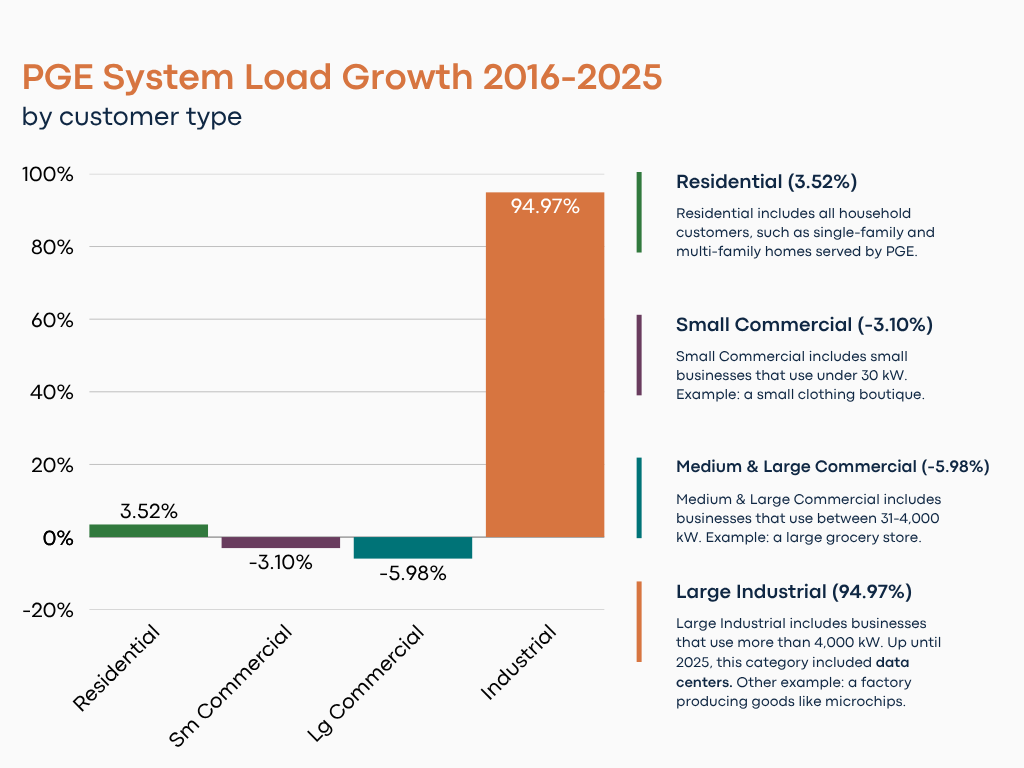
Only residential and data centers have shown load growth in the last 10 years, though the difference in contribution is staggering. Because these are the only two groups with growth, PGE is proposing that they divide up the bulk of the costs of load growth, with 34-45% of that cost on residential customers and the rest to data centers. But this is absurd. Residential load growth has been small and has been fully offset by investing in energy efficiency.
PGE Wants to Charge Oregonians for Data Center Growth
Let’s think about a hypothetical situation to break down what PGE is really proposing.
Imagine Google wants to open a new data center in Wilsonville. This is otherwise a relatively small community with relatively modest energy needs. To this point, PGE has made investments in power lines and equipment that fit the modest amount of energy needed, but hasn’t gone beyond what local communities and businesses need. This hypothetical data center coming online could very easily double the energy needs of Wilsonville.
To accommodate this hypothetical data center, PGE would have to make major investments to double the capacity of the local energy grid. Big local high-voltage power lines would have to be installed in order to deliver that much power to a single site. PGE would need to invest millions in grid upgrades just to provide electricity to one data center.
Let’s say this hypothetical data center added $100,000,000 in costs for PGE. Under PGE’s proposal, residential customers would be assigned $34,000,000 of the costs that only benefit one data center. Despite creating the need for the hundred-million-dollar project, data center customers would only be assigned $54,000,000,000 of this hypothetical project – the remainder would be assigned to other commercial and industrial customers.
Effectively, Oregonians are being asked to subsidize data centers and thus big tech companies — like Google — through our energy bills. This goes against everything legislators intended with the POWER Act.
Even When Data Centers Pay Full Price, PGE Lets Them Off Early
While there are some costs that PGE is proposing go entirely to data centers, that wouldn’t last for long.
Many utility investments are meant to last for 50 years. Customers slowly pay for those costs over those 50 years, along with paying for the profits utilities are allowed to make from investments. PGE is proposing that data centers only pay for the first three years of the 50-year costs, with customers picking up the next 47 years of investment costs.
This proposal would be akin to buying a house, paying your mortgage for three years, and then charging your next-door neighbors for a portion over the rest of your 30-year mortgage. With the POWER Act, legislators are asking data centers to be good neighbors, and PGE is undermining these efforts.
We Know Data Centers Have Already Added Huge Costs
We don’t just need to rely on hypothetical projects, though. Hillsboro is one of the top ten fastest-growing data center hot spots in the country. To manage this massive growth, PGE recently completed the Hillsboro Reliability Project in Washington County, which was primarily for serving data centers. The publicly available estimate of part of that project to serve data centers? $210 million in investments. The actual cost is hidden in confidential legal documents, but it is even higher.
Despite not creating the need for this spending, Oregon families should be responsible for $88 million (42%) of a project of this size, according to PGE.
This is just one real-world example of a massive project in Hillsboro. Data centers across the region have added a huge amount of energy demand to PGE’s system.
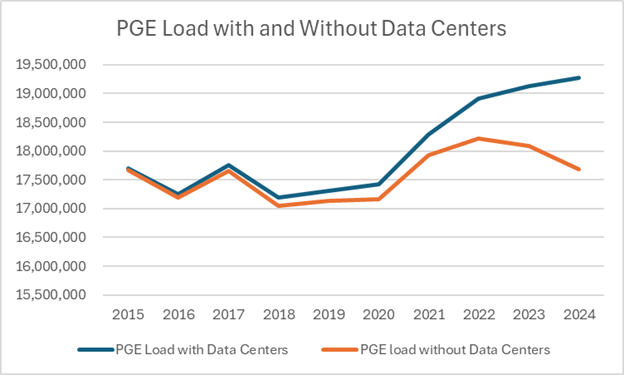
If you exclude Data Centers, PGE’s actual 2024 load was less than 1% higher than 2015. But when data centers are included, PGE’s load has increased by 9%. Without data centers, we would not be where we are today.
Why Is PGE Proposing Charging Oregon Families for Data Center Load Growth?
PGE is using twisted logic to justify maintaining the status quo of Oregon families subsidizing data centers. PGE wants residential customers to be the deep pockets that help fund adding very profitable businesses — data centers — to their energy system.
To justify charging household customers 34-45% of load growth, PGE is only looking at part of the picture. They argue that residential customers make up a portion of the growing demand for electricity and should pay for a significant portion of the added cost. Despite the fact that residential load has only grown by 3.5% of growing demand since 2016, PGE says residential customers should pay for 34-45% of investments in our electrical grid that are required by overall growth.
PGE is Not Looking at the Long-Term Benefits of Residential Customers
PGE’s limited scope allows it to ignore the outsized impact of data centers and continue to overcharge Oregon families. The utility has a financial incentive to attract very large energy users because they are profitable for the company. Residential customers are already paying more than their fair share.
CUB has found that residential customers are reducing demand for energy for all customers. What PGE fails to consider is that residential investment in energy efficiency actually reduces overall energy demand.
Think of it like this: you buy a brand-new home and invest in energy-efficient appliances, HVAC systems, and a heat pump. While connecting this home to the energy grid creates new energy demand, your energy efficiency investments actually reduce overall demand by making how you use energy in your home more efficient.
Household customers are the main ones paying for energy efficiency investments that lower energy demand across the state, especially for PGE’s system. And because of those investments, Oregon has achieved extraordinary results. Since 1992, PGE’s household energy use has decreased 21% while, in the rest of the country, residential energy use has increased by 34% in that same time period.
Oregon Families Already Pay More Than Our Fair Share
Household energy bills pay for more than just household energy efficiency projects, and we need to be compensated. Dollars from our home energy bills go to reducing energy use for commercial and industrial customers, too. PGE claims residential customers are responsible for 110 MW of peak load growth. CUB has found that residential customers have more than offset this load growth through energy efficiency programs that we fund. Households are actually responsible for -79 MW of peak load reduction. It’s not fair for Oregon families to be effectively double-charged.
These results are only possible because of residential customers. The biggest energy users, industrial customers, have a cap on how much utilities can charge them for energy efficiency. This makes PGE households the deep pocket that is funding more than 60% of energy efficiency investments — and this share is growing as more data centers come online.
The fact is, while there has been modest growth in the number of residential customers, energy efficiency investments paid by residential customers have more than offset that load growth. PGE ignores this fact so it can justify having residential customers subsidize big data centers.
You Can Take Action: Tell Regulators to Take Data Centers Off Our Bills
PGE is cherry-picking data, proposing more subsidies, and ignoring the law. And we need regulators to step up and protect our home energy bills from paying for data centers.
We need strong, forward-thinking regulations to hold utilities accountable for charging data centers for their own energy costs. While regulators are considering new paths forward, we must make our voices heard! Use the button above to submit your comments by December 1, 2025!
Stay Up to Date on Oregon Utility Issues
CUB will continue to advocate for people in Oregon on major utility issues. Sign up for the CUB email list for the latest updates, action alerts, and news on policies that affect the utilities your home relies on.
11/24/25 | 0 Comments | Is PGE Ignoring Oregon’s New Data Center Law?
Legislators Secure Utility Disconnection Moratoriums for Some Customers
Posted on November 19, 2025 by Cassie Allen
Tags, Energy, General Interest

After pressure from legislators, Oregon’s three largest state-regulated utilities agreed to a voluntary pause on disconnections for some customers through the rest of 2025.
Through December, PGE, Pacific Power, and NW Natural low-income customers who receive monthly bill discounts or anyone who has a medical certificate can no longer be disconnected from their utility service because of past due bills. Gas utilities, Avista and Cascade, along with Idaho Power, separately agreed to temporary protections related to the federal government shutdown.
This pause on disconnections for some households is a crucial step towards protecting vulnerable customers, but more needs to be done. CUB and other energy advocates are pushing to extend the temporary moratorium for all for-profit utility customers into 2026 and to finalize stronger, year-round disconnection protections.
No one should go without heating in the winter or have to choose between paying their energy bill and buying food or other necessities.
Advocacy in Action: Legislators Secure Moratorium for Some Customers
On November 7th, Senator Deb Patterson (D-Salem) and 17 of her fellow legislators delivered a signed letter to regulators urging action to prevent utility disconnections. PGE, Pacific Power, NW Natural, Cascade Natural Gas, Avista, and Idaho Power responded to the letter with their own voluntary actions to support some customers.
These important, but limited, protections come on the heels of the longest government shutdown in US history, which delayed the distribution of Supplemental Nutrition Assistance Program (SNAP) and Low-Income Home Energy Assistance Program (LIHEAP) funds. These public programs help keep low-income Oregonians fed and connected to power.
Thanks to the advocacy of legislators, these for-profit utilities committed to taking their own actions to support some households.
“We are also entering the cold weather season, when families need access to heating. Disconnecting households from their utilities during this time would compound Oregonians’ suffering and make it even more difficult for families to stay afloat.”
- Legislators’ Letter to the Oregon Public Utility Commission
Oregon’s three largest utilities adopted plans to keep some vulnerable households connected to power through the end of the year:
- Pacific Power and Portland General Electric (PGE) are halting shutoffs through the end of the year for customers who are enrolled in the utilities’ bill discount programs and customers with medical certificates. These protections end January 1, 2026.
- NW Natural is suspending shutoffs through the end of the year for customers who are enrolled in the utility’s bill discount program. These protections end January 1, 2026.
The remaining for-profit utilities in Oregon agreed to temporary protections related to the federal government shutdown:
- Cascade Natural Gasis suspending collections and disconnections for customers who report to Cascade that they have been affected by the federal government shutdown and for customers who are enrolled in its bill discount program. These protections will last until the end of December.
- Avista will provide a 30-day grace period for customers who notify Avista they are affected by the federal shutdown, which will prevent them from entering the collections process and potential shutoffs. This grace period begins when a customer notifies Avista that they have been impacted and lasts for 30 days. Avista may extend this to 60 days due to ongoing delays in receiving LIHEAP funds.
- Idaho Power implemented a limited pause on disconnections for customers affected by the government shutdown until the federal government reopened.
Beyond December: Stronger Shutoff Moratorium Needed This Winter
While the voluntary moratoriums and other protections are a good first step, more needs to be done. We need to ensure more Oregon households stay connected to power this winter.
CUB and other energy justice advocates are pushing regulators to expand the disconnection moratorium to include all for-profit utilities and all of their customers, not just those already enrolled in utility programs. We are also fighting to extend the shutoff pause and other protections until April 1, 2026, or 45 days after Oregon receives federal energy assistance funds (LIHEAP), whichever comes later. We requested the extended moratorium in multiple dockets at the Public Utility Commission.
Multnomah County Commissioners Add Pressure
The Multnomah County Commissioners have also recently joined CUB and energy justice advocates’ call for expanding protections. The Commissioners requested a temporary disconnection moratorium for all customers of all for-profit utilities through April 1, or 45 days after Oregon receives LIHEAP funding, whichever is later.
“We applaud the action that utilities have committed to in temporarily suspending service disconnections for certain qualified customers through the end of this year. And we strongly support proposals to extend these protections to more customers and through all of the coldest months of the year.”
- Multnomah County Commissioners
Communities Call for Permanent Disconnection Protections
For over a year now, CUB has been collaborating with regulators and energy justice advocates on finalizing stronger permanent rules for disconnection protections. These protections will be year-round, keeping more households connected to power. The updated, permanent rules are expected to take effect by the end of the year.
Organizations such as the Multnomah County Office of Sustainability, the Oregon Just Transition Alliance, Verde, Community Action Partnership of Oregon (CAPO), Community Energy Project, Self Enhancement Inc., and community action agencies in Klamath, Lake, Jackson, and Multnomah Counties have been instrumental in advocating for stronger protections.
You Can Take Action: Advocate for an Extended Moratorium
We’ll keep doing what we do best: advocating for stronger protections for Oregon customers. In the meantime, you can take action today by contacting the Public Utility Commission and urging regulators to expand the limited disconnection moratorium.
Make sure to say you want to see the protections include all utility customers, across all utilities, until April 1, 2026, or until all federal LIHEAP funds are distributed, whichever is later. You can use the button above to submit a public comment, email .(JavaScript must be enabled to view this email address), or call 503-378-6600 to make your voice heard today.
Stay Up to Date on Oregon Utility Issues
CUB will continue to advocate for people in Oregon on major utility issues. Sign up for the CUB email list for the latest updates, action alerts, and news on policies that affect the utilities your home relies on.
To keep up with CUB, follow us on Instagram, Facebook, Bluesky, and LinkedIn!
11/24/25 | 0 Comments | Legislators Secure Utility Disconnection Moratoriums for Some Customers
NW Natural Customers Avoid Big Rate Increase, Lose on Electrification
Posted on October 29, 2025 by Charlotte Shuff
Tags, Press Releases
FOR IMMEDIATE RELEASE October 30, 2025
NW Natural Customers Avoid Big Rate Increase, Lose on Electrification
Regulators approve a $4.28 per month gas bill increase after denying consumer advocates new policies that support bill savings from customers moving off the gas system.
Salem, OR — Starting October 31, NW Natural customers will see a small increase in their gas bills. Regulators approved two rate increases that will raise home gas bills by 5.5 percent on average, about $4.28 per month. This increase will be higher in the winter months as heaters use more gas. Consumer advocates helped reach agreements with the gas utility to lower the overall increase by about two-thirds, cutting nearly $38 million.
Last Friday, regulators at the Oregon Public Utility Commission approved NW Natural to collect more money from customers’ gas bills. This billing rate increase is primarily to replace aging equipment, fund seismic upgrades, and address inflation and rising methane costs, the primary fuel in natural gas.
Of all of the cuts, profits were the largest reduction in the rate increase. Advocates’ agreement with the utility to cut profit margins increased savings for customers by nearly $15 million a year. Consumer advocates included the Oregon Citizens’ Utility Board and Green Energy Institute, on behalf of Climate Solutions, Coalition of Communities of Color, Verde, Sierra Club, and Oregon Environmental Council.
“After years of back-to-back rate increases, NW Natural customers are seeing their first break,” said Bob Jenks, Executive Director of Oregon Citizens’ Utility Board. “Oregonians have had too many major increases in our gas and electric bills over the last five years. The outcry over unaffordable energy bills has been growing.”
Consumer advocates also asked regulators to approve new policies to address electrification, the switch from gas to electric appliances. Regulators rejected two proposals: one to remove from customers’ bills the profits NW Natural earned on gas infrastructure that is no longer in use due to household electrification, and one to allow funds from the Oregon Low Income Energy Efficiency Program to go to replace old or broken furnaces with high-efficiency heat pumps that provide heating and cooling.
“This result means NW Natural will go several more years without taking any meaningful actions to reduce its emissions in a cost-effective manner,” said Cole Souder, Staff Attorney, Green Energy Institute. ”With the federal government intent on increasing carbon emissions, we hoped Oregon would be proactive in directing NW Natural to support customers seeking to electrify, just as Commissions across the country have done. Customers deserve a utility and a Commission that keeps up with peers doing more to meet the moment.”
Oregon has seen community-led pushes to move away from natural gas (methane) increasingly over the last few years. There has been a rise in local chapters of Electrify Oregon across the state. In 2023, the City of Eugene passed an ordinance banning new gas hookups for low-rise residential buildings. Although this was reversed after a federal court ruling, there was strong public support for the ordinance.
The Commission also rejected a proposal to require NW Natural to begin studying targeted voluntary electrification, a process where customers in certain areas are given a special financial incentive to electrify their gas appliances, despite approving a similar proposal for Avista earlier this year. In other states like Washington, Colorado, and Vermont, targeted electrification has been shown to reduce emissions, lower overall energy use, and save customers money.
Earlier this year, NW Natural asked for a $59.3 million (7 percent) increase in billing rates for its household gas customers. The gas utility filed this request with regulators just two months after receiving a rate increase on November 1, 2024. With the passage of the FAIR Energy Act (HB 3179), NW Natural will not be able to come back for another rate increase request for 18 months, with an additional 10 months before any such request could show up on customer bills.
###
MEDIA CONTACT:
Charlotte Shuff
Oregon Citizens’ Utility Board
503.719.8744 | .(JavaScript must be enabled to view this email address)
Juan M. Muñoz Jimenez
Climate Solutions
937.219.5565 | .(JavaScript must be enabled to view this email address)
10/30/25 | 0 Comments | NW Natural Customers Avoid Big Rate Increase, Lose on Electrification
Small NW Natural Bill Increase Starts October 31
Posted on October 29, 2025 by Charlotte Shuff
Tags, Energy
Starting October 31, NW Natural customers will see a small increase in their gas bills. Regulators approved two rate increases that will raise home gas bills by 5.5% on average, about $4.28 per month. This increase will be higher in the winter months as heaters use more gas.
Earlier this year, NW Natural asked for a 7% increase in billing rates for its household gas customers. The gas utility filed this request with regulators just two months after receiving a rate increase on November 1, 2024. CUB helped reach agreements with the gas utility to lower this increase by about two-thirds, cutting nearly $38 million.
Why Are NW Natural Billing Rates Increasing?
Regulators approved NW Natural to collect more money, primarily for replacing aging equipment, seismic upgrades, and rising costs from inflation.
Major cost drivers include:
- Inflation: Rising costs for equipment, staffing, etc.
- Infrastructure: Replacing equipment at the Mist gas storage facility and the North Coast Feeder pipeline.
- System Upgrades: Seismic upgrades for resource centers and modernizing IT systems
This increase also included changes in the cost of methane, the fuel used by gas companies. Gas costs are almost entirely passed on to customers by utilities based on the cost of fuel. The cost of methane has increased from last year, accounting for about half of the total billing rate increase this year.
CUB Helped Cut $38 Million from NW Natural Bill Increases
NW Natural initially asked for $59.3 million from customers. CUB, Green Energy Institute, regulators, and other parties in the case were able to negotiate that amount down to a $21.3 million increase.
What CUB Helped Cut:
- Profit margin increases
- Membership dues (e.g., American Gas Association)
- Overprojected wages/salaries
Of all of these cuts, profits were the largest reduction in the rate increase. Originally, NW Natural asked to increase its allowable profit margin from 9.4% to 10.4%. CUB and other advocates negotiated an increase to just 9.5%, in line with other gas utilities in Oregon. This cut alone saved customers nearly $15 million a year.
CUB also helped cut millions of dollars in profits that NW Natural wanted to make from the Mist compressor replacement project. In our investigation, we found that NW Natural was trying to continue profiting from equipment from the Mist Underground Natural Gas Storage Facility in Columbia County that was no longer being used.
NW Natural originally projected that this project would have a 50-year lifespan, but retired it after just 25 years. While it’s normal for customers to continue paying off the cost of the equipment if it’s retired early, it’s against state policy for a utility to earn a profit from something that is not actually in use. Replacements for safety and to save money are in the customers’ best interest, but added profits for unused equipment are not.
Regulators Shy Away From Addressing Electrification
As Oregon’s gas utilities have to grapple with reducing emissions 90% by 2050, electrification has been on many people’s minds. Replacing gas furnaces, stoves, and water heaters with all-electric appliances is an easy way to reduce how much gas we’re using in our buildings. While issues of electrification were raised in this case by CUB and Green Energy Institute, regulators at the Oregon Public Utility Commission shied away from making any changes in policy.
Customer Will Still Pay for Retired Equipment After Electrification
When a home or business goes all electric, it leaves behind pipes, meters, and other equipment tying it to the gas system. This infrastructure gets slowly paid off by everyone for decades, often over 50 years, with added costs for utility profit.
This year, CUB proposed that just the profit from any equipment left behind by electrification be taken off of customers’ bills if it is no longer in use. We found it reasonable to pay for the remaining infrastructure costs, but the utility shouldn’t make money off of equipment that is no longer used.
Unfortunately, regulators ruled against CUB’s proposal to cut out profits from unused gas infrastructure after a customer goes all-electric. Regulators said that there is not enough data showing that customers are leaving the gas system. The problem is that NW Natural also refuses to collect data about electrification.
We know that there are many Oregonians who have gone all-electric. Without utility-collected data, we may never be able to proactively address the issue of cost. When a customer chooses to leave the gas system, they are no longer the ones paying for the pipes and other things that connected them to the gas system. Instead, the utility passes those stranded costs on to customers who remain on the system. We could be left with low-income customers, renters, and anyone who cannot voluntarily leave gas with increasingly high bills for equipment that does not benefit anyone.
Funds for Low-Income Customers Cannot Be Used for Heat Pumps
A main issue raised by Green Energy Institute was how low-income assistance funds can be used when an old furnace breaks. Currently, funds are available through OLIEE (Oregon Low Income Energy Efficiency Program) for qualified households to replace broken or inefficient furnaces. These funds are vital to help reduce gas bills and provide heat for those with the fewest resources.
For a program with “energy efficiency” in the name, it would make sense for customers to be able to access the most energy-efficient form of home heating — heat pumps. But because these heaters do not use gas, OLIEE funds cannot be used for replacing an old gas furnace with a heat pump.
This year, Green Energy Institute asked regulators to allow these OLIEE funds to be used for heat pumps. Regulators declined and recommended that this issue be brought back in a different case. This is not the first, or even second, time that the Commission has punted this issue.
CUB Supporters Helped Make These Wins Possible
While we are disappointed in the outcomes on electrification, cutting NW Natural’s request by roughly two-thirds is still a big win for customers. Thank you to all of the community members and organizations who spoke out against NW Natural’s request! Your support helped move the needle on avoiding another large rate increase in 2025.
Stay Up to Date on Oregon Utility Issues
CUB will continue to advocate for people in Oregon on major utility issues. Sign up for the CUB email list for the latest updates, action alerts, and news on policies that affect the utilities your home relies on.
To keep up with CUB, follow us on Instagram, Facebook, Bluesky, and LinkedIn!
12/01/25 | 1 Comment | Small NW Natural Bill Increase Starts October 31
Regulators Grapple with PGE’s Lackluster Proposal to Address Data Centers
Posted on October 28, 2025 by Charlotte Shuff
Tags, Energy
This year, CUB has been hard at work tackling a big source of rising energy costs for many Oregonians: data centers. In June, we helped pass the POWER Act (HB 3546), a bill designed to hold data centers accountable for their own energy costs. Now that we’ve passed this new law, the work is just beginning.
This fall, regulators are considering a new framework for how PGE divides up costs for all of its different customer groups — including the new data center customer category. This case will become the template for how data center customers are charged for energy costs for all of Oregon’s for-profit utilities.
We need to make sure regulators get it right the first time and eliminate any new data center costs from going onto the energy bills of our homes and small businesses. CUB does not think that PGE’s proposal goes far enough to protect Oregon households from data centers’ energy costs.
Want even more information about this case? Check out Docket UM 2377 at the Oregon Public Utility Commission!
Data Centers: The Newest, Largest Energy Users
Data centers use a massive amount of electricity — an entire city’s worth! A single 30 MW data center uses more electricity than the City of Ashland. Larger, 250 MW data centers, associated with AI, require a similar amount of energy to the City of Eugene.
And these city-sized energy users are coming to Oregon in droves. Since 2016, PGE has seen more than a 95% growth in energy demand from industrial customers, where data centers were classified before the POWER Act. Meanwhile, PGE’s residential customers’ energy demand has only increased 3.5% since 2016.
We have never seen a single type of energy customer grow at a rate that outpaces all others.
Big Growth Means Expensive Utility Investments
When there are massive increases in energy usage, utilities have to build the infrastructure to safely and reliably provide electricity to everyone. From new substations, battery storage projects, and more, data centers require a lot of upgrades to our energy systems.
For example, in the last few years, it has cost $210 million just to build out local transmission in Washington County to serve new large loads in PGE territory. This infrastructure does not necessarily benefit other customers. It was only built to serve data centers’ high energy needs.
Regulators Are Creating the New Template for Charging Data Centers
When a new law, like the POWER Act, is passed, that is just the first step in making that law a reality. After our legislators pass laws, they turn to government agencies to roll out the new policies. With this law, the Oregon Public Utility Commission is the state agency that oversees regulating all of our for-profit electric (and gas) utilities.
What’s in the POWER Act?
The POWER Act (HB 3546) holds large energy users accountable for paying for their own energy needs:
- Requires state regulators to create new policies to help protect Oregon households from paying for the energy needs of data centers, cryptocurrency, and other big tech.
- Makes for-profit utilities identify the costs that these large energy users are adding to the system—and make businesses like data centers pay their share.
- Creates a special customer category for data centers, so regulators can protect Oregonians from covering the cost of these businesses.
Implementing the POWER Act
The process of implementing the POWER Act at the Oregon Public Utility Commission is not going to happen all at once. Each for-profit electric utility will have its own investigations into separating industrial large load customers (data centers). Because PGE is the first utility to address rolling out new policies for data centers since the passage of the POWER Act, this case will serve as a template for all of the following cases.
We need to make sure regulators get it right the first time. We need a strong foundation in place to guard our home energy bills against data centers’ energy costs across the state.
The Template: PGE’s Large Load Investigation (UM 2377)
This fall, regulators are reviewing PGE’s plan to create a new customer category for data centers, as well as how costs are going to be shared across all customer categories. Anytime a new cost is added for a utility, there needs to be a method for dividing that whole pie into different-sized slices that each customer type pays for. The main customer types now include: large load industrial (data centers), industrial, small commercial, and residential.
With the addition of the data center customer category, these businesses are being moved out of the industrial category. Now, PGE is trying to increase data center rates by about 18% or roughly $23 million. CUB is concerned that PGE is not going far enough in assigning costs to data centers, at the expense of Oregon families.
Note: The process this year with PGE will not immediately change what shows up on customers’ bills, however. Moving costs to data centers’ bills (and off of other customers’ bills) will happen after an order from the Commission, not automatically in this case. Without an order, new billing rates will likely be filed in Summer 2026, with new rates starting Spring 2027.
Oregon Households Need More Compensation for Years of Subsidizing Data Centers
CUB believes that PGE is doing about as little as possible to make data centers pay for their costs. While the utility’s proposal increases data center billing rates by about 18%, it does little to lower residential customers’ billing rates. Although there has been recognition that Oregon families have been subsidizing data centers for years, under PGE’s proposal, not much will change. We will not see a meaningful decrease in our power bills if PGE’s proposal is accepted.
CUB is arguing three key points:
- PGE is limiting how much data centers are charged, even for costs that are only necessary because of these big businesses.
- Household customers are spending more on energy efficiency than they receive benefits for, effectively subsidizing all other PGE customers for system-wide benefits.
- Household customers are more responsible for local energy grids (distribution systems that provide energy services to all customers) than other customers, including for costs that benefit data centers.
Data Centers Could Avoid Paying for Their Own Energy Costs
When we passed the POWER Act, the main idea was that if data centers are adding costs to our energy systems, they should pay for it. But PGE’s proposal is woefully insufficient in meeting that goal.
Many utility investments are meant to last for 50 years. Customers slowly pay for those costs over those 50 years, along with paying for the profits utilities are allowed to make from investments. PGE is proposing that data centers would only have to pay for the first three years of any investment out of the 50 years of costs.
To go back to an example from earlier, PGE spent $210 million for transmission in Washington County to meet data centers’ high energy needs. If they have to make another similarly sized investment, data centers will only shoulder the costs for the first three years. Beyond that, the next 47 years of costs will be shared across all customer groups.
There is no reason why residential customers should have to share costs that data centers have caused for 47 years. These are costs that will last a generation. Under PGE’s proposal, a high schooler just learning to drive could still be paying for current data centers’ energy costs when she retires.
Under PGE’s proposal, a high schooler just learning to drive could still be paying for current data centers’ energy costs when she retires.
PGE Households Overspend on Energy Efficiency
Generally speaking, energy efficiency is anything that reduces how much electricity customers use. In a home, this could mean replacing old windows or upgrading to higher-performing appliances like heat pumps. But these investments also happen at the business or industrial level, as well as upgrades to the whole energy system.
But household customers are the main ones paying for energy efficiency costs, especially for PGE’s system.
Oregon has achieved extraordinary results from energy efficiency investments. Since 1992, PGE’s residential energy use has fallen 21% while, in the rest of the country, residential energy use has increased by 34% in that same time period.
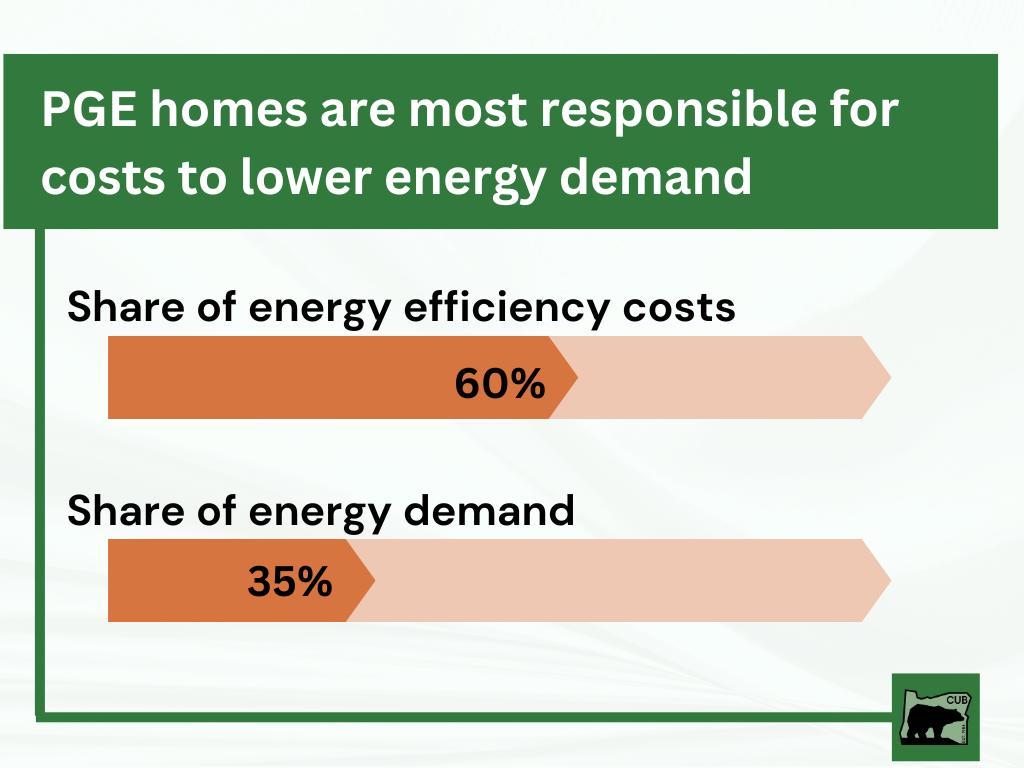
PGE households are not just paying for energy efficiency for Oregon families, but also for data centers. Residential customers are paying nearly $80 million per year for energy efficiency investments, despite being only 35% of PGE’s system.
There is a cap on how much data centers can be charged, despite these businesses adding the most demand for energy. This makes PGE households the deep pocket that is funding more than 60% of energy efficiency investments — and this share is growing as more data centers come online.
CUB is pushing for regulators to compensate residential customers for overspending on energy efficiency that benefits all customers. By reducing home billing rates in other places, we will be able to remove more of the subsidies we are paying to benefit data centers.
We are also proposing new credits for when data centers voluntarily invest in energy efficiency. Imagine if big tech companies helped with new appliances and insulation for low-income rentals!
PGE Households Largely Fund the Local Energy Grid
Household customers are the ones most responsible for the costs of our local energy grids, called our distribution system. These distribution investments include costs such as: equipment like the meters on our homes, the wooden poles we see on our streets, and substations close to our homes and businesses.
When you think about your neighborhood, most of the buildings around you are likely places where people live. Each of those homes is one customer of a utility. And we’re all the ones who need the most equipment to get electricity from that local system, such as a meter and connection cable to the nearby overhead power line. Businesses, schools, and other buildings need this equipment, too, but there are fewer of them on our blocks.
So it follows that the group of customers who have the most need pays for most of the infrastructure costs! But with the advent of two-way technologies, like with grid modernization, now it’s less clear that residential customers should continue paying as big a share as we have been for distribution costs. This infrastructure now carries rooftop solar and home batteries back to the grid, where it supports all customers, not just residential customers.
Read More: More Nickle-and-Diming? PGE Wants $72.3 Million for Grid Investments (CUB Blog)
Data centers also rely on local energy systems to receive the electricity they need to do business.
Get Involved: Tell Regulators to Protect Oregonians from Data Centers
We need strong, forward-thinking regulations to hold utilities accountable for charging data centers for their own energy costs. While regulators are considering new paths forward, we must make our voices heard!
CUB’s Community Organizer is also available to help you take the next step. Contact David Beltran Barajas at .(JavaScript must be enabled to view this email address)david@oregoncub.org to set up a meeting today!
Stay Up to Date on Oregon Utility Issues
CUB will continue to advocate for people in Oregon on major utility issues. Sign up for the CUB email list for the latest updates, action alerts, and news on policies that affect the utilities your home relies on.
To keep up with CUB, follow us on Instagram, Facebook, Bluesky, and LinkedIn!
10/29/25 | 0 Comments | Regulators Grapple with PGE’s Lackluster Proposal to Address Data Centers
More Nickle-and-Diming? PGE Wants $72.3 Million for Grid Investments
Posted on October 21, 2025 by Charlotte Shuff
Tags, Energy

This year, Portland General Electric (PGE) is passing on asking for big adjustments to customers’ bills. While this is good news after multiple years of big rate increase requests, CUB is on the lookout for utilities nickel-and-diming customers. One case we’re looking closely at is a request from PGE to pass distribution system costs onto customers starting next spring.
PGE is requesting a 2.8% increase from household customers this year, about $4.50 a month for an average customer. This amount would be higher for winter bills as energy use naturally spikes. This is one of many smaller amounts PGE has asked the Oregon Public Utility Commission to put into customers’ bills this year. And the scope of the request raises a lot of questions.
Want to go even deeper into this issue? Check out docket UE 459 at the Oregon Public Utility Commission!
What is the Distribution System?
This case is related to distribution investments: equipment like the meters on our homes, the wooden poles we see on our streets, and substations close to our homes and businesses. Added up, PGE is asking for $72.3 million, mainly from residential customers.
Read More: Oregon’s Power Grid 101 (CUB Blog)
Electricity Delivered in Our Neighborhoods
The electricity grid comprises three main parts that work together to generate and transport electricity from a power plant to your home or office. Those parts are electricity generation, transmission, and distribution.
Generation is where electricity is created, like a power plant or a wind farm. Transmission is how that electricity is moved from faraway places (sometimes other states!) into the places we live and work at very high voltages. Distribution starts at substations where the electricity is moved to a lower voltage and delivered through neighborhoods and into homes and businesses!
What’s generally included in distribution system costs:
- Substations
- Utility poles
- Overhead cables
- Transformers
- Meters
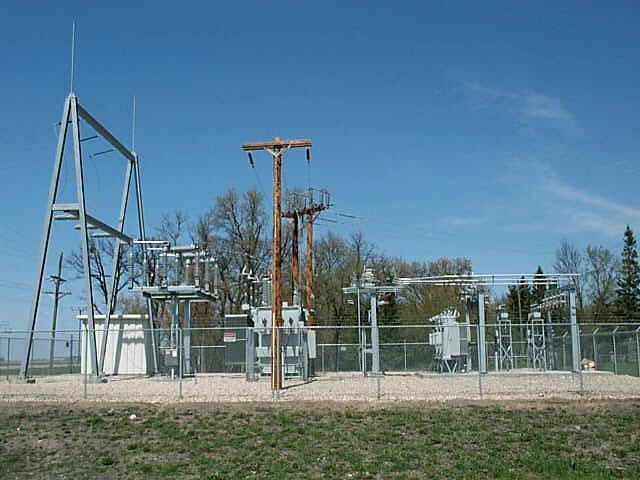
Substation in a neighborhood
By Wtshymanski at English Wikipedia - Transferred from en.wikipedia to Commons by Drilnoth using CommonsHelper., Public Domain, https://commons.wikimedia.org/w/index.php?curid=6405246
Modern Grids Require Modern Solutions: New Costs Go Beyond Distribution
PGE has been very focused on “grid modernization” over the past few years. These new technologies have changed how we manage the electricity on our grid, often for the better. Now, we have smart technology like meters, electric vehicle charging, thermostats, and more that allow utilities to lower customer usage remotely when there are big demands for energy.
For customers who opt into these programs, on a really hot or really cold day when energy demand is very high, utilities can remotely adjust thermostats by a few degrees to help manage overall demand. When customers have rooftop solar, they are sending electricity back into the grid. These are very important tools for saving energy — and costs — for all customers.
But these technologies also change how we think about distribution. In the past, distribution systems only went one way: delivering electricity to customers. Now, the investments we are making are benefiting the whole system and are not as clearly defined as just “distribution” investments. For example, when a residential customer’s solar panel, EV, and/or battery sends electricity back to the grid, this is less about distributing electricity. It is the generation of new electricity, not dissimilar from a large power plant or a large wind farm, just on a smaller scale.
The problem is that the customers who benefit the most from opting into programs with smart technologies are typically well-off homeowners, leaving lower-income customers and renters behind in the benefits.
Household Customers Take on Distribution Costs
Generally speaking, residential customers are given most of the costs of the distribution system relative to other customer groups, like commercial or industrial. And this has made sense for a long time.
When you think about your neighborhood, most of the buildings around you are likely places where people live. Each of those homes is one customer of a utility. And we’re all the ones who need the most equipment to get electricity from that local system, such as a meter and connection cable to the nearby overhead power line. Businesses, schools, and other buildings need this equipment, too, but there are fewer of them on our blocks.
So it follows that the group of customers who have the most need pays for most of the infrastructure costs! But with the advent of two-way technologies, like with grid modernization, it’s less clear that residential customers should continue paying as big a share as we have been for distribution costs.
Distribution Costs are a Big Chunk of Your Power Bill
When you look at your PGE bill, you can see that a big portion is going directly to distribution costs.
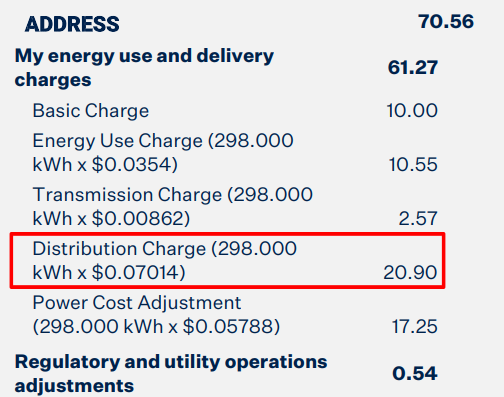
But because the costs of a few power lines and transformers here and there are relatively small, these costs get a lot less attention. If we’re concerned about making energy bills more affordable, distribution costs are a good place to focus to make an impact for Oregon families. It’s such a big portion of our monthly bills!
But PGE doesn’t want us to focus on these costs. In fact, the way the utility is asking to add to your bills is making it incredibly difficult for us to even write this blog to tell you about what PGE is proposing.
$72.3 million… But You Can’t Know What For
Here’s what we can say for certain:
- PGE is asking for $72.3 million from customers
- Household customers are likely to pay the majority of that amount
- Before filing this case, PGE agreed to keep it to just distribution costs
But almost everything beyond those statements is hidden behind red tape and confidentiality agreements. To even submit formal testimony in the legal case investigating PGE’s request, you would need to lawyer up and sign confidentiality agreements. One of the reasons CUB exists in the first place is to be the customer advocates with those lawyers. But our legal team and analysts can’t be the only ones in the know!
We need more transparency in this process so customers like you know what you’re paying for.
Are All of These Costs Even for Distribution Investments?
CUB can’t say. Not because our analysts don’t have enough information. But because our legal team told us we couldn’t include that information in this blog, due to PGE labeling much of this case as confidential.
And that’s a problem.
What we can say is that we have some serious questions about whether PGE is expanding the scope of this request to include costs that are outside the scope of what they agreed to. The public can see the big buckets of spending like “grid modernization,” “transportation electrification integration,” and “virtual power plant.” And within those, there are categories such as “compliance” and “action plan,” but actual projects and their costs are not public information.
If Oregonians are footing the bill, we deserve more transparency.
Is PGE Asking to Charge Customers for Necessary Investments?
Once again. CUB can’t say. This time, not because of confidentiality. But because regulators haven’t yet finished reviewing PGE’s plan for what customers need from the distribution system. This is being decided in a separate case (UM 2362) before the Oregon Public Utility Commission, which hasn’t even ended.
With grid modernization, we need to make sure that the new technology we are investing in is actually necessary, not just “gold plating” the system with high-tech solutions that are more expensive. We also need to make sure that these costs are spread fairly, so residential customers aren’t footing too much of the bill for investments that benefit everyone. Big businesses that use a lot of electricity, like data centers, are often the ones benefiting the most from these investments without paying their fair share.
In fact, the Commission won’t even decide on if PGE’s plan for its distribution system is adequate until the end of October. This case is also riddled with red tape and confidential information. PGE filed its ask to pass these $72.3 million costs onto customers in July.
Regulators must ensure that we’re only paying for what is fair and necessary.
We Need Your Help to Push Our Regulators to Hold PGE Accountable
Regulators need to know that customers won’t stand for decisions being made in the shadows. We’re asking you to join CUB in calling for more transparency in what is going into our power bills. We’re asking you to speak out on reigning in unnecessary and sneaky costs. And we’re asking you to push our regulators to hold PGE accountable for smart, affordable, and necessary investments.
We only have a few weeks left until this case becomes even more secretive. The next phase of the case will be done almost entirely through attorneys, with even less on the public record. While public comments will still be open through early next year, now is the time to make your voice heard! Submit your comments by October 31 for the biggest impact.
10/21/25 | 1 Comment | More Nickle-and-Diming? PGE Wants $72.3 Million for Grid Investments
CUB Welcomes New Staff, Emily Dougan
Posted on October 13, 2025 by Cassie Allen
Tags, General Interest
CUB is excited to welcome a new addition to our team this year, Emily Dougan (she/her). Emily joins CUB as Utility Analyst, bringing experience working both in Oregon and across the U.S. on water and electricity infrastructure projects
Join us in welcoming our Emily to the CUB team!
Emily Dougan, Utility Analyst
Emily holds a B.A. in Earth and Environmental Science from Willamette University and an M.Sc. in Urban Environmental Management from Wageningen University in the Netherlands. She is excited to bring her passion for advancing resilient, equitable energy systems to CUB.
“Having worked in utility planning and regulation previously, in both equity and infrastructure improvement capacities, I am excited to bring that experience to CUB and advocate for an energy system that works for all Oregonians.” - Emily Dougan, CUB’s Utility Analyst
When not working, you can find Emily learning new languages, volunteering for local campaigns and initiatives in her home base of Central Oregon, or adventuring with her dog.
Welcome to the team, Emily!
Stay Up to Date on Oregon Utility Issues
CUB will continue to advocate for people in Oregon on major utility issues. Sign up for the CUB email list for the latest updates, action alerts, and news on policies that affect the utilities your home relies on.
To keep up with CUB, follow us on Instagram, Facebook, Bluesky, and LinkedIn!
10/14/25 | 0 Comments | CUB Welcomes New Staff, Emily Dougan
That’s a Wrap: CUB’s 2025 Conference
Posted on October 9, 2025 by Cassie Allen
Tags, Energy, Conference & Events, General Interest

On October 3rd, CUB’s 15th annual policy conference, Changing for a Changing Climate, was held at the Sentinel Hotel in Portland, Oregon. Over 200 attendees gathered from across the Pacific Northwest to engage in a day of networking, panel discussions, and community building.
We were thrilled by the enthusiasm and engagement at this year’s conference—special thanks to CUB staff for putting together yet another incredible event!
Conference Highlights
Attendees at this year’s conference loved the excellent programming and speakers, engaging panel content, and diversity of perspectives. One attendee told us they appreciated the presence of several female leaders and the focus on equity, including those who have not previously been represented in energy conversations. Other conference attendees spoke about how the high-quality panel topics and exposure to new energy issues gave them a broader perspective on the work being done in the energy industry.
One of the biggest “complaints” we received about the conference:
“It was hard to choose what to go to, which speaks to the CUB staff’s diligence in finding topics that are interesting and timely.”
We also heard from many people who enjoyed the networking opportunities at the conference. Whether you work for a utility company, government agency, or nonprofit, or attend as a community member, the CUB conference is the place for you to connect!
Recordings of our panels will be made available to attendees in the near future. For folks who couldn’t attend the conference, stay tuned for an opportunity to purchase a digital-only conference package!
Thank you to everyone who attended our 15th annual conference!

CUB’s Keynote Speaker: Fireside Chat with Janine Benner & Letha Tawney
This year, CUB was overjoyed to welcome Janine Benner, Director of the Oregon Department of Energy, and Letha Tawney, Chair of the Oregon Public Utility Commission, as our keynote speakers. These industry leaders sat down for a fireside chat with Bob Jenks, CUB’s Executive Director.
Both speakers described the challenges and opportunities present in meeting Oregon’s ambitious climate goals. Letha recognized that hard decisions would need to be made in the coming years, but was hopeful that emerging opportunities, like energy markets in California, would move Oregon forward toward meeting climate mandates.
Janine spoke about how the ample resources present in Oregon, including the people power in the room, will help Oregon reach its climate goals. These industry leaders presented a refreshingly optimistic vision for Oregon’s energy future.
Thank you to Janine and Letha for providing a thoughtful and hopeful conversation on Oregon’s energy future!
Thank You to Our Sponsors
CUB is grateful to our generous sponsors for making the CUB Policy Conference possible. Their sponsorship enables CUB to bring together a wealth of industry knowledge for an incredible day of discussion, networking, and sharing diverse perspectives. Thank you to our 2025 sponsors!
2025 CUB Conference Sponsors
Portland General Electric
Pacific Power
Energy Trust of Oregon
Electrify Now
CLEAResult
Oregon Department of Energy
Department of Energy Quality
Northwest & Intermountain Power Producers Coalition
Davison Van Cleve PC
NW Power and Conservation Council
Climate Solutions
Energy 350
Stay Up to Date on Oregon Utility Issues
CUB will continue to advocate for people in Oregon on major utility issues. Sign up for the CUB email list for the latest updates, action alerts, and news on policies that affect the utilities your home relies on.
To keep up with CUB, follow us on Instagram, Facebook, Bluesky, and LinkedIn!
10/09/25 | 0 Comments | That’s a Wrap: CUB’s 2025 Conference
One Week Until CUB’s 2025 Conference
Posted on September 26, 2025 by Cassie Allen
Tags, General Interest

We’re only one week away from the 2025 CUB Energy Policy Conference—will you be there? Join us in Portland on October 3rd for the premier energy policy conference in the Pacific Northwest!
RSVP to Changing for a Changing Climate today!
In uncertain times, collaboration is crucial. We’ve built CUB’s Policy Conference to bring together people from across the energy industry, including community leaders, regulators, utilities, and more!
Together, we’ll explore innovative policy solutions to meet Oregon’s 2030 climate goals and more. Don’t miss out on a packed day of:
- Timely policy panels tackling Oregon’s clean energy transition
- Insights from experts and community leaders
- Networking with hundreds of energy industry professionals
- Diverse voices of Oregon’s frontline communities
We’re nearly sold out of tickets! Register today to attend CUB’s 2025 Energy Policy Conference!
2025 Conference: Changing for a Changing Climate
The 2020s have brought a lot of change to Oregon’s energy landscape. From customer affordability to growing energy demands, the challenges we faced at the start of the decade are much different than today. Oregon is now five years out from meeting its 2030 climate goals for both electric and gas utilities. As we work toward a cleaner energy system, we must reflect on the progress we’ve already made and face the mounting challenges of the next half-decade.
15th Annual CUB Energy Policy Conference

Friday, October 3, 2025
9:00 am - 5:00 pm
Sentinel Hotel
614 SW 11th Ave, Portland, OR 97205
Conference Agenda
8:30 am - Check In & Light Breakfast
9:00 am - Opening Speech
9:15 am - Featured Panel
2021: Back to the Future
10:45 am - Morning Breakout Sessions
Panel 1A: Hungry Hungry Hyperscalers
Panel 1B: Unplugged from Washington, D.C.
1:00 pm - Keynote
Fireside Chat with Janine Benner & Letha Tawney
12:00 pm - Lunch with Vegan and Gluten-Free Options
2:00 pm - Afternoon Breakout Sessions
Panel 2A: Disconnected: Our Fourth Largest City
Panel 2B: Powering Careers: Workforce Development for a Clean Energy Transition
3:30 pm - Consumer Champion Award Ceremony
4:00 pm - Networking Happy Hour
Learn more about each panel at the 2025 conference website!
About the Conference
The CUB Energy Policy Conference is designed as a day of discussion, networking, and sharing diverse perspectives. This conference is ideal for community groups, regulators, advocates, utility representatives, attorneys, or those interested in our region’s energy industry.
Stay Up to Date on Oregon Utility Issues
CUB will continue to advocate for people in Oregon on major utility issues. Sign up for the CUB email list for the latest updates, action alerts, and news on policies that affect the utilities your home relies on.
To keep up with CUB, follow us on Instagram, Facebook, Bluesky, and LinkedIn!
09/26/25 | 0 Comments | One Week Until CUB’s 2025 Conference
01/23/26 | 1 Comment | CUB’s 2026 Priorities