
Q&A with an Electric Vehicle Owner
Posted on May 21, 2012 by Emmaline Pohnl
Tags, Consumers and Utility Customers, Emerging Technologies
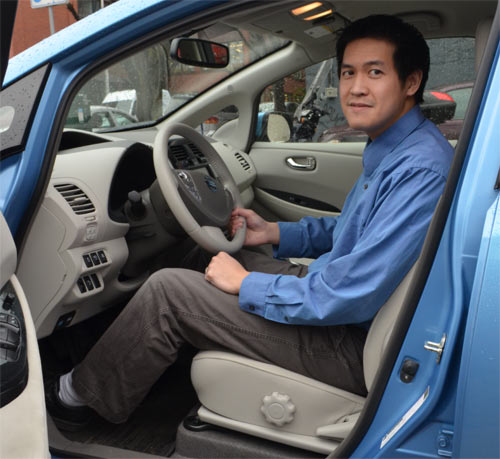
Theodore Chan and his wife, Wendy, are a typical Oregon family, with two children, aged 2 and 5. Theodore works for a tech firm on the outskirts of western Portland and Wendy is a homemaker. What isn’t so typical about the Chans is that they are owners of an all-electric vehicle, the Nissan L.E.A.F. (aka Low-Emission Affordable Family vehicle), and have been driving almost entirely gas-free for the past five months.
Although the Chan’s own a conventional gasoline mini-van, they use the LEAF as their primary mode of transportation. Since they began leasing it on November 15, 2011, the Chan’s have traveled over 5,000 all-electric miles in their LEAF. Theodore, who uses the car daily to drive to and from his work—a 30 mile round trip—agreed to answer some questions about his experience as a full-time user of an electric vehicle.
Why did you decide to purchase an electric vehicle and, specifically, a Nissan LEAF?
I wasn’t thinking about getting a LEAF originally. Actually, I watched a presentation online from Carlos Ghosn, the CEO of Nissan, and what he said piqued my interest in the vehicle. He talked about Nissan’s vision for electric vehicles and focused on the technological aspects of the LEAF. My background is technology and web development and programming, so that really caught my attention. Also, I think it’s exciting that Nissan is giving the first big push of the mass-produced electric vehicle. Previously, I thought electrical vehicles were interesting; however, to me they seemed mostly for the wealthy or hobbyists because of concerns about maintenance and upkeep. With a major car producer like Nissan behind the LEAF, I know that they will stand behind their product. Carlos Ghosn is essentially betting the company on electrical vehicles, putting a lot of energy and resources into their development. I believe he is a true visionary.
What resources have you used or what support have you received as a new vehicle owner?
This is actually my first Nissan vehicle and I am pleased with the quality of the vehicle and the customer support they offer. Nissan hosts a website which lets you create an account to track your vehicle usage and plan trips. The internet in general is a great resource; there are dozens of websites and organizations with information on electric vehicle technology.
The individual dealerships on the ground also are very helpful. For example, last week the dealership I bought my LEAF from hosted a workshop for LEAF owners. I attended the event, which provided us owners a chance to talk with the sales representatives and fellow owners about our experiences owning and using the LEAF. It was also was a great opportunity to share tips with one another!
How have colleagues at work or your friends reacted to your purchase?
One of my colleagues was very skeptical about my decision; he pestered me about it a lot. He’s really into exotic cars, like Porsches and Jeeps, and has driven many sports cars like the Acura NSX, Nissan GT-R, Porsche Boxster, Porsche Carrerra. I think he looked down on the different drive-train technology. I invited him to drive my LEAF, once I bought it, and he agreed to try it out. Well, after driving it, he admitted it was pretty fun to drive, so I wonder if I’ve converted him to being an electric vehicle fan. I should talk to him about getting a Tesla, which is an all-electric sports car!
One concern people sometimes have about electric vehicles is the battery technology that stores the energy to power the car. What have you learned about the batteries and how is Nissan addressing this concern?
I think it’s accurate to say that people are unsure of how long batteries will be able to operate at full capacity. There is some variability depending on usage. If you look at how people use their cell phones, laptops, and tablets, their batteries may last a long time, but a lot depends on how they use it. Five or six years after buying a laptop, the battery might not last the same number of hours as when they first got it. Similarly, everyone acknowledges that an electric battery’s capacity decreases over time, as the chemicals that store the energy “wear out”, but no one is 100% sure about how electric vehicle batteries will degrade. However, the batteries are improving and they have more “smart” batteries now. Most automobile manufacturers making electric vehicles have an eight year warranty on their battery and provide a free battery diagnostics for the first few years. You won’t have to go in to get an oil change—just an easy battery check! I saw a sample report; it tells you how you batteries are doing and tips on how to charge or drive more effectively in order to maximize the life of the battery. I’m sure Nissan did a good job of testing and development to build good batteries.
What do you like best about your electric vehicle?
That’s hard to say; I think it’s a great car in a lot of ways. One big benefit is not having to purchase gas and seeing my savings on fuel costs. Electricity cost is nominal, in comparison to gasoline. I’d rather spend 15 cents per kWh than $5 per gallon of gas. To charge the LEAF from empty to full (at 15 cents per kWh), it will cost $3.60 and I am able to drive 92 miles. When I drive by the gas station now, I don’t even care how much gas is, because it doesn’t matter to me! It’s also a roomy car—I can fit 5 people, three adults and two car seats, for my kids. One of my friends is fairly tall and he still can comfortably fit in the front passenger seat. I also enjoy the driving experience; it accelerates fast, because there are no gears to switch, which makes getting up hills effortless. The technology incorporated into my LEAF makes using it easier and fun as well.
Can you elaborate on that technology or programs that are connected to or in the vehicle?
Sure. There are lots of cool technologies included, which honestly make driving the LEAF like driving a computer. There is an on-board GPS, voice control, RSS Voice Reader, Bluetooth integration to connect your smart phone or iPod, and a USB port to charge your mobile electronics or listen to your iPod library, Android or MP3 Player. You can start charging it remotely with an app on your smart phone or from Nissan’s website, so you could be upstairs in your house and start charging it, as long as you have already plugged it in. On-board technology makes it easy to monitor the status of your battery and programs included allow you to plans trips and compare your usage data to other drivers, if they also are sharing it. I think it will be neat to see what other technology develops.
The Nissan website also has a “world ranking” that compares data from all their LEAFs; so, for example, you can try to rank higher or “beat” other LEAF drivers various categories such as Average Energy Economy, Distance Traveled, Regenerated Energy and other categories. It’s fun to see your ranking, see how you can improve your driving, and beat other drivers.
Have you encountered any challenges to using your electric vehicle, such as running out of battery power and ending up stranded?
I haven’t been stranded, but a couple times I had to wait at a charging station to re-charge the battery. It only happened during the first few weeks that I owned my LEAF, when I wasn’t yet familiar with the range and battery capacity. The first time, I had to unexpectedly recharge on the go, because my trip took more battery power than I thought it would. I hadn’t planned my route well and there was a lot more traffic than I had anticipated, especially on the highway. Now I can pretty confidently gauge how far I’ll be going and how much my battery needs to be charged, so I haven’t had any problems since then.
How do charge your electric vehicle at your house? Have you heard of smart charging*?
I have a level 2 Blink charger installed in my garage that I plug my car into every night. There are two methods of managing your vehicle’s charging. You can control the charging within the Leaf itself via on-board charging control timers, or with the Blink charger. If you want to control it from the Leaf, you plug it in and just turn it on, which will start charging the battery to reach 100% capacity every time. If the charger is unplugged before reaching 100%, the battery will be charged to whatever level it is when it is unplugged. With the on-board timer in the LEAF, you also have the option of setting it to start charging at a specific time and control the percentage of capacity you’d like to charge to. It’s better for the long-term health of the battery to only fill it up to 80%, so I try to do that. If you control the charging from the Blink charger, you can also set specific times to manage charging.
I’m not familiar with smart charging, but it sounds like a good concept. It would be fine with me if the grid communicated with my car to manage charging, as long as I still remain in control ultimately. If I need to use it in the evening to go out, I need to know that it’s not be ramped down by the grid. I think it’s best to give people options.
“Smart charging” describes a system where the charging of electric vehicles is managed by computer programs that enable the car to communicate with the electrical grid, to stop charging automatically in response to signals from the grid. For example, if more renewable energy is online, the cars will be told to charge. If demand suddenly increases and the grid is under increasing strain, the cars will be told to pause charging. In all situations, CUB believes the car owner must be given the right to override the automation.
If you are out running errands around town and decide you want to put more power in your LEAF’s battery, how do you charge up?
Several private charging companies offer charging services. Right now, I think most charging station companies and host sites offer free charging, but eventually that will change. Once they start charging for the charge, that’s going to change behavior. I hope they keep it as free as long as possible, in order to spur adoption even more.
Some of the vehicle charging companies, such as Blink, require you to have a card with the company in order to access their stations and power up your vehicle. Since there are three or four different companies, this means a vehicle owner may want to have three or four different cards on hand, if he wants to easily charge while around town. It’s almost like he’d have to have a key ring just of charging station membership cards! Some companies, though, do allow you to use a credit card, which makes it easier for everyone to use without pre-planning.
I personally have cards with the Blink and Chargepoint networks. It took a couple of weeks for the card from Blink to arrive and so I could only charge at places that didn’t ask for cards—which, at the time, were the Nissan dealerships. I should add that it’s important to remember that I do most of my charging at home, overnight, so charging on the go typically isn’t something I need to do unless I know I’m going to be taking trips further than 75 miles.
What issues do you think need to be addressed in order to “smooth out” the adoption of electric vehicles?
I think one big issue is the need for a standardized charging infrastructure. Tesla is making it’s own charging equipment and there are other competing configurations out there. Every manufacturer should be using the same port standards (the shape of the plug and signals for the wires that are plugged into your vehicle), to make it easier for us drivers. It seems like what is most widespread and popular now should be the standard, I think. It’s very possible to create universal standards, either through legal standards or open communication between companies. Currently Nissan Leaf’s and Chevrolet Volt’s use the J1772 plug (as well as the upcoming Toyota Prius PHEV). For quick charges, there is a plug called CHAdeMO that is commonly used. Take cell phones—each manufacturer used to have different adapters to charge their phones. Now there has been a push to standardize the micro USB ports so you don’t have to buy a new car charger and adapter for every new phone you purchase. Electric vehicle charging station manufacturers need to do that too.
Do you have any final thoughts you’d like to share with our blog followers?
I think everything is in the beginning stages of the mass deployment of electric vehicles, so it will be an interesting industry to watch develop! I’m just looking forward to the expansion of the charging network across our state and country, so I can very easily drive longer distances to go on trips with my family. I’d love to use my LEAF to drive my family out to Crater Lake or head north to Seattle so I can’t wait for charging stations are put in along those routes soon. Lastly, I recently started a website, “EV Dash”>, that will provide updates on news on electric vehicles, charging stations, and my own ownership experience. I invite everyone to check it out!
A big thanks to Theodore for sitting down with me to share his insights!
To keep up with CUB, like us on Facebook and follow us on Twitter!



03/29/17 | 0 Comments | Q&A with an Electric Vehicle Owner