
Wildfire Mitigation Plans: Protecting Customers from Wildfire Risk
Posted on August 25, 2026 by Cassie Allen
Tags, General Interest, Energy
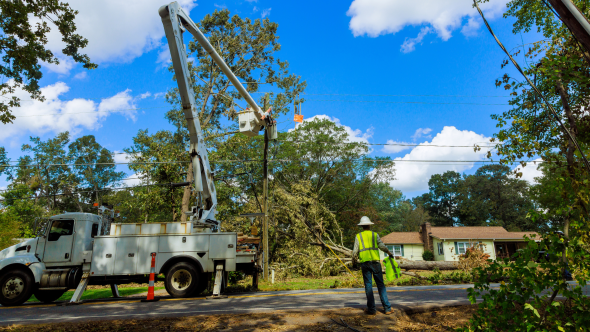
With Oregon’s wildfire season continuing to break records year after year, planning for wildfires is everyone’s responsibility, but especially our utilities. Thanks to legislation passed in 2021, Oregon’s electric utilities are required to file wildfire mitigation plans. These plans aim to lower the risk of wildfires caused by electric utilities. Wildfire mitigation plans improve customers’ safety during wildfire season and beyond.
These plans are meant to show how electric utilities intend to address wildfire risk in their service areas. These plans must identify high-risk areas and show how utilities’ policies and investment plans will reduce wildfire risk. Utilities are required to collaborate with local communities in the planning process.
Wildfire Mitigation Plans (WMPs)
In 2021, Oregon passed Senate Bill 762, a law requiring utilities to create comprehensive plans to lower wildfire risk in Oregon. This law applies to the state’s three for-profit electric utilities: Portland General Electric, Pacific Power, and Idaho Power. It tasks regulators at the Public Utility Commission with ensuring that utilities create holistic, cost-effective plans.
Why are Wildfire Mitigation Plans Important?
As Oregon’s wildfire seasons continue to worsen, we need these plans to keep our communities safe. In 2020, the Labor Day fires swept through Oregon, leaving over a million acres burned west of the Cascades. These fires impacted thousands of households, destroyed homes, and upended lives. In court, Pacific Power was deemed responsible for the four wildfires due to gross negligence. Utilities’ risk of causing wildfires is why these plans are necessary.
These plans show the strategies utilities will use to prevent wildfires in our state. This should include informing customers of planned and potential outages, called Public Safety Power Shutoffs. The goal of these plans is to minimize the risk of utility-caused wildfires. And most importantly—protecting Oregonians from life-threatening wildfires.
Managing Utility-Caused Wildfire Risk
Utilities’ plans are required to identify wildfire risks where they deliver electricity. Utilities also have to show risks around where they are moving electricity across distances (e.g., power lines). Through their analyses, utilities must include a description of what they are doing to reduce this risk.
Wildfire mitigation strategies include:
- Vegetation management (tree trimming, removal, etc.)
- System hardening (insulating wires, sensors for downed lines, etc.)
- Investment decisions (new line locations, power plant locations, etc.)
- Operational decisions (when to shut off power based on weather, etc.)
In addition to analysis and system plans, utilities must also plan for community engagement strategies. This includes their plans to work with local fire departments, local governments, and other public safety partners.
This year, regulators directed utilities to expand community-focused wildfire safety efforts. This change came at the recommendation of CUB and other energy advocates. This includes providing more home hardening and defensible space strategies. Utilities should also now provide communities with preparedness materials, fire location, and awareness tools at local events.
Multi-Year Planning: Updating the Planning Process
Previously, these plans had to be filed by December 31 of each year for the next year. Regulators then had six months to review the plans and provide recommended changes to utilities. That meant that a plan filed at the end of 2023 for 2024 wasn’t evaluated until after it had already been implemented. This system wasn’t working.
In 2025, Oregon moved from a one-year to a three-year planning process. After being filed, regulators now have six months to analyze the plans and make recommendations. An independent evaluator, who is a utility wildfire mitigation expert, also provides feedback on whether the utility has met state requirements. At the end of the review, regulators either approve the plans as is or with recommendations. These plans will be in place for the next three years.
Where They’re At Now: Wildfire Plans
On December 31, 2025, Oregon’s electric utilities filed plans with state regulators for 2026, 2027, and 2028. After being reviewed, all the plans were approved with conditions.
This year, regulators directed the utilities to provide more information on their data, analysis methods, and measurable results. This information shows the effectiveness of utilities’ wildfire mitigation strategies to inform their next multi-year plan.
The utilities will be coming back to update regulators on where they are in implementing their current plans in 2027. CUB expects utilities to address regulators’ recommendations in their updates.
Advocating for Customers: CUB’s Role in Wildfire Mitigation
Throughout the wildfire mitigation plan review process, our staff advocates for customers’ interests by prioritizing cost-effective best practices. We also work closely with fellow energy advocates to demystify this complex process and explain plans. Regulators are working to make this process more transparent for community groups and the public.
Costs from wildfire mitigation plans can be passed on to customers.
Because customers ultimately foot the bill for wildfire mitigation, these plans must be evaluated to ensure they’re the lowest-cost option. Independent evaluators have consistently found that our electric utilities are not meeting the requirements.
At CUB, we believe investments in wildfire protections are important, but they also must be smart. While utilities are allowed to pass wildfire mitigation costs to customers, they can’t be given a blank check. Our staff consistently advocates for the least-cost strategies and holds utilities accountable for providing hard data to back up their plans.
CUB will continue to advocate for Oregon households and ensure we are only paying for necessary costs that protect our communities, not utility cash grabs.
Stay Up to Date on Oregon Utility Issues
CUB will continue to advocate for people in Oregon on major utility issues. Sign up for the CUB email list for the latest updates, action alerts, and news on policies that affect the utilities your home relies on.
To keep up with CUB, follow us on Instagram, Facebook, Bluesky, and LinkedIn!



08/25/26 | 0 Comments | Wildfire Mitigation Plans: Protecting Customers from Wildfire Risk