
Utilities Need to Prepare for Electric Vehicles
Posted on April 27, 2017 by Bob Jenks
Tags, Energy
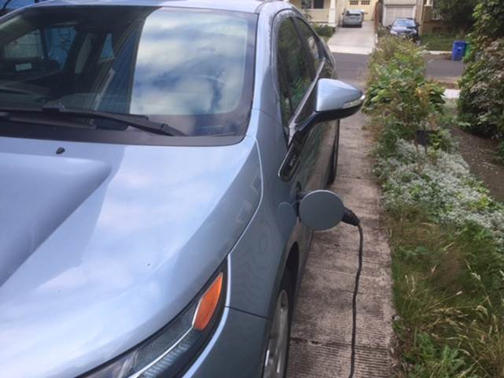
“EVs are coming and utilities need to prepare”, was the message CUB delivered in testimony filed this week with the Public Utility Commission. If a utility prepares and offers the right programs, Electric Vehicles can lower utility costs and benefit all customers. On the other hand, if a utility does not prepare, EVs can lead to higher costs and higher rates.
EVs are coming
EVs sales were up 89% in March 2017, compared to a year ago. On a national level, they were 1.2% of auto sales. Electric vehicles are common in many communities.
This is not surprising. As states and communities address climate change, promotion of EVs is critical to reducing transportation carbon emissions. The electric sector has seen carbon emissions come down 20% since 2008, but carbon emissions have continued to grow in the transportation sector. EVs are one of the key pieces to reducing transportation carbon emissions.
Oregon is one of several states with sales that have been averaging roughly twice the national level. One of the reasons Oregon is a leading state for EV sales is that Oregon has the country’s best public charging network. Portland General Electric (PGE) projects that there will be more than 40,000 EVs in its service territory by 2020, more than 100,000 by 2025, and more than 200,000 by 2030.
Making EVs benefit utility customers
Whether EVs provide a net benefit or harm to customers will depend on whether utilities are prepared and have the right programs and policies in place. If a utility simply ignores this trend, EV charging in the early evening will coincide with the summer peak load causing the utility to have to invest in expensive energy sources to meet this peak load. Additional load at peak times could also overwhelm parts of the distribution system, requiring utilities to upgrade equipment.
However, with the right policies in place, most EVs can be charged at night when there is little demand – in fact, this Spring we are seeing more hydro and wind production at night than there is demand, forcing curtailment of pollution-free renewable power. Utilities could use EV charging as a tool to balance renewables and avoid expensive new power plants that are designed to balance wind. The idea is pretty simple: wind and solar are intermittent resources that do not generate all the time and EVs are intermittent load that does not need to charge all the time. There is ample opportunity to coordinate the two to save significantly on generation costs.
PGE’s EV Plan
PGE has proposed a series of pilot programs related to EVs in its territory: increasing public charging stations, helping Tri-Met electrify buses, promoting EVs within its service territory and experimenting with managing the charging for a small number of EV customers.
CUB’s primary concern with PGE’s programs is that the company is overly focused on trying to generate new car sales, and not focused enough on how to manage EVs on its system.
Time-of-Use and Managed Charging
PGE’s plan includes an effort to encourage customers with EVs to switch to time-of-use (TOU) pricing, which refers to charging higher rates during peak time and lower rates off-peak (at night). CUB agrees that TOU rates will encourage EV owners to charge at night, but CUB is concerned that PGE’s educational efforts will not have much effect. Many EV owners charge their cars from a normal electric outlet (120 volt, called Level 1), and will find that the off-peak period of time is not sufficient to charge the vehicle for normal daily use. To really take advantage of off-peak rates, many EV owners will need Level 2 (240 volt) charging. CUB has proposed that PGE should identify the financial benefit to its system of EV off-peak charging and consider a cost-based rebate to help customers install Level 2 charging equipment and switch to TOU rates.
Fork in the Road
More EVs are added to Oregon roads every day. But will those EVs require that utilities spend hundreds of millions of dollars on new generation to serve that load, or will EVs allow utilities to avoid spending hundreds of millions on new generation designed to balance renewables?
Click here for an in-depth look at CUB’s testimony in response to PGE’s proposal.
To keep up with CUB, like us on Facebook and follow us on Twitter!



04/27/17 | 0 Comments | Utilities Need to Prepare for Electric Vehicles