
Technology and Policy Innovation in Oregon: A Symposium Report
Posted on April 18, 2018 by Mike Goetz
Tags, Energy
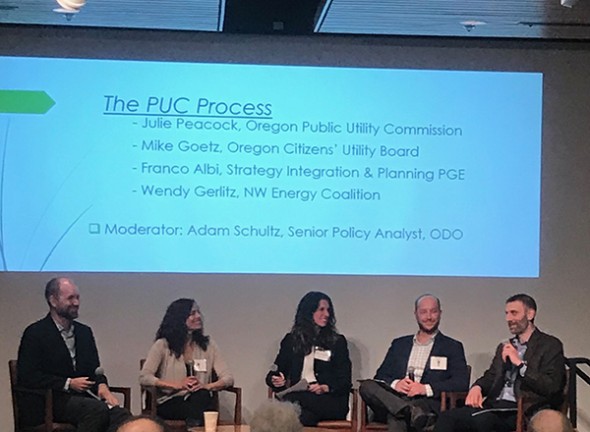
Last Friday, April 13, I had the opportunity to represent CUB on a panel of utility representatives, regulators, and public interest stakeholders at a symposium entitled “Charging Forward: The Future of Energy in Oregon”, a joint effort between the University of Oregon School of Law’s Environmental and Natural Resources Law Center, and the Green Business Initiative Student Association. The event was well attended by local energy practitioners, businesses, various interest groups, and students with an eye toward how technology, policy, and regulatory innovation are paving the way for a clean, flexible, and dynamic energy system in Oregon.
The panel I participated in was centered on the Public Utility Commission (PUC’s) current SB 978 public process to engage a wide array of stakeholders in fulfilling the 2017 Oregon Legislative Assembly’s intent in passing the legislation. SB 978 can broadly be thought of as a grid modernization study that analyzes current and future technology and policy drivers to potentially re-examine the utility regulatory model. The question being asked is whether the current system of benefits and incentives is ideally situated to get the utility to behave in a manner that comports with the flexibility needs of the future. To date, much of the public process at the PUC has surrounded level-setting to create a common understanding of the utility regulatory model and incentives.
That is, utility profits are and have been driven by the level of capital investment that they make. However, Oregon along with much of the country has seen the slowing of both load growth and demand in recent years, decreasing the need for large investment in central generating plants. With more intermittent renewables coming onto the system each year, along with an influx of new technologies such as electric vehicles, the real need for the modernized grid of the future will be flexibility. With energy storage rolling out; increased participation in regional energy markets; and options for energy efficiency, demand response, and consumer-sited distributed energy resources; the utility of the future may rely more heavily on distribution-level investments to balance its system. I discussed these and other issues with my fellow panelists: Franco Albi of PGE, Wendy Gerlitz of NW Energy Coalition, and Julie Peacock of the PUC; the discussion was moderated by Adam Schultz of the Oregon Department of Energy.
Beyond the PUC’s SB 978 process potentially reshaping the future of regulation in Oregon, the balance of the symposium also offered an optimistic view of the future for our state in the context of promising technology and forward-thinking policy. The morning’s first panel discussed legal and business opportunities for Oregon in energy storage and electric vehicle technology—and both are coming online at an accelerating pace. Both EVs and storage have the potential to add significant flexibility to a utility’s system, while also spreading the fixed costs of the distribution system more thinly in a manner that creates downward pressure on rates for all customers.
Another panel in the early afternoon discussed various carbon emissions reduction policies and initiatives being explored throughout the state. Last Legislative session, a cap and invest (SB 1070) proposal was considered, but with a short five-week session the bill did not make it through legislature. Advocates, legislative leaders, and the Governor are optimistic that a new iteration of the bill may yield different results next year. At the same time, as the transportation sector continues to outstrip the electric sector as the main source of Oregon’s carbon emissions, key policies and legislation will continue to push the needle to curb transportation-related emissions.
With keynote speeches from Kristen Sheeran, Energy and Climate Policy Advisor to Governor Kate Brown, Megan Decker, PUC Commissioner, and Jessica Shipley from the Regulatory Assistance Project, the symposium was a worthwhile exercise that brought a diverse range of stakeholders to the table. Oregon’s energy future is certainly looking bright—you might want to get yourself some shades.
To keep up with CUB, like us on Facebook and follow us on Twitter!



04/18/18 | 0 Comments | Technology and Policy Innovation in Oregon: A Symposium Report