
So I Finally Bought An Electric Vehicle
Posted on February 9, 2018 by Samuel Pastrick
Tags, Energy
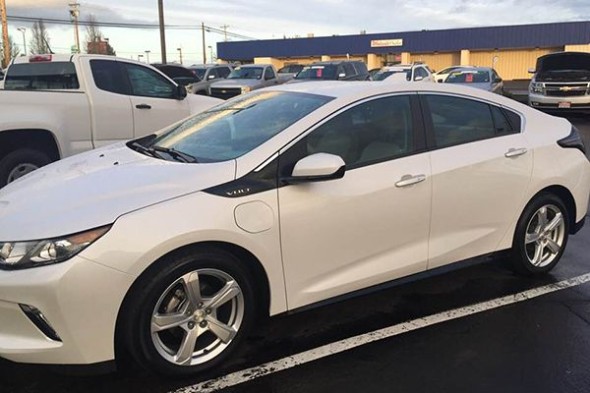
In August of 2016 I wrote a blog titled So I Think I Want to Buy An Electric Vehicle…, which among other things, imagined how each of the three kinds of EVs might work for me. I ended the article suggesting that within a few weeks, I would write a follow-up article about my shopping experience and what entered into my decision to purchase. Well that was 1.5 years ago …and the circumstances in my life finally allowed me to not only shop for but also purchase an electric car.
If you read the 2016 article, you might recall that I was driving a 2003 Mustang Convertible. It was my teenage dream car which I bought in middle age. It was already seven years old when I bought it and has served me faithfully for another seven years, though the gas mileage really was awful. But let me tell you, there is nothing like driving through the backroads of Clackamas County under Oregon’s summer sky.
The truth of the matter is however, that this same beautiful summer sky motivated me to make a change. As much as I loved the wind in my hair…I did not love the size of my carbon footprint. So, with a 40-mile round trip (RT) to work, and a lot of extra driving in my current bid for county-wide elected office, I just could not put off buying an EV any longer.
My first consideration was figuring out what my goals were. Here is what I came up with:
- I wanted to be able to go to and from work (40 miles RT minimum) on electric only – after all that was the point of my change.
- At least at first I’d need to be able to charge from an outside 120V outlet as we have temporarily turned our garage into a make-shift office and I am unable to immediately install a stronger charging system.
- To avoid unneeded stress (if not the guilt) I needed to be able to seamlessly switch to gas travel should my electric run out, AND I needed 250+ mileage range for frequent trips to Seattle and Medford.
- Because I will be driving a lot this year, I think certain safety features and creature comforts are a must. Therefore I looked for back-up cameras, blind-spot warning devices, hands free navigation, Bluetooth, heated leather seats, and a heated steering wheel.
- I figured if I was going to buy electric, I might as well buy new and get the tax deductions or rebates available.
Next I had to figure out, given my goals, how to differentiate between the three types of electric cars and decide which one really made sense. So I went back to my last article, did a little research, and updated my information. Here again are the three varieties:
Battery Electric Vehicles (BEVs), which run exclusively from a battery charged by plugging them into an electric charger every 80–238 miles. The BEV cannot be realistically charged from a 120 Volt outlet as most cars take 30–35 hours to charge. Even at 240 Voltage, a BEV takes 11–13 hours.
Plug-In Hybrid Electric Vehicles (PHEV), which run their first 11–53 miles on a battery charged via a plug-in, but have gasoline engines for long distance backup. These cars can be charged from a regular 120V outlet in about 13 hours; manufacturers claim you can achieve a 4.5–5 hour charge when using a specially installed charger that provides 240V. Though these chargers must be professionally installed, they not only reduce the charge time – one model can even be programed to draw energy in the middle of the night at off-peak hours, which is most economical and, in my service area, most likely to be drawing from wind energy available in the Columbia Gorge.
Hybrid Electric Vehicles (HEV), which run on a combined battery and gasoline fueled engine that automatically switches back and forth according to the need.
Clearly, a fully electric car was probably not going to meet my needs. The Tesla Model S, while it has a long maximum driving range of 315 miles, was definitely out of my price range, and the reasonably priced Chevy Bolt’s mileage of 238 put me short of my need to travel up and down I-5. So that left me with either a PHEV or a HEV. I figured out pretty quickly that since my first goal was to drive my 40 Mile RT commute on all electric, a PHEV was what I wanted.
I spent about two hours reading reviews from Green Car Report and Car and Driver to figure out which car best fit my goals and my vanity. I pretty quickly narrowed it down to the Chevy Volt, the Prius Prime, and the Ford Fusion Energi. While the Prius and the Fusion were slightly lower priced than the Volt, the latter consistently met the range goals as well as the safety and comfort goals I had set. The Volt mileage had the highest ratings in both 2017 (45 mph) and 2018 (53 mph) for a plug-in hybrid and the car still qualifies for the $7,500 tax credit. It also qualifies for Oregon’s full $2,500 rebate, though that money will not be released till later in the year.
Now that I knew I wanted a new Volt, the question became which one. So I spent the next hour playing around on the Chevy website building my own 2018 Chevy Volt. After weeding through all of the options I found that the LT model, which boasted the basics plus a few added features, was the way to go. The basics included:
- MyLink infotainment system (with Apple CarPlay and Android Auto), two USB ports, and built-in 4G LTE and Wi-Fi connectivity
- Remote keyless entry with push-button start
- Single-zone automatic climate control
I added leather seats, which required that I also buy the comfort package of heated seats, steering wheel and outside mirrors (oh darn), an upgraded safety package, and the all-weather car mats to protect my carpet. Then I entered my zip code and pushed a button that gave me a list of the Chevy Volts in my area that had all or most of the features I wanted.
It turns out that most of that package came for about $5000 less in a 2017 model than in the 2018. The two things I would have to give up? The blind-spot warning device, and a drop from 53 mile range to a 45 mile range. Additionally, the 2017 model was an upgraded color, had the gray leather seats that I really wanted, and featured OnStar and Sirius Radio capabilities.
So I sent the dealer my information, said I wanted to buy the car, and we arranged for me to pick it up two days later. It was that simple. And I have exactly the car I want – or at least I thought I did. It turns out there have been some minor disappointments such as: the fact that charging the car outside in the cold, instead of in a garage, reduces the battery’s ability to charge fully. Consequently, I often start the day with 38 miles as opposed to 45 miles of electric energy, and that is after more than 12 hours of charging.
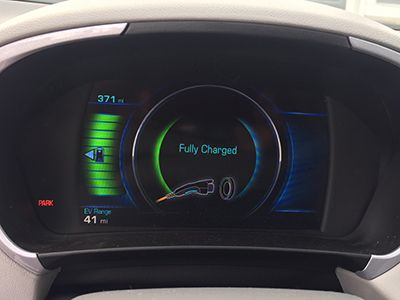
On the other hand, the upgraded power system allows for sophisticated electric battery regeneration that can be seen on-screen as you drive. I really enjoy watching this screen and seeing if I can drive such that I am able to reclaim some electric energy! For example: I love to take my foot off the gas pedal when I go downhill and watch the screen out of the corner my eye to create that reverse flow. The biggest surprise is that this little sedan accelerates quickly and drives very smoothly.
The best thing about my new car is that I am driving with a less guilt. I have used less than two gallons of gas in the 400 miles I have driven in the last 1.5 weeks. What’s more, during that time, I have not picked up my phone even once – instead I make and answer calls with the Bluetooth feature that works with one push on the steering wheel button and a simple voice command. I have even managed to avoid rolling stops because the screen shows me when the car is fully stopped.
Now, if I can just remember to plug my car in at night, everything will be perfect.
To keep up with CUB, like us on Facebook and follow us on Twitter!



09/05/22 | 0 Comments | So I Finally Bought An Electric Vehicle