
Portland Balks at FCC-Imposed Limits on 5G Negotiations
Posted on October 4, 2018 by Samuel Pastrick
Tags, Energy, Telecommunications
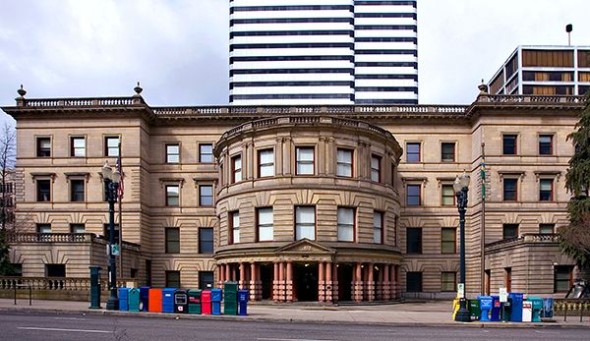
On October 2, Portland City Council voted unanimously (4-0 with Commissioner Dan Saltzman absent) in favor of allowing the City to sue the Federal Communications Commission (FCC). The suit would come in response to a September 26 FCC decision prohibiting local governments from negotiating in good faith with wireless carriers as they ready their networks for fifth generation (5G) wireless service.
What is 5G anyway?
The term “5G” describes the next generation of wireless technology, which will largely operate on both unlicensed radio spectrum (Wi-Fi) and underutilized spectrum bands like Citizens’ Broadband Radio Service (historically used by the federal government for radar operations). Most wireless devices in use today, especially those in more densely populated urban areas, operate on third or fourth generation (3G or 4G) wireless technology.
5G wireless facilitates a quicker response time, moves data faster, uses less energy, and can accommodate cutting-edge technology innovations. These include but are not limited to: autonomous vehicles; connected “smart” home, neighborhood, city, or even regional initiatives; and virtual and augmented reality applications. They also facilitate advanced energy utility programs, allowing for improved energy efficiency and the ability to remotely monitor and control production and distribution facilities, better incorporate renewable resources, and engage with customers.
What prompted the City to take action?
Last Wednesday (September 26) the conservative FCC majority voted 3-1 in favor to effectively eliminate local jurisdictions’ ability to require public benefit dollars from wireless carriers like Verizon and AT&T when they request access to the public rights-of-way to install 5G wireless infrastructure – namely devices called small cells. One “cell” is roughly the size of a large pizza box.
Specifically, the FCC’s decision limits the fees local governments can collect from wireless carriers for use of the public rights-of-way by capping application-processing expenses at $100 per cell and limiting annual fees to $279 per installation. With no clear explanation, the FCC describes these limits as a “reasonable approximation of [jurisdictions’] costs for processing applications and for managing deployments in the rights-of-way.”
This is wildly problematic for cities or other government bodies expecting to negotiate in good faith with wireless carriers to increase public benefits – especially for low-income and digitally redlined residents. The city of San Jose, for example, had earlier this year led the nation with an expertly negotiated rights-of-way public benefits package with wireless carriers that achieved the mutually beneficial goals of expediting small cell deployment and funding important digital equity initiatives. The FCC decision threatens this win-win package and others like it.
By the FCC’s own admission, the September 26 decision will save the wireless industry only $2 billion. While this may seem like a great sum of money, it is not for one of the largest and most profitable industries in the country. For example, $2 billion represents less than one percent of the estimated $275 billion the wireless industry anticipates to spend on small cell deployment in the coming years. However, it is a significant chunk of change for local governments to make much needed investments targeting digital inequity in their communities. As Portland Mayor Ted Wheeler put it in Tuesday’s hearing, this FCC decision represents “a property grab by the federal government” because the agency will take $2 billion from local governments and their residents and inappropriately pass these dollars back to the wireless industry without any community benefit requirements.
Both the FCC’s and the wireless industry’s argument is that $2 billion in savings will incentivize carriers to defy economics and invest in higher cost, often rural, low-or-no profit areas. Though the basis of their logic is a complete mystery, both the FCC and the wireless industry suggest that a less than one percent overall cost reduction will reverse decades of market behavior. One needs to look no further than the current low levels of 4G Long-Term Evolution (LTE) coverage in rural areas of Oregon and across the US. Verizon, for example, has long overstated the quality of their 4G LTE rural coverage in federal filings and, in so doing, has greatly impeded the ability of rural wireless carriers to receive needed federal support to build out their own networks.
The truth is that the wireless carriers are extremely unlikely to invest in either lower-income sparsely populated rural communities or in lower-income urban digital deserts because the economics will never work, at least not without some sort of government or financial intervention. And this is precisely why the federal government must empower, not hamper, local jurisdictions’ ability to extract important public benefits through good faith negotiations with wireless carriers in their deployment of 21st century infrastructure.
This issue is a prime example of the intersection of two of CUB’s consumer advocacy worlds – energy and information/communications technology. It demonstrates that what were once two distinct worlds have become one interconnected universe. The topic of 5G technology and its increasing impact on the energy sector is a featured discussion of the Connected Utility: Data and Digitalization panel at CUB’s eighth annual Policy Conference, Destination: Decarbonization. CUB will also testify next week (October 10) at the City of Portland’s DEAP (Digital Equity Action Plan) year-two report hearing and discuss 5G as a vehicle for local governments to address digital inequity.
To keep up with CUB, like us on Facebook and follow us on Twitter!



09/05/22 | 0 Comments | Portland Balks at FCC-Imposed Limits on 5G Negotiations