
MultCo “100 Percent Renewable by 2050” Goal: Two Year Progress Report
Posted on October 28, 2019 by Samuel Pastrick
Tags, Energy
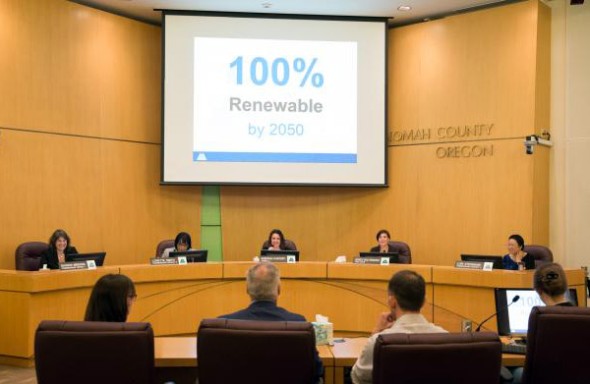
CUB was pleased to support Multnomah County’s resolution setting a goal to meet 100 percent of community-wide energy needs with renewables by 2050. Adopted in June 2017, parallel to the City of Portland’s companion resolution, the County’s Sustainability Office organized an update briefing for the Multnomah County Commission on October 15 to assess gains and remaining challenges. CUB Executive Director, Bob Jenks, and presenters from Portland General Electric (PGE), Pacific Power, NW Natural, the Sierra Club, Portland Youth Climate Council (PYCC), and Verde were invited to the briefing.
The discussion began with highlights from a City of Portland report that tracks county level greenhouse gas emissions. The good news is that emissions are 15 percent below 1990 levels, despite a 38 percent population increase and a 34 percent increase in jobs. The bad news is that these reductions are plateaued and there is serious risk of the County not meeting its long-term renewable energy goals.
The resolution has three primary benchmarks: 1) meet 100 percent of community electricity needs from renewable sources by 2035; 2) meet 2 percent of community-wide energy needs from community-based renewable infrastructure by 2035; and 3) meet 100 percent of community energy needs from renewable sources by 2050. The resolution calls for public updates on progress toward meeting the benchmarks. CUB was glad to participate in this initial briefing and especially honored to share the stage with community youth and environmental justice leaders from the PYCC and Verde.
It is important to note that energy and electricity are not the same thing. Energy is the capacity to do work, such as moving a 200 lb. couch 20 ft. Power is the rate at which the work is completed, such as moving a 200 lb. couch 20 ft. takes three minutes and burns 100 calories. Put another way: Using four 75-watt bulbs for two hours consumes 600 watt-hours of energy. Watt is the unit of power and 600 watt-hours is the totality of the energy consumed.
The point of this brief physics aside is that the term “energy” refers more generally to the totality of power production and consumption across more than just the power sector. Energy considers more than the amount of electricity needed to power four 75-watt bulbs for two hours. It’s an umbrella term used in this context to describe how we heat and cool buildings, regardless of the source (electricity, natural or biogas, petroleum, wood, etc.); as well as how we travel, regardless of the mode (automobile, scooter, bus, train, plane etc.) or fuel type (electricity, traditional or synthetic gasoline, hydrogen, etc.).
This means that the nearer-term 2035 goal of meeting 100 percent of community-wide electricity needs from renewable sources is different than the more ambitious goal of meeting 100 percent of community-wide energy needs with renewables by 2050.
The reason is that the 2035 goal doesn’t account for heating and cooling buildings with natural gas, or transportation beyond the provision of clean, electric fuel. Also, the resolution’s definition of renewable energy is different from Oregon law for PGE’s and Pacific Power’s 50 percent by 2040 Renewable Portfolio Standard (RPS) since it allows for hydroelectric power and some renewable natural gas or “biogas.”
CUB is particularly supportive of the County resolution’s strategic synergy between state and local policy. The Oregon Legislature passed SB 1149 in 1999, paving the way for establishment of the Energy Trust. In 2007, SB 838 established the state’s first RPS and increased energy efficiency investment from PGE and Pacific Power. In 2016, SB 1547 doubled the RPS to 50 percent by 2040 and required the elimination of coal from the state’s electric mix by 2035. These state policies underpin the adoption of any local government resolution and will assist the County meeting its 2035 goal.
CUB supports a price on carbon, like the unsuccessful HB 2020 from this past Oregon legislative session, because such a policy would facilitate additional state and local efforts. Capping and reducing carbon emissions over time and across the entire economy acknowledges the totality of energy produced and consumed, not just electricity from the power sector, and so would bolster Multnomah County’s goal of meeting 100 percent community-wide energy needs with renewables by 2050.
At the October 15 briefing, Verde Executive Director Tony DeFalco was the last speaker of the day and, much like the earlier presenters from the PYCC, spoke truth to power. There is no denying our changing climate and the moral responsibility of public policy to reduce the human-caused, heat-trapping emissions that cause climate change. Moreover, in policy conversations, particularly at the local level, it’s important to acknowledge that the communities unduly harmed by climate change are also those most often excluded from a meaningful stakeholder position in the effort to effectuate change. This self-perpetuating cycle must be broken because, paraphrasing DeFalco’s opening introduction:
Addressing climate change is also about reducing energy burden, as well as creating wealth and enterprise opportunities for hardest-hit communities, particularly low-income people and people of color. To meet climate action goals, we must do so via a community-led effort because we can no longer rely on traditional solutions. We’re in a crisis, so must turn to and rely on community-based knowledge and earnest investment in community-based planning.
Having worked with the County in support of their strong climate action work, CUB has faith that, while hearing all comments at the briefing, officials paid particular attention to DeFalco’s words. It’s now incumbent on us all - energy utilities, youth, environmental justice and ratepayer advocates, and Oregonians alike - to work together as one community to solve the climate crisis quickly and justly.
To keep up with CUB, like us on Facebook and follow us on Twitter!



09/05/22 | 0 Comments | MultCo “100 Percent Renewable by 2050” Goal: Two Year Progress Report