
Is PGE Ignoring Oregon’s New Data Center Law?
Posted on November 24, 2025 by Bob Jenks
Tags, Energy, Data Centers

This year, CUB has been working diligently to address a significant source of rising energy costs for many Oregonians: data centers. In June, we helped pass the POWER Act (HB 3546), a bill designed to hold data centers accountable for their own energy costs. But now, it seems that PGE is ignoring this new state law in an attempt to stick Oregon families with data centers’ energy costs.
Right now, PGE is proposing a new framework for how the utility divides up costs for all of its different customer groups — including the new data center customer category. CUB has criticized this proposal. Now, PGE has doubled down on continuing to pass data center costs to customers’ energy bills, ignoring the widely popular POWER Act.
Legislators made it clear: Oregonians are done paying data centers’ energy bills.
PGE Proposes Charging Oregon Families Millions for Data Center Growth
The biggest change with the POWER Act is that Oregon’s for-profit utilities must create a new customer category for large load energy users and charge data centers for their own energy costs. This fall, regulators are reviewing PGE’s plan to create a new customer category for data centers, as well as how costs are going to be shared across all customer categories. CUB believes that PGE is doing about as little as possible to make data centers pay for their costs.
Anytime a new cost is added for a utility, there needs to be a method for dividing that whole pie into different-sized slices that each customer type pays for. The main customer types now include: large load industrial (data centers), industrial, small commercial, and residential.
PGE is proposing that residential customers should be charged for 45% of the cost of new power supply necessary to meet load growth, and 34% of new transmission, no matter who is responsible for that growth (spoiler: it’s data centers).
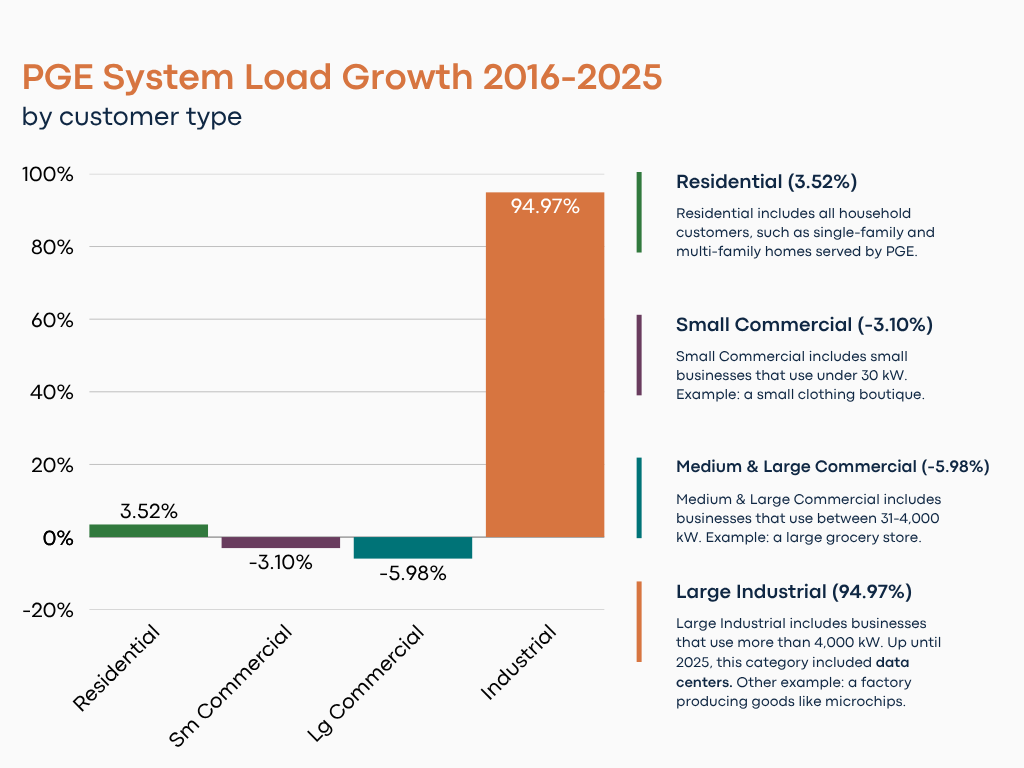
Only residential and data centers have shown load growth in the last 10 years, though the difference in contribution is staggering. Because these are the only two groups with growth, PGE is proposing that they divide up the bulk of the costs of load growth, with 34-45% of that cost on residential customers and the rest to data centers. But this is absurd. Residential load growth has been small and has been fully offset by investing in energy efficiency.
PGE Wants to Charge Oregonians for Data Center Growth
Let’s think about a hypothetical situation to break down what PGE is really proposing.
Imagine Google wants to open a new data center in Wilsonville. This is otherwise a relatively small community with relatively modest energy needs. To this point, PGE has made investments in power lines and equipment that fit the modest amount of energy needed, but hasn’t gone beyond what local communities and businesses need. This hypothetical data center coming online could very easily double the energy needs of Wilsonville.
To accommodate this hypothetical data center, PGE would have to make major investments to double the capacity of the local energy grid. Big local high-voltage power lines would have to be installed in order to deliver that much power to a single site. PGE would need to invest millions in grid upgrades just to provide electricity to one data center.
Let’s say this hypothetical data center added $100,000,000 in costs for PGE. Under PGE’s proposal, residential customers would be assigned $34,000,000 of the costs that only benefit one data center. Despite creating the need for the hundred-million-dollar project, data center customers would only be assigned $54,000,000,000 of this hypothetical project – the remainder would be assigned to other commercial and industrial customers.
Effectively, Oregonians are being asked to subsidize data centers and thus big tech companies — like Google — through our energy bills. This goes against everything legislators intended with the POWER Act.
Even When Data Centers Pay Full Price, PGE Lets Them Off Early
While there are some costs that PGE is proposing go entirely to data centers, that wouldn’t last for long.
Many utility investments are meant to last for 50 years. Customers slowly pay for those costs over those 50 years, along with paying for the profits utilities are allowed to make from investments. PGE is proposing that data centers only pay for the first three years of the 50-year costs, with customers picking up the next 47 years of investment costs.
This proposal would be akin to buying a house, paying your mortgage for three years, and then charging your next-door neighbors for a portion over the rest of your 30-year mortgage. With the POWER Act, legislators are asking data centers to be good neighbors, and PGE is undermining these efforts.
We Know Data Centers Have Already Added Huge Costs
We don’t just need to rely on hypothetical projects, though. Hillsboro is one of the top ten fastest-growing data center hot spots in the country. To manage this massive growth, PGE recently completed the Hillsboro Reliability Project in Washington County, which was primarily for serving data centers. The publicly available estimate of part of that project to serve data centers? $210 million in investments. The actual cost is hidden in confidential legal documents, but it is even higher.
Despite not creating the need for this spending, Oregon families should be responsible for $88 million (42%) of a project of this size, according to PGE.
This is just one real-world example of a massive project in Hillsboro. Data centers across the region have added a huge amount of energy demand to PGE’s system.
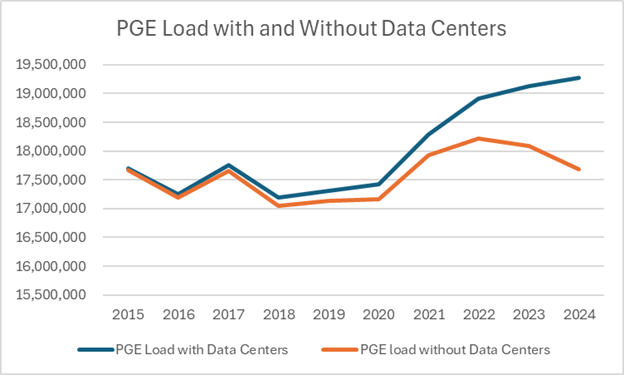
If you exclude Data Centers, PGE’s actual 2024 load was less than 1% higher than 2015. But when data centers are included, PGE’s load has increased by 9%. Without data centers, we would not be where we are today.
Why Is PGE Proposing Charging Oregon Families for Data Center Load Growth?
PGE is using twisted logic to justify maintaining the status quo of Oregon families subsidizing data centers. PGE wants residential customers to be the deep pockets that help fund adding very profitable businesses — data centers — to their energy system.
To justify charging household customers 34-45% of load growth, PGE is only looking at part of the picture. They argue that residential customers make up a portion of the growing demand for electricity and should pay for a significant portion of the added cost. Despite the fact that residential load has only grown by 3.5% of growing demand since 2016, PGE says residential customers should pay for 34-45% of investments in our electrical grid that are required by overall growth.
PGE is Not Looking at the Long-Term Benefits of Residential Customers
PGE’s limited scope allows it to ignore the outsized impact of data centers and continue to overcharge Oregon families. The utility has a financial incentive to attract very large energy users because they are profitable for the company. Residential customers are already paying more than their fair share.
CUB has found that residential customers are reducing demand for energy for all customers. What PGE fails to consider is that residential investment in energy efficiency actually reduces overall energy demand.
Think of it like this: you buy a brand-new home and invest in energy-efficient appliances, HVAC systems, and a heat pump. While connecting this home to the energy grid creates new energy demand, your energy efficiency investments actually reduce overall demand by making how you use energy in your home more efficient.
Household customers are the main ones paying for energy efficiency investments that lower energy demand across the state, especially for PGE’s system. And because of those investments, Oregon has achieved extraordinary results. Since 1992, PGE’s household energy use has decreased 21% while, in the rest of the country, residential energy use has increased by 34% in that same time period.
Oregon Families Already Pay More Than Our Fair Share
Household energy bills pay for more than just household energy efficiency projects, and we need to be compensated. Dollars from our home energy bills go to reducing energy use for commercial and industrial customers, too. PGE claims residential customers are responsible for 110 MW of peak load growth. CUB has found that residential customers have more than offset this load growth through energy efficiency programs that we fund. Households are actually responsible for -79 MW of peak load reduction. It’s not fair for Oregon families to be effectively double-charged.
These results are only possible because of residential customers. The biggest energy users, industrial customers, have a cap on how much utilities can charge them for energy efficiency. This makes PGE households the deep pocket that is funding more than 60% of energy efficiency investments — and this share is growing as more data centers come online.
The fact is, while there has been modest growth in the number of residential customers, energy efficiency investments paid by residential customers have more than offset that load growth. PGE ignores this fact so it can justify having residential customers subsidize big data centers.
You Can Take Action: Tell Regulators to Take Data Centers Off Our Bills
PGE is cherry-picking data, proposing more subsidies, and ignoring the law. And we need regulators to step up and protect our home energy bills from paying for data centers.
We need strong, forward-thinking regulations to hold utilities accountable for charging data centers for their own energy costs. While regulators are considering new paths forward, we must make our voices heard! Use the button above to submit your comments by December 1, 2025!
Stay Up to Date on Oregon Utility Issues
CUB will continue to advocate for people in Oregon on major utility issues. Sign up for the CUB email list for the latest updates, action alerts, and news on policies that affect the utilities your home relies on.



04/15/26 | 1 Comment | Is PGE Ignoring Oregon’s New Data Center Law?