
Home Cooling, Heat Resilience, and Energy Security
Posted on June 24, 2026 by Sarah Wochele
Tags, General Interest, Energy, Data Centers
Editor’s Note: This blog is adapted from CUB’s presentation to the Interim House Committee on Housing and Homelessness on June 16, 2026. To see the full video of this presentation, visit the Oregon Legislature website.
Energy inefficient homes can create a host of problems: families struggling to make ends meet, unsafe living conditions, housing instability, and a bigger strain on our energy grid.
Energy Insecurity & Housing Instability
A disconnection for non-payment is the canary in the coal mine for housing instability, for eviction, and for foreclosure. When families don’t pay their energy bills, it is almost always because they have to prioritize housing costs and other household essentials like food and medicine.
Even before a family misses a bill, families have often already been using coping strategies, or what we call “energy-limiting behaviors,” to try to get by with as little energy as possible. To try to better afford their energy bills and avoid being shut off from energy entirely. For example, not using AC at all in the summer. This is energy insecurity.
“I was forced into choosing to pay my power bill or buying groceries, or paying my power bill or my rent. I chose to have a home. I cut back on how much I eat and was eating less healthy foods because they are cheaper. I also started reducing the amount of power I use, only turning on the lights when absolutely needed and only running the AC when it was super hot.” - Ceri S., Medford, OR
When families cannot afford to cool their homes in the summer due to inefficient housing, inefficient or a lack of cooling, they face dangerous circumstances that impact their health and safety. People do die in their homes from heat and lack of cooling.
Energy Insecurity: Summer 2025 Data
Nearly one-third of the disconnections that happened in 2025 (a total of 71,190) happened in the summer. In June, July, and August of 2025, 21,306 households were shut off from energy service because they could not afford their bills. Of these, 80% were electricity system disconnects. This is energy insecurity.
“I am a disabled ex-Marine. I have glaucoma and edema of the retina, leaving me unable to see. I lost my job because of this and now am unable to work at all. I received very little money from disability and am unable to keep up with my bills. My power is on but I can’t run the A/C, even when the temp is supposed to be 103º in Medford today, because the bill gets too high.” - Mark S. Medford, OR
Portland General Electric: Low-Income Customers with High Energy Use
This data looks at a subset of households that are enrolled in PGE’s monthly bill discount program. That means we know they have incomes at or below 60% of the State Median Income, adjusted for household size. In 2025, that would be $78,827 a year for a family of four. These customers have higher-than-average energy use and are in the top 10% of energy users in the bill discount program.
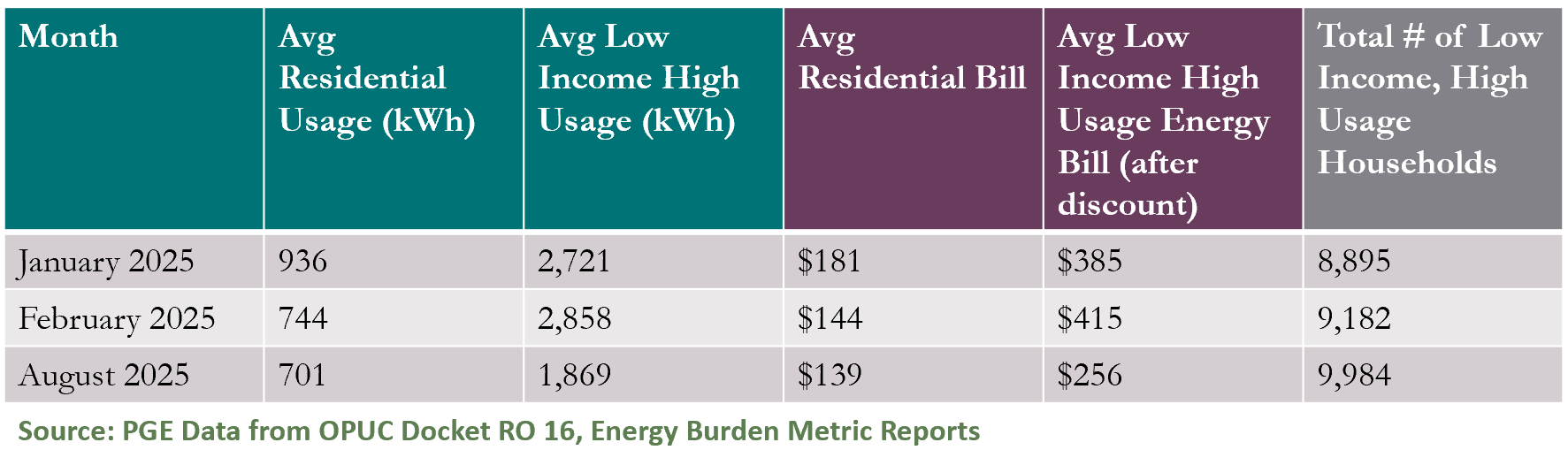
You can see the tremendous disparities in usage that result in much higher energy bills for already low-income families. It is very safe to assume that in these winter months in particular, these households have resistance heating and are living in homes that are in serious need of weatherization and repair.
“This summer, PGE disconnected my service due to overdue payments. The higher prices during the winter were too expensive for me and accumulated. I owed PGE $1079.39 and one day in June, they disconnected me. I think it was a Friday. My family was left without electricity for a day and a night [...] Simply put, you can either pay for rent, food, or electricity, but you can’t pay for all three.” - Soledad M., Portland, OR
And when looking at the whole year of data, it is the same story. High usage customers are consistently double or higher than the monthly average of the average residential customer. In August 2025, these families used more than 2x the energy as the average PGE household, and their bill was over $100 more, even with their monthly discount.
This shows you another measure of energy insecurity: how much families owe in past-due bills across the year.
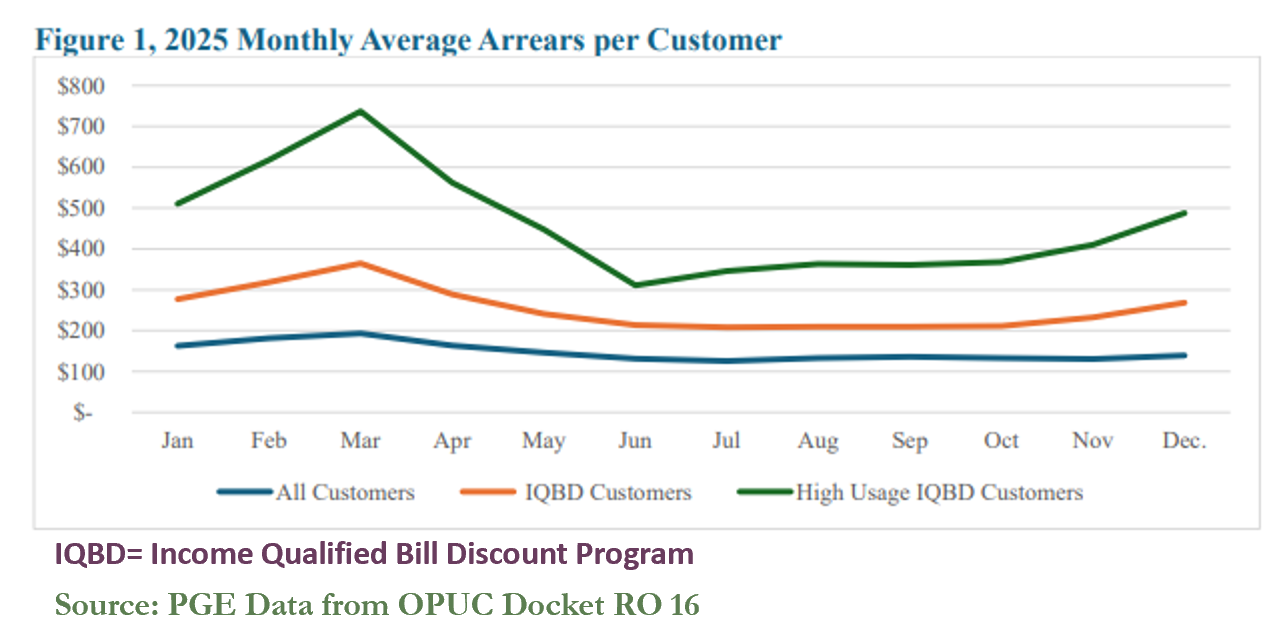
The green line at the top represents these known low-income customers who receive a monthly bill discount and who have very high energy use, and how much in past-due bills they owe on average each month. We can see that households with the highest usage—households that we know are living with low incomes—have tremendous past due bills, especially coming out of the winter heating season. They simply cannot afford $400 dollar monthly winter bills or $300 dollar monthly summer bills.
Pacific Power: Low-Income Customers with High Energy Use
This is the same subset of households, but in Pacific Power territory. You can see that while Pacific Power has fewer impacted households than PGE, there are extreme disparities in usage that result in unacceptable energy bills for low-income families. Generally, Pacific Power customers live in parts of the state where it’s colder in the winter and hotter in the summer, so they are going to be using more energy than PGE customers on average.
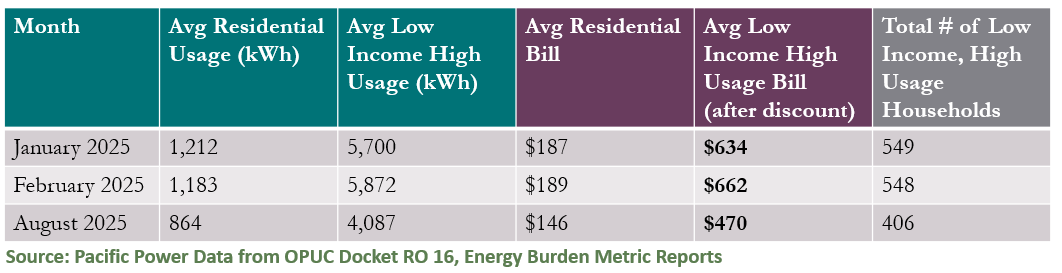
In August 2025, these families used nearly 5x the energy as the average Pacific Power household, and their bill was over $300 more, even with their monthly discount.
How can a low-income family afford a monthly winter heating bill of $600? And a summer bill that is almost $500? These homes are very likely in desperate need of critical repairs, weatherization, and other energy efficiency upgrades to their home.
“I get $2,595 between retirement and benefits. I pay $152 a month for Pacific Power. It’s more and the winter, and my gas bill goes up too. But right now I’m paying 6% of my income just on the power bill. I ended up getting my power shut off because the trailer I was living in wasn’t weather proofed at all. Then the rates kept increasing, so my power bill kept getting higher and higher. I’m on a fixed income, so it eventually became more than I could pay. I’m also on disability. I eventually did get shut off.” - Lisa L., Phoenix, OR
Beyond Summer: Energy Efficiency is Needed Year Round
While the focus of this blog is on cooling and heat resilience, from an energy perspective, you cannot separate summer resilience solutions from winter resilience solutions. It is good news that these seasonal problems can have the same solutions. It just means we can get more bang for our buck!
In the winter, heating is needed around the clock to stay safe and warm. But many families have very inefficient means to heat their homes, such as resistance heat, which includes baseboard heaters, wall heaters, or even space heaters.
For families who live in inefficient housing, on top of having resistance heat, managing their energy bills in the winter is even more of a problem. Those in drafty homes in need of repairs and weatherization have higher energy costs. We see this for those low-income families with the highest usage in PGE and Pacific Power territory data above.
But what we cannot see from the data shared here are all of the different dangerous coping mechanisms families have to endure. Families wearing winter jackets, hats, and scarves inside. Skipping meals. Stopping their insulin. All to save money on outrageous energy bills.
High Energy Demand Threatens Our Energy Grid
The inefficiency of our home’s infrastructure and equipment is not just a problem for individual homes and the families who live in them. It’s a problem for the entire energy grid.
Having many homes that use significant amounts of energy on the hottest and coldest days doesn’t help our grid. But a much larger threat to grid reliability is data centers.
Data centers threaten our shared grid’s reliability, and on a larger scale than inefficient homes. They create more risks for widespread blackouts in the coming years during energy emergencies that can come from extreme weather. This is of particular concern in the winter, as we have fewer resources available to meet our peak energy needs.
Because of the scale of the issue, it is no one family’s responsibility to solve the problem in their own home. The threats to our energy grid go well beyond personal responsibility, especially for those who cannot afford expensive home upgrades. We must all work together to rein in our energy demand across the state.
Leveraging Data Centers for Good: Lowering Household Energy Bills
We do have solutions to address resiliency at both the household and grid level to ensure more resilient summers and winters for all of us: weatherization, home repairs, and heat pumps.
“As a young person who rents, my utility bill in the summer months is about three times higher than in the winter months. This is because my apartment was not built to insulate from heat, and I have no central air conditioning. The portable AC units that I have raise my electric bill substantially, and my apartment is still often 90 degrees inside on hot days.” - Paloma R., Ashland, OR
One solution to addressing grid reliability, especially under a just energy transition framework, is intentionally reducing the energy needs of households that have inefficient housing infrastructure and appliances. And we can include data centers as a part of that solution.
If data centers want to come to town, they need to be good neighbors. By requiring data centers to help fund critical home repairs and energy efficiency improvements, we can feed two birds with one scone. Data centers can receive incentives for doing so, such as joining the grid faster. And low-income households can access much-needed funding that is not currently available for solutions that not only lower energy bills well into the future, but also make homes healthy.
This has the potential to add significant capacity to the grid by reducing the energy needs of the overall system. And better ensure a just energy transition for Oregonians who are struggling to make ends meet!
Read More: Oregon Still Needs More Protections Against Data Centers (CUB Blog)
Heat Pumps Provide Benefits Year Round
In addition to much-needed critical repairs with weatherization, we need to ensure our heating and cooling appliances are the most efficient. While AC and heat pumps use the same sort of technology, new heat pumps are so efficient that they take less energy to cool. This means you can spend less money to stay cool and safe in your home.
Cold-weather heat pumps are 150-200% more efficient than resistance heating. For example, on the coldest of days, like a 5-degree Fahrenheit day, a cold-weather heat pump uses half the energy of resistance heat!
Our Homes Are the First Line of Defense
Investing in making homes more efficient, for the families who can least afford it, is an investment in resiliency for our homes:
- Helps keep people housed and healthy in their homes
- Helps keep everyone’s energy costs down
- Helps families make room for the costs of other essentials like housing, food, healthcare, and transportation
These resiliency investments in our homes can also benefit the overall energy grid and wider communities:
- Increases grid capacity and reliability
- Lowers the risk of energy emergencies during extreme weather
- Reduces emissions and improves air quality
Unfortunately, right now, thousands of homes across Oregon are making families more exposed to climate and energy-related risks. And energy efficiency can be a big part of the solution for not just these families, but everyone in Oregon.
Our homes can actually be the first line of defense against energy insecurity, against an increasingly strained energy grid, and against more extreme weather.
Stay Up to Date on Oregon Utility Issues
CUB will continue to advocate for people in Oregon on major utility issues. Sign up for the CUB email list for the latest updates, action alerts, and news on policies that affect the utilities your home relies on.
To keep up with CUB, follow us on Instagram, Facebook, Bluesky, and LinkedIn!



07/29/26 | 0 Comments | Home Cooling, Heat Resilience, and Energy Security