
CUB’s Grid Infrastructure Bike Tour
Posted on August 4, 2026 by David Beltrán Barajas | CUB Oregon
Tags, General Interest, Energy, Conference & Events
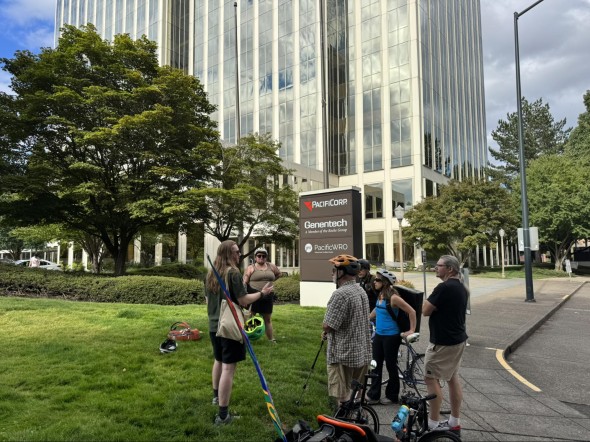
At the end of July, CUB hosted its first-ever Grid Infrastructure Bike Tour! Ten community members came out on this sunny summer day to learn about Portland’s electrical grid and how Oregonians can take action to combat energy bill rate increases.
Stop 1: Generation
We started the tour at Chapman Square, near the SW waterfront, for introductions and a discussion on generation. Generation is the act of creating electrical energy from a resource, such as fossil fuels, like coal or natural gas, or a renewable source, like solar or wind.
We chose Chapman Square as our first stop because it’s the endpoint of the first long-distance transmission line in North America, connecting Willamette Falls to Portland. Willamette Falls was Oregon’s first electric generating dam.
We discussed Oregon’s generation makeup, what our state’s energy generation has looked like, what it’s transitioning to, and where we would like go to have a green transition over the coming years.
According to the Oregon Department of Energy, as of 2024, Oregon’s energy mix comes from:
- Hydro - 33.91%
- Natural Gas - 20.41%
- Wind - 7.85%
- Coal - 8.29%
- Solar - 3.90%
Do you have a preferred form of generation? If so, share in the comments what you prefer and what you would like to see more of in Oregon!
Stop 2: Transmission
Transmission is the physical transportation of the energy produced at a generation site to local areas where it will be used. This energy can travel hundreds of miles before entering your home to power your devices, keep your home warm, and light up our city.
Electricity travels on high-voltage transmission lines that span the state and bind our grid together, making it possible for us to go about our days without questioning if the lights will turn on when we flip a switch.
Transmission doesn’t always have to span hundreds of miles to make it to you and other customers. On this tour, we stopped in front of the Oregon Convention Center, which houses about six thousand solar panels on its roof! This generation is right in the heart of the city. According to the Energy Trust, they have a 2MW capacity and provide about 25% of the convention center’s energy needs. However, these panels only provide power for the convention center itself.
There is, however, a community solar park out near the Cully neighborhood that also provides generation within city limits. This project provides energy credits for 150 low-income Cully families, and makes renewables accessible to demographics that may not be able to access rooftop solar.
Read More: When a Solar Panel is More Than a Solar Panel (CUB Blog)
Stop 3: Distribution
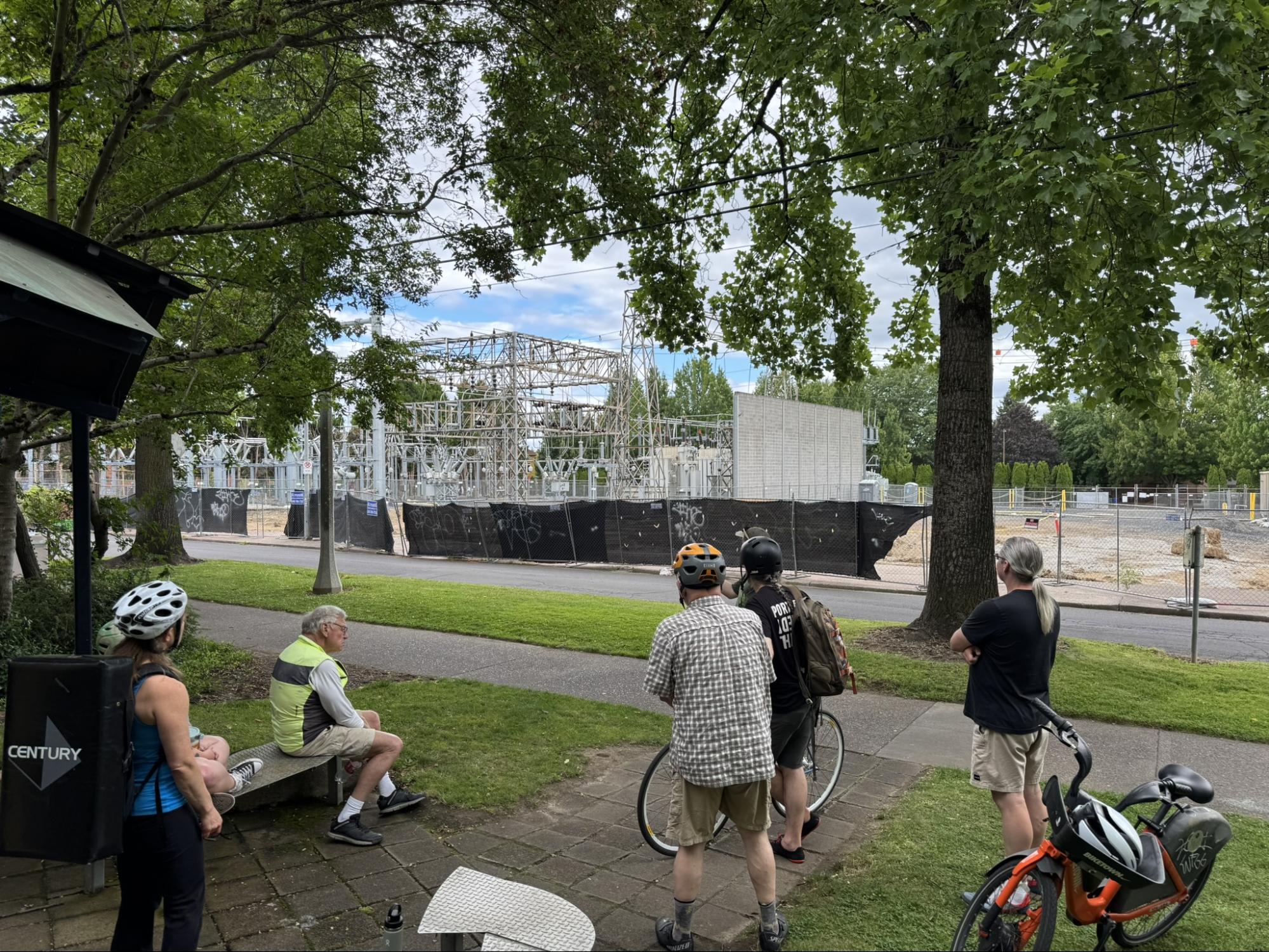
Community members gathered across from the Knott Substation owned by Pacific Power. We gathered to hear Joe D’Ambrosia explain what a substation is and does for our grid.
The final stretch of our group ride took us up NE 7th to Matt Dishman Community Center and the Knott Substation. Along the way, we could see the web of distribution cables that connected all the homes in the Irvington neighborhood to our grid.
Did you know one of the largest chunks of your bills is actually made up of distribution costs? All of this statewide infrastructure is necessary to keep our homes connected to the grid. Compare this to large industries or commercial businesses that are a little more concentrated and easier to connect to the grid. This is why residential rates for distribution are larger than other customers.
While in front of the Knott substation, community member and Electrical Engineer, Joe D’ Ambrosia, joined us to explain what a substation is and does. In short, substations are the bits of infrastructure that take all the high-voltage electricity sent over from generating sites and convert it, or “step it down,” to lower voltages that then will be distributed to our homes, businesses, or other needs depending on the type of substation being used.
Last Stop: Public Comment Workshop
The final stop on the bike tour was the PacifiCorp headquarters in the Lloyd district. Here, we talked about the ongoing request from Pacific Power to increase customers’ bills. In this public comment workshop, we went through the details about the request and how community members can get involved.
Read More: Pacific Power Requests 11.3% Residential Increase (CUB Blog)
There was a lot of discussion on the projected sale of Pacific Power’s Washington state territories to PGE, and the addition of Washington coal generation costs onto Oregonian bills. Community members were also interested in learning about the recent years of rate increases and how they impact Oregonians throughout the state.
In 2025, Oregon saw its second record-breaking year for disconnections. Oregonians are maxed out on what they can afford for energy. Pacific Power has already raised rates by more than 50% between 2021 and 2025, and now they’re asking for an additional 11%.
Look Out for More Bike Tours From CUB
Feedback from participants was positive, so CUB looks forward to hosting another bike tour in the future. If you’re interested in getting involved with CUB, sign up for our newsletter and follow us on our socials to keep up with the latest on what we’re up to!
Stay Up to Date on Oregon Utility Issues
CUB will continue to advocate for people in Oregon on major utility issues. Sign up for the CUB email list for the latest updates, action alerts, and news on policies that affect the utilities your home relies on.
To keep up with CUB, follow us on Instagram, Facebook, Bluesky, and LinkedIn!



08/04/26 | 1 Comment | CUB’s Grid Infrastructure Bike Tour