
CUB Proposes New Methodology to Evaluate Utility EV Programs
Posted on December 17, 2019 by Bob Jenks
Tags, Energy
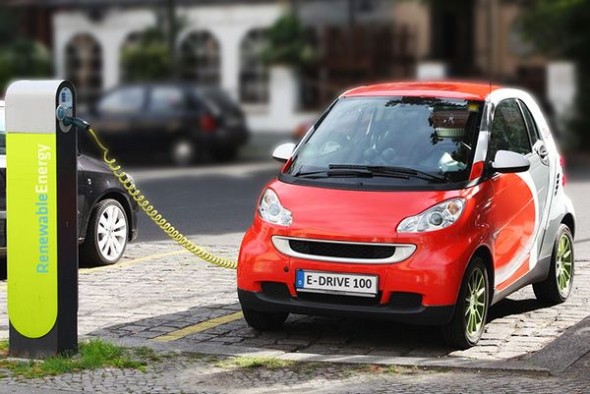
Carbon emissions from Oregon’s transportation sector comprise 40 percent of the state’s ongoing carbon impact, and worse – they are increasing. Addressing this problem, along with the multitude of related public health and equity issues, requires us to take action on many fronts. One critical step, transportation electrification, is about more than just getting more electric vehicles (EVs) on the road. Electrification of the transportation sector must be accomplished equitably, ensuring that all Oregonians — not just EV owners — can realize its benefits. CUB’s principal interest in transportation electrification is seeing that the utilities make effective investments to serve transportation load that maximize these benefits on behalf of all customers. To ensure this is achieved, we are proposing a new methodology for evaluating utility programs and investments focused on electric vehicles.
For the past two years, Oregon has had the third highest rate of EV sales in the country. Portland General Electric (PGE), which serves less than one third of the state, provides the fuel (electricity) for more than 60 percent of Oregon’s EVs. CUB estimates that more than 6 percent of new car sales in PGE’s service territory are electric; this appears to be among the highest adoption rates in the nation. Going forward, PGE projects that there will be as many as 99,000 EVs using its system by 2025. At that time, PGE will have more EV load (electricity use) on its system than the load of either irrigation pumping or street lighting.
As EV load increases, so does the revenue PGE receives from EV charging. CUB calculates that through a process called decoupling, PGE’s residential and business customers (most of whom do not own EVs) received more than $4 million in rate credits from 2016-2018 due to revenue from EV charging. This demonstrates the potential for EV investments by PGE to benefit its system and customers. In other parts of the country, there are concerns that investments in EV charging infrastructure will require a subsidy from non-EV customers. But in PGE’s case, there are already enough EVs in the service territory to support the needed investments.
PGE’s current revenues from EV charging are adequate to cover the investments necessary to achieve system benefits for all its customers. But maintaining this “more EVs benefit the utility system” trend requires PGE to invest in programs to support EV charging. Without utility programs, customers will tend to plug in their cars when they get home from work, which adds demand to the system when daily load is already at its peak. This load may require additional distribution system investments and will likely be served by the least efficient power plants, all of which adds costs to PGE’s system.
With strategic investments to manage EV charging, however, utilities like PGE can move EV demand to off-peak times, thereby avoiding new investments in the distribution system, reducing the cost of integrating renewables, and reducing carbon emissions. In short, PGE can either ensure that myriad benefits are captured by the way it manages EV load, or put added stress on the grid and see new costs emerge.
The quest to determine which utility EV investments have the greatest potential to provide benefits to all utility customers is informed by three factors:
- The difference between Level 1 and Level 2 charging: Level 1 charging uses typical electric plugs and takes many hours to complete, so EVs need to charge through most or all of the night. Consequently, fully charging an EV on a Level 1 charger requires most customers to charge their EVs during on-peak utility demand hours (in the morning or early evening). In contrast, Level 2 charging requires an investment in 240 volt equipment, but charge time is dramatically reduced which facilitates avoiding charging during peak demand periods.
- Time-of-use (TOU) rates: TOU is a rate option that allows customers to be charged a lower rate for power used at off-peak times and a higher rate on-peak. Level 2 EV charging enables TOU rates because it allows EV charging to fully fit into the off-peak window. Currently, EV owners can put their entire home on TOU. Utility investments that allow TOU rates to apply to the EV charger but not the rest of the home will create a tremendous incentive for customers to tailor their EV charging to times that are most beneficial to the electric system.
- The value of grid connected charging infrastructure: When a charger is connected to the grid, PGE can acquire real time data on charging usage. If the utility is able to manage the charging of a grid connected device, the utility can manually shape the charging profile to ensure that EVs are not being charged during on-peak times. The utility can also increase and decrease charging load to correspond with changes in wind and solar. For example, as a cloud passes overhead and reduces solar production, PGE could back off EV charging. Within this paradigm, each customer can set parameters to ensure their EV is fully charged when they need it.
The key utility EV investment is grid-connected Level 2 charging, which combines these three factors. It allows the utility to adjust charging in order to keep it off-peak, absorb variable resources like wind and solar, and reduce grid impacts, while ensuring that the vehicle is fully charged by the time the driver needs it.
PGE currently has a pilot program that would provide $500 rebates to about 3,000 customers for installing grid-connected Level 2 chargers to test the feasibility of this approach, including customer acceptance. However, this leaves thousands of customers without Level 2 grid-connected EV charging, which increases the likelihood that that charging will be on-peak and costly – the exact opposite of what PGE should be facilitating: EV charging investments that benefit PGE’s system.
Part of PGE’s problem is that Oregon has taken the approach of evaluating utility EV programs based on the public policy goal of accelerating transportation electrification. This is a great goal, but CUB believes it is vital to step back and realize that most of the new EVs in PGE’s service territory will be purchased and added to its system independent of any programs sponsored by the utility, as is illustrated by CUB’s graphic below.

Source: UM 1811 • PGE Application for Transportation Electrification Programs • March 15, 2017, p 72
CUB believes a better approach is to view EVs as new load that is providing revenue to the system. PGE could then consider how much of that revenue can be spent on connecting EVs to the grid, while still ensuring that all customers benefit from the new EV load. There is already a model for this kind of approach, called a “Line Extension Allowance”, that governs how much a utility can invest to serve new construction.
If you are building a new home, PGE will need to extend the distribution system in order to connect your home. Because the distribution system is shared by all customers, a new distribution customer will be charged for using the distribution system and the revenue that is produced will offset the shared costs, therefore reducing the costs charged to other customers. The line extension allowance defines how much the utility can invest in the distribution system to hook up a new customer, while still ensuring that all customers benefit from the reduction in shared costs.
PGE’s line extension allowance, which is approved by the PUC, allows it to invest up to four times the annual distribution revenues from a new home to serve that new home. Because the cost of that new investment is recovered over the life of the new assets, all customers benefit from a reduction in shared costs.
Each year a new home will contribute $406 in distribution revenue (the blue line at the $406 level in the chart below), and PGE can spend up to four times the $406 annual distribution revenue, or $1624. That $1624 is then spread out over the investment’s life (in this example, 30 years). In the first year, the cost of the investment plus the financing costs (return of the investment and return on the investment) is just over $200 (the purple line in the chart below) and this declines annually until it reaches about $50. The difference between the two lines is the contribution that the new home is making to the shared distribution costs that everyone pays, and is a benefit to other customers.

A similar approach can be developed for integrating an EV to the distribution grid. A new EV will contribute $147 per year in distribution revenues. Allowing the utility to spend four times that amount on connecting the EV to the grid would allow spending up to $587 per EV. Assuming the equipment needed to integrate the EV to the grid only has a 10-year useful life produces a grid integration allowance cost effectiveness that looks like the following chart.

Again, the difference between these two lines represents the benefit to all customers because the EV is providing distribution revenues that are greater than the cost it is adding to the distribution system.
Under this approach, PGE could expand its grid-integrated charging program beyond its current pilot size. As the EVs on PGE’s system grow to 99,000, PGE could spend up to $58 million to connect these EVs to the grid and still ensure that all customers on its system – even those who don’t own EVs – benefit from the revenues that EV drivers pay to the utility.
For several years, CUB and other stakeholders have been examining EV utility regulation policy from a viewpoint that EVs are coming. However, the reality for PGE’s service territory is that EVs are here with significant increases expected. We need to adjust our method of analyzing EVs to this new reality.
To keep up with CUB, like us on Facebook and follow us on Twitter!



12/18/19 | 0 Comments | CUB Proposes New Methodology to Evaluate Utility EV Programs