
Carbon Reduction Policy Launches In Salem
Posted on May 24, 2018 by Janice Thompson
Tags, Energy
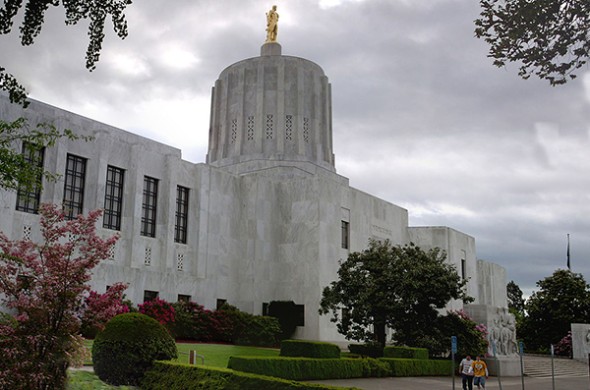
Though carbon reduction regulation did not pass during the 2018 short Oregon legislative session, both the Governor’s office and legislative leadership have signaled commitments for success in 2019. The Joint Interim Committee on Carbon Reduction met in Salem for the first time on May 22 with the goal of laying groundwork for enactment of comprehensive legislation to put a price on carbon in 2019. One signal of the importance of this issue is that Senate President Peter Courtney and Speaker of the House Tina Kotek are co-chairs of this interim committee.
Much, but by no means all, of the interim attention will be on the top carbon emitting sectors – transportation and electricity production. According to sector analysis by the Department of Environmental Quality, transportation emitted 39 percent and production of electricity used in our state emitted 26 percent of the 62 million metric tons of carbon dioxide released in 2016. (A quick terminology note is that carbon is frequently used as shorthand for carbon dioxide, and is often used interchangeably with greenhouse gas emissions. However, greenhouse gases include methane and many fluorinated gases in addition to carbon dioxide.)
CUB will continue to be a resource on effective strategies to address carbon reduction linked to electricity produced to serve customers of our state’s major investor-owned private utilities, Portland General Electric and Pacific Power. These efforts build on the Coal-to-Clean bill enacted in 2016 that moves Oregon off of coal-fired electricity by 2035.
An important step forward is that Portland General Electric has already signaled their commitment to reducing their greenhouse gas emissions by more than 80 percent by 2050. This is company’s proportion of Oregon’s 2050 greenhouse gas reduction goal. How this goal will be reflected in 2019 carbon reduction legislation, as well as developing an effective strategy for Pacific Power, are policy development challenges that CUB will be working on during the interim.
Four members of the Carbon Reduction Committee also serve on the Joint Committee on Transportation, which sends a strong signal about the importance of legislation that addresses carbon emissions from the transportation sector. Senator Cliff Bentz, who was a key transportation policy-player during his time in the House, will also be an important member of the Carbon Reduction Committee. Most other Carbon Reduction Committee members also serve on House and Senate Energy Committees, which have addressed this topic in previous years.
Transportation electrification is another important carbon reduction policy issue. CUB has been a leader on the development of utility pilot projects to advance vehicle electrification as part of the implementation of the Coal-to-Clean legislation. This expertise will indeed come in handy during upcoming policy development discussions.
The Governor’s Carbon Policy Office will inform interim legislative work. The guiding principles of this office are:
Deliver emissions reductions with certainty to achieve the state’s existing greenhouse gas goals;
Rely on market flexibility to create cost-effective options to reduce carbon emissions and increase demand for clean, sustainable energy;
Be rooted in principles of equity, create resilient communities, and protect vulnerable Oregonians; especially low-income families, communities of color, rural areas, and those on the frontlines experiencing disproportionate impacts from climate change and pollution;
Support family-wage jobs and local businesses, while investing in workforce development and encouraging innovation;
Recognize the value of Oregon’s farm, ranch, and forestlands as a critical part of our heritage and economy; drive investment to rural communities to incentivize carbon sequestration and storage;
Leverage regional solutions to grow Oregon’s economy; and
Ensure transparency and accountability in program design and implementation.
The Carbon Policy Office will manage research studies on forest carbon sequestration, energy intensive-trade exposed industries (EITEs), and economic impact analysis. White papers will be prepared on implications of cap-and-trade for highway cost allocation and affected communities.
The Carbon Policy Office and pertinent state agencies will staff three working groups: natural and working lands, low-income utility programs, and a business advisory group.
Targeted conversations with affected stakeholders will also be conducted on the following topics:
Customer Electricity Rate Protection;
Point of Regulation (Electricity);
Energy-Intensive, Trade-Exposed Industries (EITEs) and Leakage Risk and Protection;
Natural Gas Regulation;
Transportation Fuels;
Transportation Highway Trust Fund and Infrastructure Investment;
Agriculture;
Impacted Communities; and
Labor and Just Transition.
CUB will be a key stakeholder in the Customer Electricity Rate Protection conversations and anticipates providing input on utility low-income assistance programs.
Indeed, there is a lot of work to be done in 2018, and CUB is primed to contribute with our substantial utility and energy policy expertise. The coordinated efforts of the Joint Carbon Reduction Committee and the Governor’s Carbon Reduction Office represent an exciting opportunity to enact comprehensive carbon reduction legislation in 2019.
To keep up with CUB, like us on Facebook and follow us on Twitter!



05/24/18 | 0 Comments | Carbon Reduction Policy Launches In Salem