
2017 Legislative Session Update
Posted on May 15, 2017 by Janice Thompson
Tags, Energy, Telecommunications
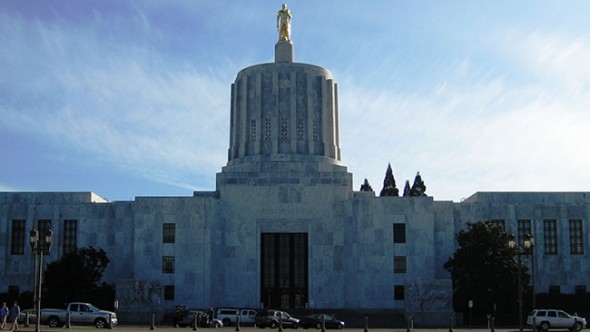
CUB has been active in Salem during the 2017 Oregon legislative session. However, due to statewide budget pressures and the 2016 Clean Electricity and Coal Transition Act, the session has been relatively quiet from an energy perspective. CUB has had particular impact on telecommunications related legislation.
Energy Legislation
Bills that are dead
Bills that do not receive hearings and work sessions in either the House or the Senate do not advance. A note of caution, of course, is that there are ways that dead bills can come back to life. But at this point, the following bills of interest to CUB are dead.
An ongoing top priority for CUB is to defend public purpose dollars raised from a small surcharge on Portland General Electric and Pacific Power customers. For the sake of administrative efficiency, both these utilities send these dollars to the Energy Trust of Oregon (ETO). Energy efficiency and renewable projects undergo rigorous ETO evaluation and save all customers money because the utilities can avoid purchasing more expensive electricity. The ETO meets strict oversight requirements, including low overhead spending imposed by the Public Utility Commission (PUC).
CUB successfully testified in opposition to two bills that would unnecessarily increase ETO administrative costs and several bills that would have reduced or diverted public purpose dollars to fund other projects. Our testimony pointed out that it was inappropriate to use dollars collected from just Portland General Electric and Pacific Power customers for statewide efforts, but we emphasized education about the success of the public purpose charge and ETO’s work.
Another priority was opposing damaging changes to last year’s SB 1547, the Clean Electricity and Coal Transition Act. CUB successfully testified against a bill that would have inappropriately extended the deadline for compliance with renewable portfolio standard requirements under certain circumstances. Another bill regarding small scale renewable projects was well intentioned but would have had a detrimental impact on SB 1547 implementation.
Unfortunately, a bill that CUB supported, proposing to strengthen energy efficiency building code requirements in new construction, did not advance. However, a key legislator has committed to continued work on this goal with the Governor’s office and the Building Code Division. Since energy efficient new construction reduces costs for utility customers, CUB will continue to work for this change either administratively or in future legislation.
Bills that are still alive
HB 2020 adds climate change as a priority for the Oregon Department of Energy and ensures a voice for residential customers on an advisory committee. Read our full report on this bill here. This bill was voted out of the House Energy and Environment committee and referred to House Rules, a committee that continues to meet even after policy committees wind down in early June, meaning that this bill remains alive until the end of the session.
HB 2681 extends the residential energy tax credit, typically referred to as RETC, for six years and adds evaluation and other accountability requirements. This bill was voted out of House Energy and Environment and referred to the Joint Committee on Tax Credits. The revenue needed for this bill is its major challenge given State budget constraints.
HB 2134 ensures up to $20 million in low income bill payment assistance through a small assessment on all customer classes served by Portland General Electric and Pacific Power. Previously, a significant chunk of those dollars came only from residential customers, a feature that CUB had opposed even though we supported the overall purpose of helping low-income customers. This bill is a cooperative effort with the two utilities and Community Action Partnership of Oregon (CAPO). This bill passed the House with 56 “yes” votes and is currently in the Senate Business and Transportation Committee.
CUB is monitoring final development of the transportation bill for possible detrimental effects on the Clean Fuels program, which implements previously adopted low carbon fuel standards. This program provides incentives for renewable transportation fuels, but faces opposition from the oil industry. Evidently some adjustment to this program is considered necessary to secure enough votes for the transportation bill, particularly from rural legislators concerned about increased fuel costs that particularly affect their constituents. The concern is that such adjustments would unduly hurt the Clean Fuels program, an important element of addressing greenhouse gas emissions from the transportation sector.
Telecommunications Legislation
CUB supported two bills - one that “fixed” and one that repealed tax incentives intended to entice Google Fiber to bring their high speed broadband product to Oregon. Once it became clear that Google Fiber changed plans, CUB endorsed a repeal of the financial incentive, or at least a fix to address an unintended use of the original incentive by other companies. We will continue to work on this issue to ensure that tax incentives are effectively targeted or repealed if market forces achieve the goal of increasing broadband speed and access.
The Oregon Telephone Assistance Program (OTAP), which reduces phone bills for low income households, is supported by a special fund called the Residential Service Protection Fund, or RSPF. This Fund also supports two programs serving individuals with hearing, visual, cognitive, and mobility handicaps. CUB opposed early versions of a bill (HB 3268) that would have ended or inappropriately harmed the RSPF.
CUB did, however, support the underlying goal behind HB 3268 to increase participation in both the OTAP program and a parallel federal Lifeline program. Common interest in this goal led to an amended bill that primarily creates an OTAP advisory committee on which CUB would serve. The bill has moved through the House and was referred to the Senate Business and Transportation Committee.
Since the OTAP advisory committee can be formed by the PUC without legislation, there is some chance the bill will not move forward. Regardless of the fate of this legislation, however, CUB is committed to finding effective options to improve participation in both the Lifeline and OTAP programs.
CUB supported HB 2091 that allows the PUC to use Universal Service Fund dollars to encourage broadband service availability. The fund’s original focus was ensuring landline phone service in high cost (often rural and other underserved) areas. This bill is a logical expansion of the fund’s purpose given the importance of broadband service. This bill sailed through both the House and the Senate and now awaits the Governor’s signature.
While there are more energy bills than telecom-related in the current session, CUB plays a particularly important role in the telecom arena since we serve as the only consumer advocate in the state. For example, one legislator thanked us for a meeting on the Google Fiber bills since he had only heard from self-interested companies up to that point.
More to come
Though some priority bills for CUB have died, our work in Salem will continue on bills that still have life. Especially at the end of the session, legislation can sometimes reappear or take interesting twists, so ongoing vigilance is a priority. Stay tuned to our blog for a final update around the closing of the session!
To keep up with CUB, like us on Facebook and follow us on Twitter!



05/15/17 | 0 Comments | 2017 Legislative Session Update